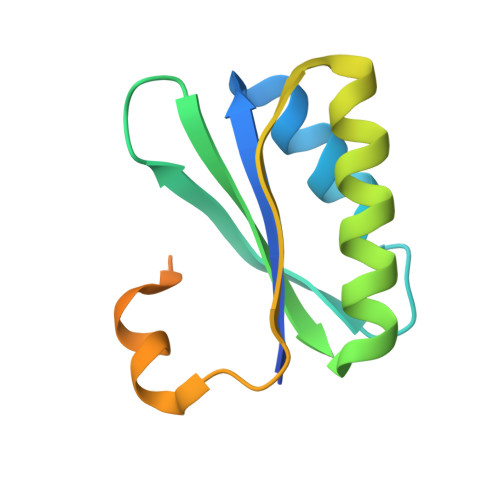
4P7V | pdb_00004p7v

Structural insights into higher-order assembly and function of the bacterial microcompartment protein PduA


Experimental Data Snapshot

  • Method: X-RAY DIFFRACTION
  • Resolution: 1.93 Å
  • R-Value Free: 
    0.271 (Depositor), 0.271 (DCC) 
  • R-Value Work: 
    0.207 (Depositor), 0.206 (DCC) 
  • R-Value Observed: 
    0.210 (Depositor) 

wwPDB Validation 3D Report Full Report

Validation slider image for 4P7V

This is version 1.3 of the entry. See complete history

Literature

Structural Insights into Higher Order Assembly and Function of the Bacterial Microcompartment Protein PduA.

Pang, A.Frank, S.Brown, I.Warren, M.J.Pickersgill, R.W.

(2014) J Biological Chem 289: 22377-22384

  • DOI: https://doi.org/10.1074/jbc.M114.569285
  • Primary Citation Related Structures: 
    4P7T, 4P7V

  • PubMed Abstract: 

    Bacterial microcompartments are large proteinaceous assemblies that are found in the cytoplasm of some bacteria. These structures consist of proteins constituting a shell that houses a number of enzymes involved in specific metabolic processes. The 1,2-propanediol-utilizing microcompartment is assembled from seven different types of shell proteins, one of which is PduA. It is one of the more abundant components of the shell and intriguingly can form nanotubule-like structures when expressed on its own in the cytoplasm of Escherichia coli. We propose a model that accounts for the size and appearance of these PduA structures and underpin our model using a combinatorial approach. Making strategic mutations at Lys-26, Val-51, and Arg-79, we targeted residues predicted to be important for PduA assembly. We present the effect of the amino acid residue substitution on the phenotype of the PduA higher order assemblies (transmission electron microscopy) and the crystal structure of the K26D mutant with one glycerol molecule bound to the central pore. Our results support the view that the hexamer-hexamer interactions seen in PduA crystals persist in the cytoplasmic structures and reveal the profound influence of the two key amino acids, Lys-26 and Arg-79, on tiling, not only in the crystal lattice but also in the bacterial cytoplasm. Understanding and controlling PduA assemblies is valuable in order to inform manipulation for synthetic biology and biotechnological applications.


  • Organizational Affiliation
    • From the School of Biological and Chemical Sciences, Queen Mary University of London, Mile End Road, London E1 4NS, United Kingdom and.

Macromolecule Content 

  • Total Structure Weight: 72.44 kDa 
  • Atom Count: 3,817 
  • Modeled Residue Count: 516 
  • Deposited Residue Count: 708 
  • Unique protein chains: 1

Macromolecules

Find similar proteins by:|  3D Structure
Entity ID: 1
MoleculeChains  Sequence LengthOrganismDetailsImage
Polyhedral bodies
A, B, C, D, E
A, B, C, D, E, F
118Citrobacter freundiiMutation(s): 1 
Gene Names: pduA
UniProt
Find proteins for B1VB62 (Citrobacter freundii)
Explore B1VB62 
Go to UniProtKB:  B1VB62
Entity Groups
Sequence Clusters30% Identity50% Identity70% Identity90% Identity95% Identity100% Identity
UniProt GroupB1VB62
Sequence Annotations
Expand
Reference Sequence

Small Molecules

Ligands 1 Unique
IDChains Name / Formula / InChI Key2D Diagram3D Interactions
GOL

Query on GOL


Download:Ideal Coordinates CCD File
G [auth E]GLYCEROL
C3 H8 O3
PEDCQBHIVMGVHV-UHFFFAOYSA-N

Experimental Data & Validation

Experimental Data

  • Method: X-RAY DIFFRACTION
  • Resolution: 1.93 Å
  • R-Value Free:  0.271 (Depositor), 0.271 (DCC) 
  • R-Value Work:  0.207 (Depositor), 0.206 (DCC) 
  • R-Value Observed: 0.210 (Depositor) 
Space Group: P 1 21 1
Unit Cell:
Length ( Å )Angle ( ˚ )
a = 68.04α = 90
b = 53.34β = 117.64
c = 68.12γ = 90
Software Package:
Software NamePurpose
REFMACrefinement

Structure Validation

View Full Validation Report


Entry History 

Deposition Data

Revision History  (Full details and data files)

  • Version 1.0: 2014-06-04
    Type: Initial release
  • Version 1.1: 2014-06-25
    Changes: Database references
  • Version 1.2: 2014-10-01
    Changes: Database references
  • Version 1.3: 2023-12-27
    Changes: Data collection, Database references, Derived calculations, Other, Refinement description, Source and taxonomy