Download Mendeley
Environmental Contributions to Proton Sharing in Protein Low-Barrier Hydrogen Bonds.
Lin, J., Gerlits, O., Kneller, D.W., Weiss, K.L., Coates, L., Clarke, J.L., Hix, M.A., Effah, S.Y., Kovalevsky, A., Walker, A.R., Wilson, M.A.(2026) Biochemistry 65: 764-778
- PubMed: 41656622 Search on PubMedSearch on PubMed Central
- DOI: https://doi.org/10.1021/acs.biochem.5c00762
- Primary Citation Related Structures:
9YFR, 9YFS, 9YGW, 9YGX, 9YH8, 9YKF, 9YZV, 9YZW - PubMed Abstract:
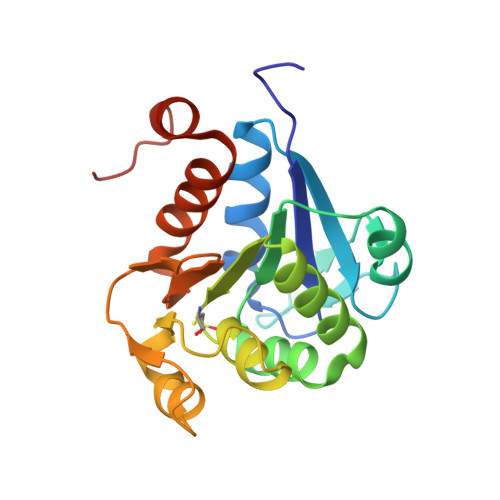
Hydrogen bonds (H-bonds) are central to biomolecular structure and dynamics. Although H-bonds are typically characterized by well-defined proton positions, proton delocalization has been proposed to play a role in facilitating enzyme catalysis and allostery in some systems. Experimentally locating protons is difficult, hampering the study of proton mobility in H-bonds. We used neutron crystallography, atomic resolution X-ray bond length analysis, and large quantum mechanics/molecular mechanics-Born-Oppenheimer molecular dynamics (QM/MM-BOMD) simulations to comprehensively characterize the shared proton/deuteron in a Glu-Asp low-barrier hydrogen bond (LBHB) in the bacterial protein YajL that is a conventional H-bond in the homologous disease-associated human protein DJ-1. X-ray bond length analysis of protiated and perdeuterated DJ-1 and YajL shows no significant effect of deuteron substitution on these carboxylic acid-carboxylate H-bonds but does reveal an effect at the active site glutamic acid near a cysteine thiolate. Residues in an H-bonded network that might favor LBHB formation in YajL were interrogated by the mutation of homologous residues in DJ-1. A distal DJ-1 substitution increases proton delocalization in the Glu-Asp H-bond, demonstrating that mutations within extended H-bond networks can modulate proton transfer barriers in carboxylic acid-carboxylate H-bonds. In addition, proton mobility in the H-bond is correlated with dimer-spanning motions in the QM/MM-BOMD simulations of YajL and DJ-1. Our results show that proton delocalization can be tuned using combined bioinformatic, structural, and computational information, opening the possibility of using engineered proton delocalization as a probe of H-bonding environments and as a tool to test hypotheses about LBHB function.
- Department of Biochemistry, University of Nebraska, Lincoln, Nebraska 68588, United States.
Organizational Affiliation: