Download Mendeley
Structural insights into SetA-mediated Rab1 glucosylation and PI3P-guided localization during early Legionella infection.
Im, H.N., Lee, Y., Song, Y., Hahn, H., Jeon, H., Shin, D., Lee, S., Kim, K.H., Kim, K.T., Suh, S.W., Jang, D.M., Kim, H.S.(2026) Proc Natl Acad Sci U S A 123: e2535016123-e2535016123
- PubMed: 41894332 Search on PubMedSearch on PubMed Central
- DOI: https://doi.org/10.1073/pnas.2535016123
- Primary Citation Related Structures:
8X4J, 8X4K, 8X4M, 8X4N - PubMed Abstract:
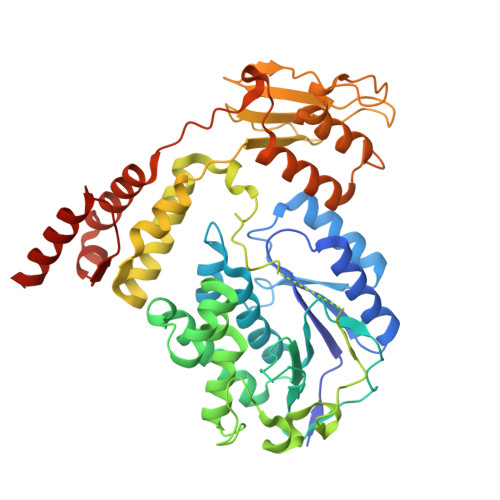
The bacterial pathogen Legionella pneumophila secretes effector proteins that remodel host endomembranes to establish a replication-permissive niche known as the Legionella -containing vacuole (LCV). Among these, SetA disrupts vesicle trafficking by glucosylating the small GTPase Rab1, essential for ER-to-Golgi transport. Here, we report comprehensive structural and mechanistic insights into SetA-mediated Rab1 glucosylation and its PI3P-dependent membrane targeting. Crystal structures of its N-terminal glycosyltransferase and C-terminal lipid-binding domains, captured in multiple ligand-bound states, reveal how SetA specifically recognizes GDP-bound Rab1 and the head group of phosphatidylinositol 3-phosphate (PI3P), which is enriched on early LCV membranes. SAXS-based full-length modeling, biochemical assays, and cellular imaging analyses demonstrate that SetA integrates Rab1 modification with membrane localization, thereby perturbing Golgi integrity and ER morphology. Together, these findings define the dual structural mechanisms underlying SetA's coordination of substrate glucosylation and membrane association, providing a spatiotemporal framework for understanding Legionella 's early infection strategy.
- Research Institute, National Cancer Center, Goyang 10408, Republic of Korea.
Organizational Affiliation: