8C2O | pdb_00008c2o

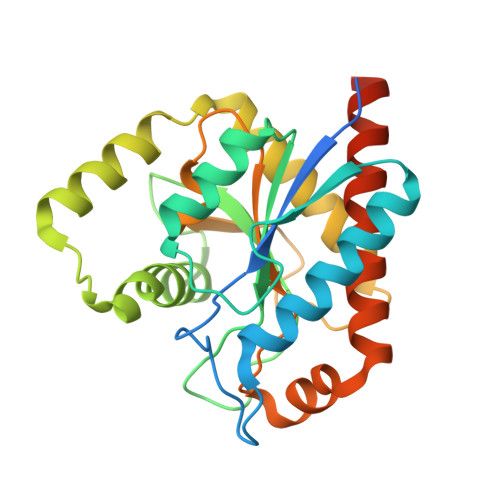
Structure of E. coli AmiA


Experimental Data Snapshot

  • Method: X-RAY DIFFRACTION
  • Resolution: 2.35 Å
  • R-Value Free: 
    0.236 (Depositor), 0.237 (DCC) 
  • R-Value Work: 
    0.177 (Depositor), 0.184 (DCC) 

Starting Model: in silico
View more details

wwPDB Validation 3D Report Full Report

Validation slider image for 8C2O

This is version 1.1 of the entry. See complete history

Literature

Activator-induced conformational changes regulate division-associated peptidoglycan amidases.

Cook, J.Baverstock, T.C.McAndrew, M.B.L.Roper, D.I.Stansfeld, P.J.Crow, A.

(2023) Proc Natl Acad Sci U S A 120: e2302580120-e2302580120

  • DOI: https://doi.org/10.1073/pnas.2302580120
  • Primary Citation Related Structures: 
    8C0J, 8C2O

  • PubMed Abstract: 

    AmiA and AmiB are peptidoglycan-hydrolyzing enzymes from Escherichia coli  that are required to break the peptidoglycan layer during bacterial cell division and maintain integrity of the cell envelope. In vivo, the activity of AmiA and AmiB is tightly controlled through their interactions with the membrane-bound FtsEX-EnvC complex. Activation of AmiA and AmiB requires access to a groove in the amidase-activating LytM domain of EnvC which is gated by ATP-driven conformational changes in FtsEX-EnvC complex. Here, we present a high-resolution structure of the isolated AmiA protein, confirming that it is autoinhibited in the same manner as AmiB and AmiC, and a complex of the AmiB enzymatic domain bound to the activating EnvC LytM domain. In isolation, the active site of AmiA is blocked by an autoinhibitory helix that binds directly to the catalytic zinc and fills the volume expected to accommodate peptidoglycan binding. In the complex, binding of the EnvC LytM domain induces a conformational change that displaces the amidase autoinhibitory helix and reorganizes the active site for activity. Our structures, together with complementary mutagenesis work, defines the conformational changes required to activate AmiA and/or AmiB through their interaction with their cognate activator EnvC.


  • Organizational Affiliation
    • School of Life Sciences, University of Warwick, Coventry CV4 7AL, United Kingdom.

Macromolecule Content 

  • Total Structure Weight: 58.32 kDa 
  • Atom Count: 3,586 
  • Modeled Residue Count: 454 
  • Deposited Residue Count: 528 
  • Unique protein chains: 1

Macromolecules

Find similar proteins by:|  3D Structure
Entity ID: 1
MoleculeChains  Sequence LengthOrganismDetailsImage
N-acetylmuramoyl-L-alanine amidase AmiA
A, B
264Escherichia coliMutation(s): 0 
Gene Names: amiAyfeEb2435JW2428
EC: 3.5.1.28
UniProt
Find proteins for P36548 (Escherichia coli (strain K12))
Explore P36548 
Go to UniProtKB:  P36548
Entity Groups
Sequence Clusters30% Identity50% Identity70% Identity90% Identity95% Identity100% Identity
UniProt GroupP36548
Sequence Annotations
Expand
Reference Sequence

Experimental Data & Validation

Experimental Data

  • Method: X-RAY DIFFRACTION
  • Resolution: 2.35 Å
  • R-Value Free:  0.236 (Depositor), 0.237 (DCC) 
  • R-Value Work:  0.177 (Depositor), 0.184 (DCC) 
Space Group: P 2 21 21
Unit Cell:
Length ( Å )Angle ( ˚ )
a = 59.515α = 90
b = 73.899β = 90
c = 115.563γ = 90
Software Package:
Software NamePurpose
REFMACrefinement
DIALSdata reduction
Aimlessdata scaling
PHASERphasing

Structure Validation

View Full Validation Report


Entry History 

& Funding Information

Deposition Data


Funding OrganizationLocationGrant Number
Biotechnology and Biological Sciences Research Council (BBSRC)United KingdomBB/V017101/1

Revision History  (Full details and data files)

  • Version 1.0: 2023-06-14
    Type: Initial release
  • Version 1.1: 2024-06-19
    Changes: Data collection, Refinement description