7LIB | pdb_00007lib

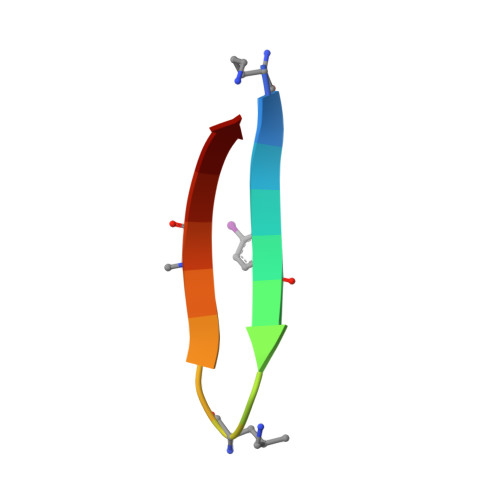
X-ray crystal structure of a cyclic peptide containing beta-2-microglobulin (63-69) and a gamma-methylornithine turn unit


Experimental Data Snapshot

  • Method: X-RAY DIFFRACTION
  • Resolution: 1.10 Å
  • R-Value Free: 
    0.208 (Depositor), 0.207 (DCC) 
  • R-Value Work: 
    0.177 (Depositor), 0.177 (DCC) 
  • R-Value Observed: 
    0.179 (Depositor) 

wwPDB Validation 3D Report Full Report

Validation slider image for 7LIB

This is version 2.0 of the entry. See complete history

Literature

An Improved Turn Structure for Inducing beta-Hairpin Formation in Peptides.

Li, X.Sabol, A.L.Wierzbicki, M.Salveson, P.J.Nowick, J.S.

(2021) Angew Chem Int Ed Engl 60: 22776-22782

  • DOI: https://doi.org/10.1002/anie.202105559
  • Primary Citation Related Structures: 
    7LIB

  • PubMed Abstract: 

    Although β-hairpins are widespread in proteins, there is no tool to coax any small peptide to adopt a β-hairpin conformation, regardless of sequence. Here, we report that δ-linked γ(R)-methyl-ornithine ( δ MeOrn) provides an improved β-turn template for inducing a β-hairpin conformation in peptides. We developed a synthesis of protected δ MeOrn as a building block suitable for use in Fmoc-based solid-phase peptide synthesis. The synthesis begins with l-leucine and affords gram quantities of the N α -Boc-N δ -Fmoc-γ(R)-methyl-ornithine building block. X-ray crystallography confirms that the δ MeOrn turn unit adopts a folded structure in a macrocyclic β-hairpin peptide. CD and NMR spectroscopy allow comparison of the δ MeOrn turn template to the δ-linked ornithine ( δ Orn) turn template that we previously introduced and to the popular d-Pro-Gly turn template. These studies show that the folding of the δ MeOrn turn template is substantially better than that of δ Orn and is comparable to d-Pro-Gly.


  • Organizational Affiliation
    • Department of Chemistry, University of California Irvine, 4126 Natural Sciences I, Irvine, CA, 92697-2025, USA.

Macromolecule Content 

  • Total Structure Weight: 2.09 kDa 
  • Atom Count: 172 
  • Modeled Residue Count: 16 
  • Deposited Residue Count: 16 
  • Unique protein chains: 1

Macromolecules

Find similar proteins by:  Sequence   |   3D Structure  
Entity ID: 1
MoleculeChains  Sequence LengthOrganismDetailsImage
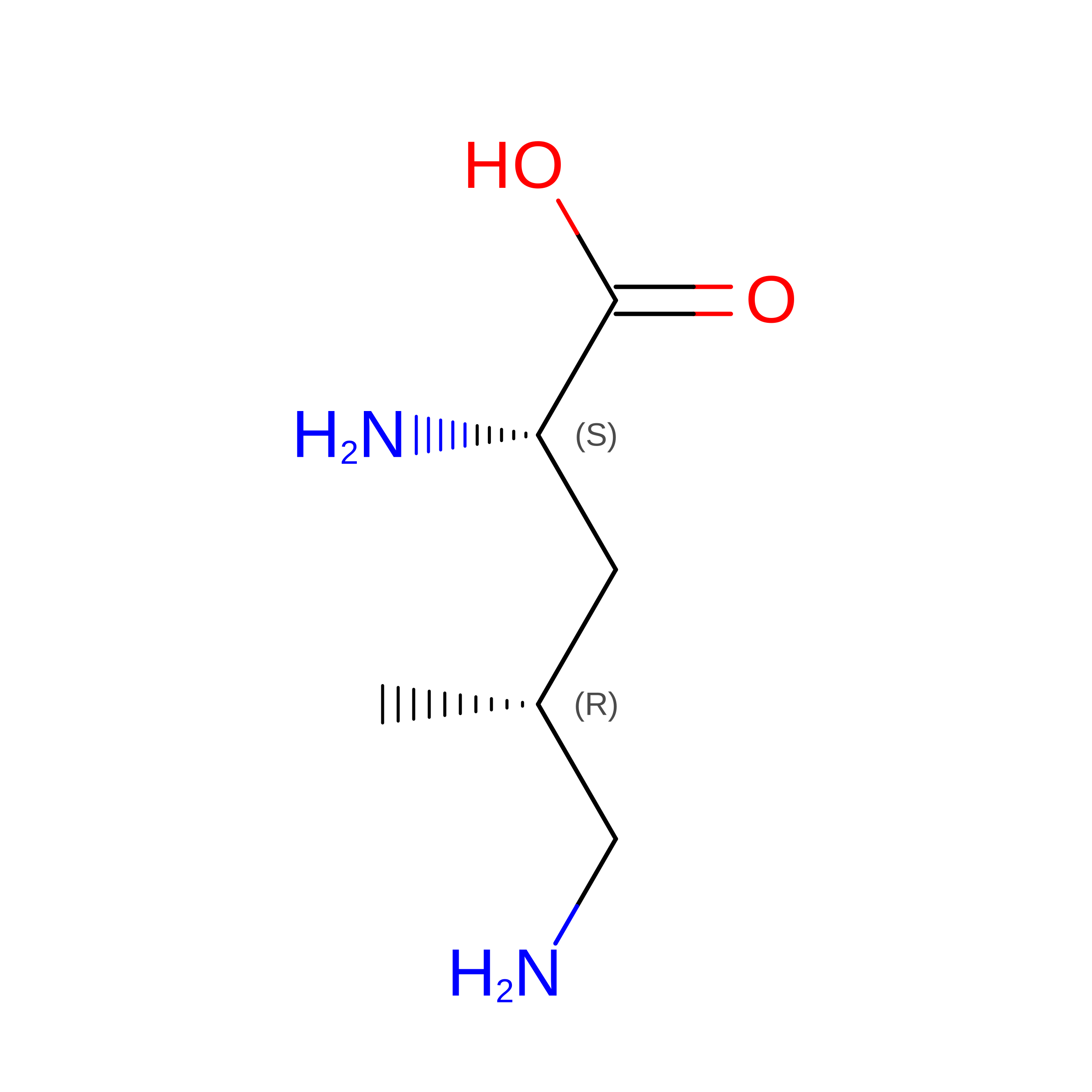
Cyclic peptide ORD-TYR-LEU-LEU-PHI-TYR-THR-GLU-GMO-LYS-VAL-THR-MVA-THR-VAL-LYS16synthetic constructMutation(s): 0 

Small Molecules

Modified Residues  4 Unique
IDChains TypeFormula2D DiagramParent
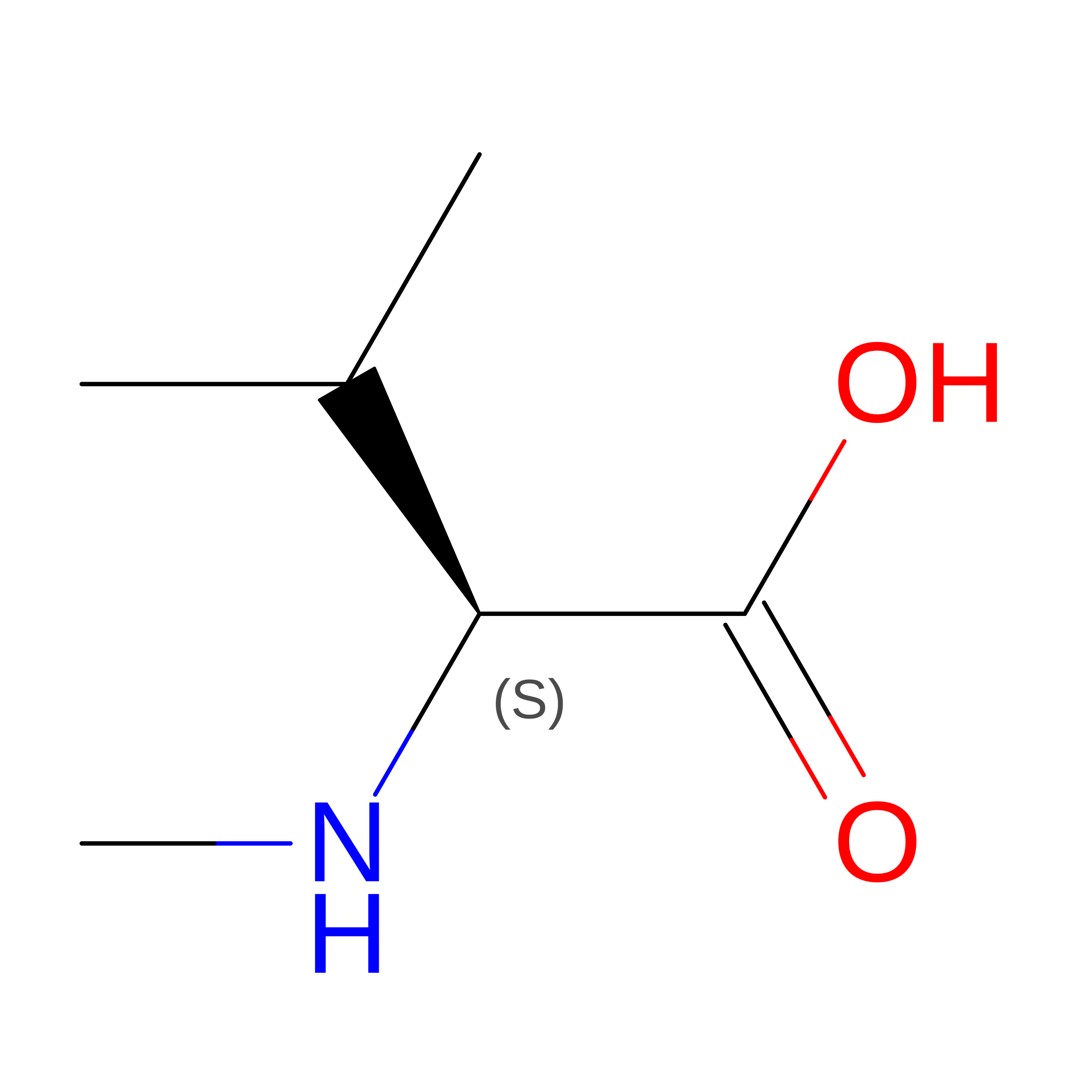
MVA
Query on MVA
A
L-PEPTIDE LINKINGC6 H13 N O2VAL
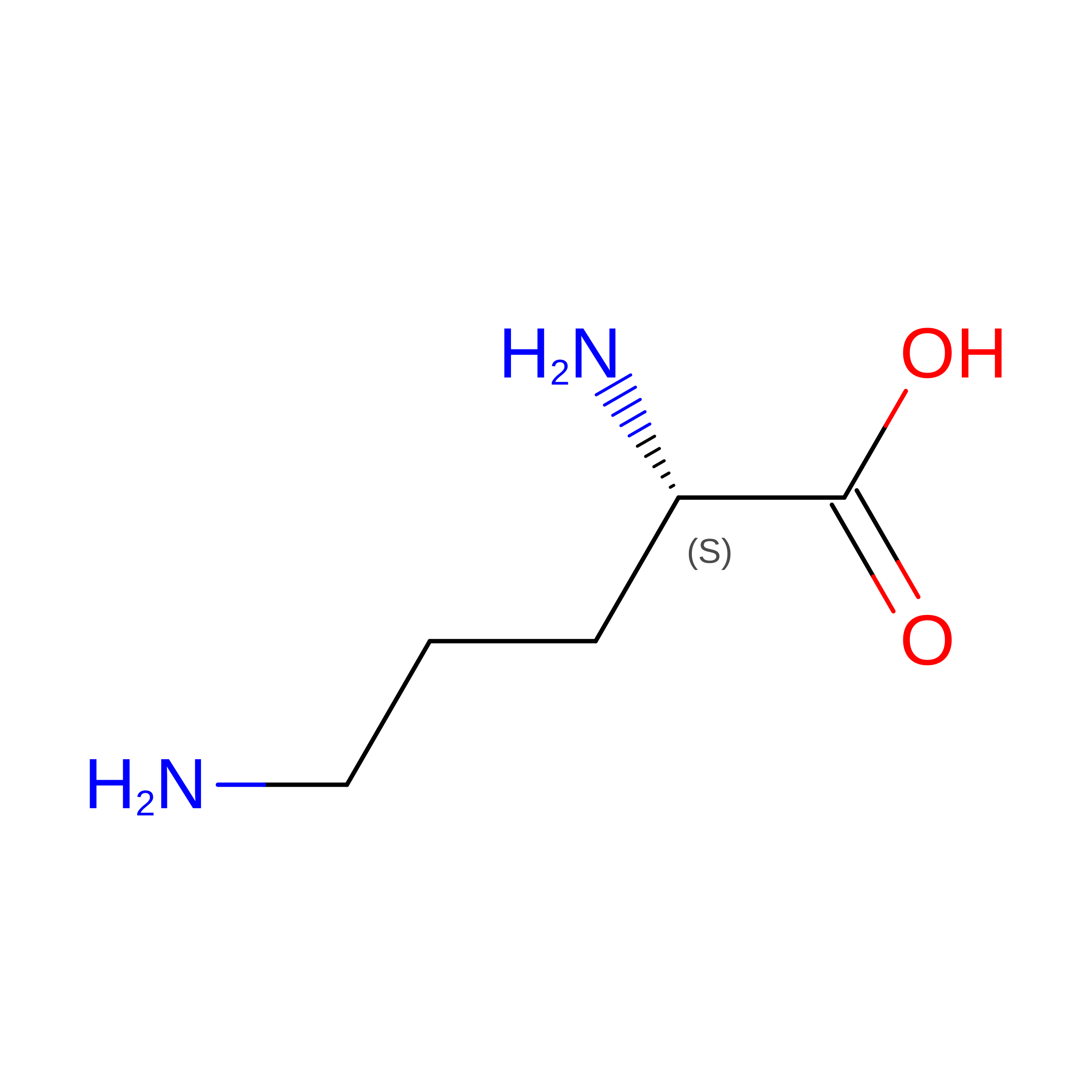
ORN
Query on ORN
A
L-PEPTIDE LINKINGC5 H12 N2 O2ALA
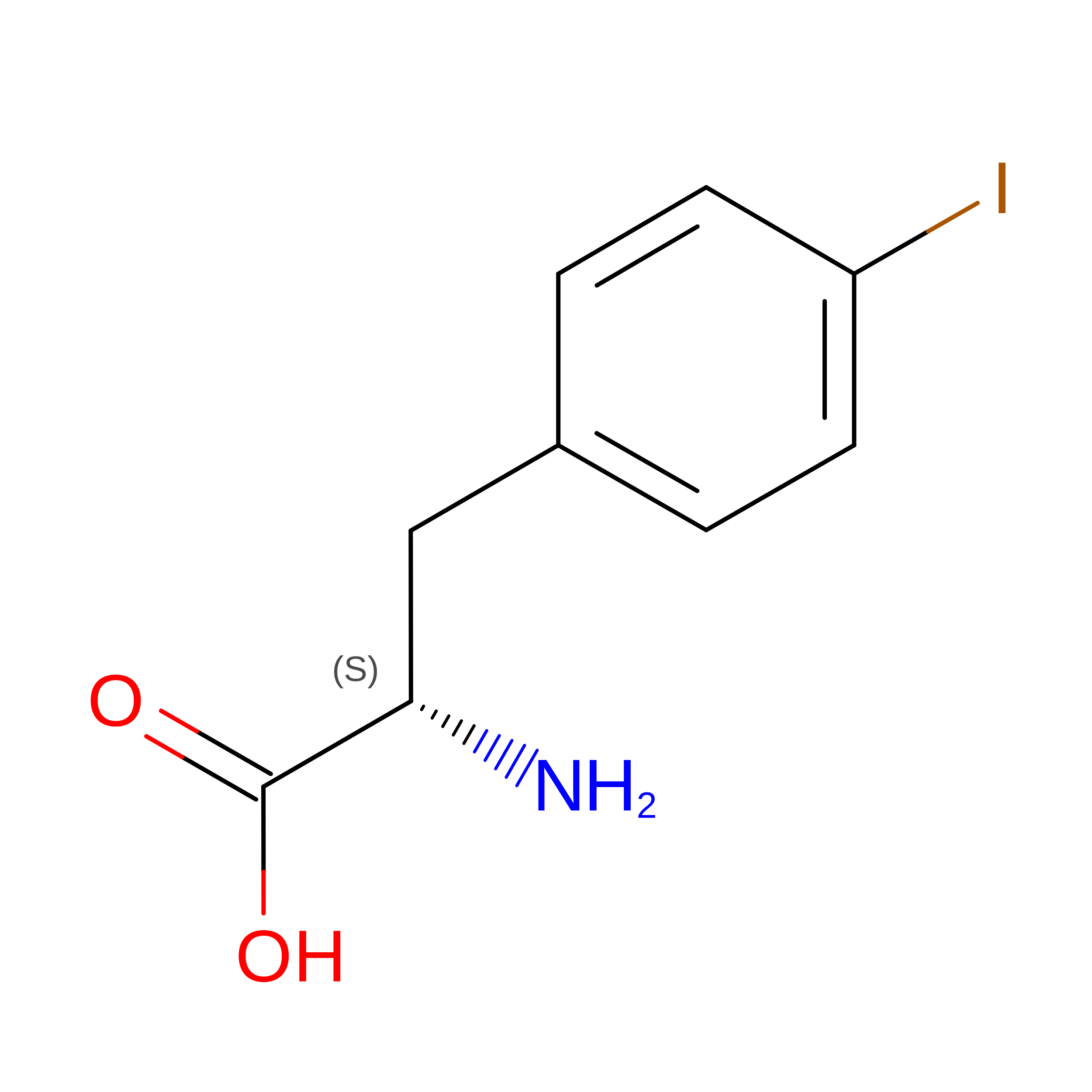
PHI
Query on PHI
A
L-PEPTIDE LINKINGC9 H10 I N O2PHE
Y1V
Query on Y1V
A
L-PEPTIDE LINKINGC6 H14 N2 O2LEU

Experimental Data & Validation

Experimental Data

  • Method: X-RAY DIFFRACTION
  • Resolution: 1.10 Å
  • R-Value Free:  0.208 (Depositor), 0.207 (DCC) 
  • R-Value Work:  0.177 (Depositor), 0.177 (DCC) 
  • R-Value Observed: 0.179 (Depositor) 
Space Group: I 4 2 2
Unit Cell:
Length ( Å )Angle ( ˚ )
a = 38.574α = 90
b = 38.574β = 90
c = 34.925γ = 90
Software Package:
Software NamePurpose
PHENIXrefinement
XDSdata reduction
Aimlessdata scaling
AutoSolphasing

Structure Validation

View Full Validation Report


Entry History 

& Funding Information

Deposition Data


Funding OrganizationLocationGrant Number
National Institutes of Health/National Institute of General Medical Sciences (NIH/NIGMS)United StatesGM097562

Revision History  (Full details and data files)

  • Version 1.0: 2021-08-11
    Type: Initial release
  • Version 1.1: 2021-10-20
    Changes: Database references
  • Version 2.0: 2023-11-15
    Changes: Atomic model, Data collection, Derived calculations