5ZPD | pdb_00005zpd

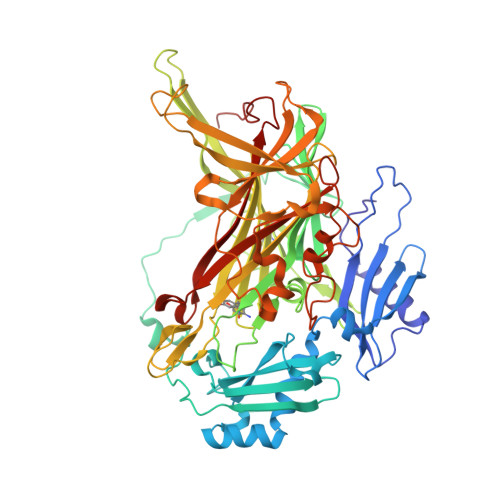
Copper amine oxidase from Arthrobacter globiformis anaerobically reduced by ethylamine at pH 6 at 288 K (1)


Experimental Data Snapshot

  • Method: X-RAY DIFFRACTION
  • Resolution: 1.67 Å
  • R-Value Free: 
    0.172 (Depositor), 0.172 (DCC) 
  • R-Value Work: 
    0.153 (Depositor), 0.153 (DCC) 
  • R-Value Observed: 
    0.154 (Depositor) 

Starting Model: experimental
View more details

wwPDB Validation 3D Report Full Report

Validation slider image for 5ZPD

This is version 1.4 of the entry. See complete history

Literature

In crystallothermodynamic analysis of conformational change of the topaquinone cofactor in bacterial copper amine oxidase

Murakawa, T.Baba, S.Kawano, Y.Hayashi, H.Yano, T.Kumasaka, T.Yamamoto, M.Tanizawa, K.Okajima, T.

(2019) Proc Natl Acad Sci U S A 116: 135-140

  • DOI: https://doi.org/10.1073/pnas.1811837116
  • Primary Citation Related Structures: 
    5ZOU, 5ZOW, 5ZOX, 5ZOY, 5ZOZ, 5ZP0, 5ZP1, 5ZP2, 5ZP3, 5ZP4, 5ZP5, 5ZP6, 5ZP7, 5ZP8, 5ZP9, 5ZPA, 5ZPB, 5ZPC, 5ZPD, 5ZPE, 5ZPF, 5ZPG, 5ZPH, 5ZPI, 5ZPJ, 5ZPK, 5ZPL, 5ZPM, 5ZPN, 5ZPO, 5ZPP, 5ZPQ, 5ZPR, 5ZPS, 5ZPT

  • PubMed Abstract: 

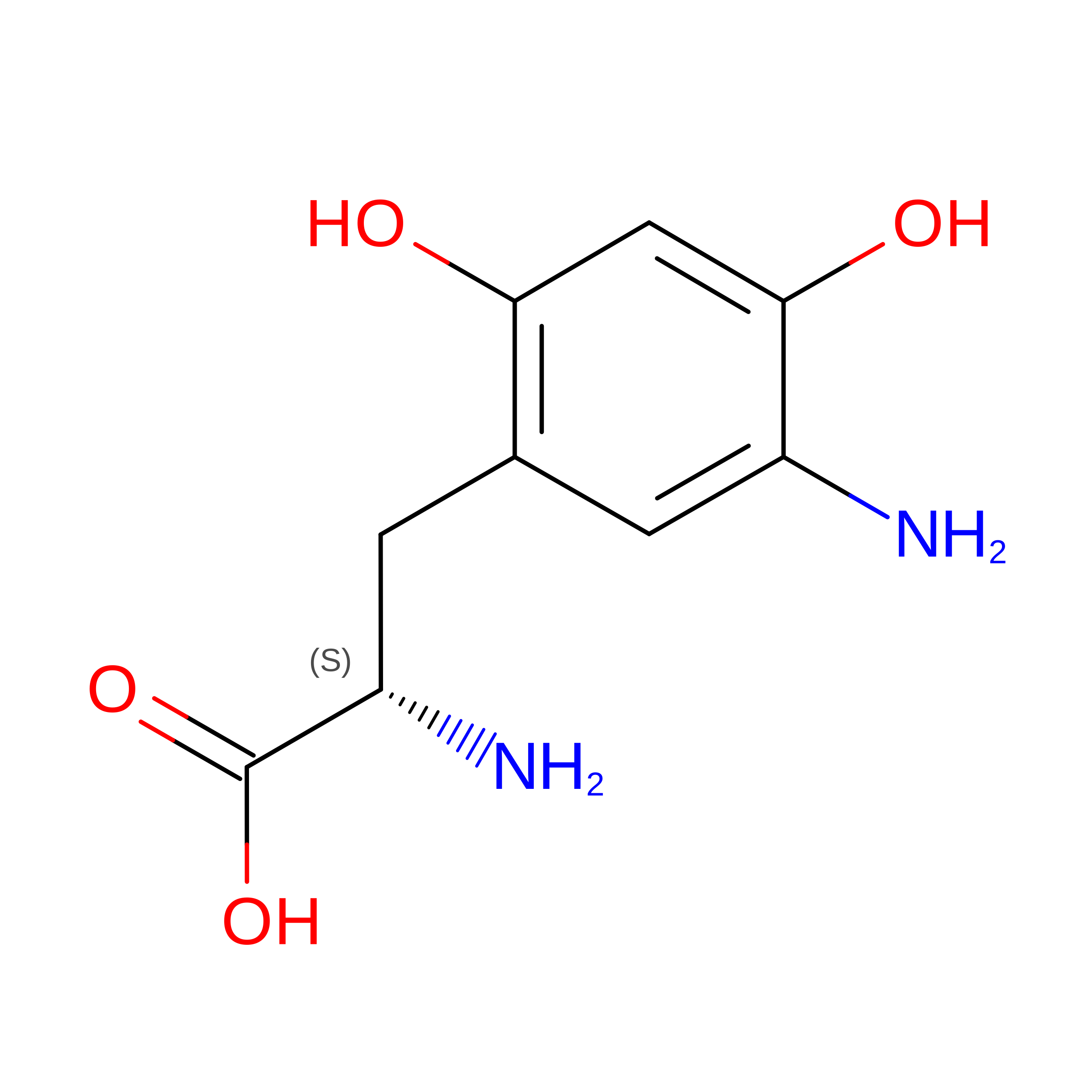
    In the catalytic reaction of copper amine oxidase, the protein-derived redox cofactor topaquinone (TPQ) is reduced by an amine substrate to an aminoresorcinol form (TPQ amr ), which is in equilibrium with a semiquinone radical (TPQ sq ). The transition from TPQ amr to TPQ sq is an endothermic process, accompanied by a significant conformational change of the cofactor. We employed the humid air and glue-coating (HAG) method to capture the equilibrium mixture of TPQ amr and TPQ sq in noncryocooled crystals of the enzyme from Arthrobacter globiformis and found that the equilibrium shifts more toward TPQ sq in crystals than in solution. Thermodynamic analyses of the temperature-dependent equilibrium also revealed that the transition to TPQ sq is entropy-driven both in crystals and in solution, giving the thermodynamic parameters that led to experimental determination of the crystal packing effect. Furthermore, we demonstrate that the binding of product aldehyde to the hydrophobic pocket in the active site produces various equilibrium states among two forms of the product Schiff-base, TPQ amr , and TPQ sq , in a pH-dependent manner. The temperature-controlled HAG method provides a technique for thermodynamic analysis of conformational changes occurring in protein crystals that are hardly scrutinized by conventional cryogenic X-ray crystallography.


  • Organizational Affiliation
    • Department of Biochemistry, Osaka Medical College, Takatsuki, 569-8686 Osaka, Japan.

Macromolecule Content 

  • Total Structure Weight: 138 kDa 
  • Atom Count: 10,795 
  • Modeled Residue Count: 1,240 
  • Deposited Residue Count: 1,240 
  • Unique protein chains: 1

Macromolecules

Find similar proteins by:|  3D Structure
Entity ID: 1
MoleculeChains  Sequence LengthOrganismDetailsImage
Phenylethylamine oxidase
A, B
620Arthrobacter globiformisMutation(s): 0 
EC: 1.4.3.21
UniProt
Find proteins for P46881 (Arthrobacter globiformis)
Explore P46881 
Go to UniProtKB:  P46881
Entity Groups
Sequence Clusters30% Identity50% Identity70% Identity90% Identity95% Identity100% Identity
UniProt GroupP46881
Sequence Annotations
Expand
Reference Sequence

Experimental Data & Validation

Experimental Data

  • Method: X-RAY DIFFRACTION
  • Resolution: 1.67 Å
  • R-Value Free:  0.172 (Depositor), 0.172 (DCC) 
  • R-Value Work:  0.153 (Depositor), 0.153 (DCC) 
  • R-Value Observed: 0.154 (Depositor) 
Space Group: C 1 2 1
Unit Cell:
Length ( Å )Angle ( ˚ )
a = 193.603α = 90
b = 64.612β = 117.09
c = 158.869γ = 90
Software Package:
Software NamePurpose
SCALEPACKdata scaling
PHENIXrefinement
PDB_EXTRACTdata extraction
HKL-2000data reduction
PHASERphasing

Structure Validation

View Full Validation Report


Entry History 

& Funding Information

Deposition Data


Funding OrganizationLocationGrant Number
Japan Agency for Medical Research and Development (AMED)Japan0294
JSPS KAKENHIJapan17K07317, JP26440037, JP23770127, JP15K05573, JP16KT0055

Revision History  (Full details and data files)

  • Version 1.0: 2018-12-19
    Type: Initial release
  • Version 1.1: 2019-01-02
    Changes: Data collection, Database references
  • Version 1.2: 2019-01-16
    Changes: Data collection, Database references
  • Version 1.3: 2023-11-22
    Changes: Data collection, Database references, Derived calculations, Refinement description
  • Version 1.4: 2024-11-13
    Changes: Structure summary