5W0M | pdb_00005w0m

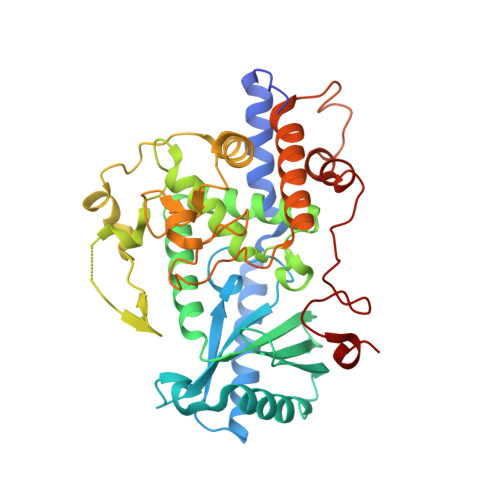
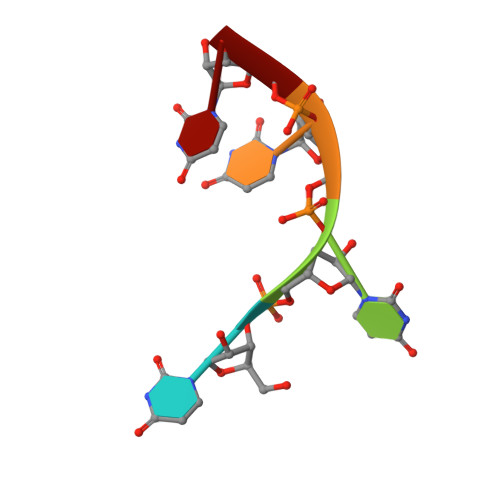
Structure of human TUT7 catalytic module (CM) in complex with U5 RNA


Experimental Data Snapshot

  • Method: X-RAY DIFFRACTION
  • Resolution: 2.30 Å
  • R-Value Free: 
    0.229 (Depositor), 0.237 (DCC) 
  • R-Value Work: 
    0.188 (Depositor), 0.198 (DCC) 
  • R-Value Observed: 
    0.190 (Depositor) 

Starting Model: experimental
View more details

wwPDB Validation 3D Report Full Report

Validation slider image for 5W0M

This is version 1.3 of the entry. See complete history

Literature

Multi-domain utilization by TUT4 and TUT7 in control of let-7 biogenesis.

Faehnle, C.R.Walleshauser, J.Joshua-Tor, L.

(2017) Nat Struct Mol Biol 24: 658-665

  • DOI: https://doi.org/10.1038/nsmb.3428
  • Primary Citation Related Structures: 
    5W0B, 5W0M, 5W0N, 5W0O

  • PubMed Abstract: 

    The uridyl transferases TUT4 and TUT7 (collectively called TUT4(7)) switch between two modes of activity, either promoting expression of let-7 microRNA (monoU) or marking it for degradation (oligoU). Lin28 modulates the switch via recruitment of TUT4(7) to the precursor pre-let-7 in stem cells and human cancers. We found that TUT4(7) utilize two multidomain functional modules during the switch from monoU to oligoU. The catalytic module (CM) is essential for both activities, while the Lin28-interacting module (LIM) is indispensable for oligoU. A TUT7 CM structure trapped in the monoU activity staterevealed a duplex-RNA-binding pocket that orients group II pre-let-7 hairpins to favor monoU addition. Conversely, the switch to oligoU requires the ZK domain of Lin28 to drive the formation of a stable ternary complex between pre-let-7 and the inactive LIM. Finally, ZK2 of TUT4(7) aids oligoU addition by engaging the growing oligoU tail through uracil-specific interactions.


  • Organizational Affiliation
    • W.M. Keck Structural Biology Laboratory, Cold Spring Harbor Laboratory, Cold Spring Harbor, New York, USA.

Macromolecule Content 

  • Total Structure Weight: 139.65 kDa 
  • Atom Count: 9,325 
  • Modeled Residue Count: 1,105 
  • Deposited Residue Count: 1,182 
  • Unique protein chains: 1
  • Unique nucleic acid chains: 1

Macromolecules


Find similar proteins by:|  3D Structure
Entity ID: 1
MoleculeChains  Sequence LengthOrganismDetailsImage
Terminal uridylyltransferase 7
A, B, C
389Homo sapiensMutation(s): 1 
Gene Names: ZCCHC6HS2KIAA1711TUT7
EC: 2.7.7.52
UniProt & NIH Common Fund Data Resources
Find proteins for Q5VYS8 (Homo sapiens)
Explore Q5VYS8 
Go to UniProtKB:  Q5VYS8
PHAROS:  Q5VYS8
GTEx:  ENSG00000083223 
Entity Groups
Sequence Clusters30% Identity50% Identity70% Identity90% Identity95% Identity100% Identity
UniProt GroupQ5VYS8
Sequence Annotations
Expand
Reference Sequence
Find similar nucleic acids by:  Sequence
Entity ID: 2
MoleculeChains LengthOrganismImage
U5 single-stranded RNAD [auth H],
E [auth I],
F [auth J]
5synthetic construct
Sequence Annotations
Expand
Reference Sequence

Small Molecules

Ligands 3 Unique
IDChains Name / Formula / InChI Key2D Diagram3D Interactions
IOD

Query on IOD


Download:Ideal Coordinates CCD File
J [auth A],
L [auth B],
O [auth C],
P [auth C]
IODIDE ION
I
XMBWDFGMSWQBCA-UHFFFAOYSA-M
SO4

Query on SO4


Download:Ideal Coordinates CCD File
G [auth A],
H [auth A],
K [auth B],
M [auth C]
SULFATE ION
O4 S
QAOWNCQODCNURD-UHFFFAOYSA-L
ZN

Query on ZN


Download:Ideal Coordinates CCD File
I [auth A],
N [auth C]
ZINC ION
Zn
PTFCDOFLOPIGGS-UHFFFAOYSA-N

Experimental Data & Validation

Experimental Data

  • Method: X-RAY DIFFRACTION
  • Resolution: 2.30 Å
  • R-Value Free:  0.229 (Depositor), 0.237 (DCC) 
  • R-Value Work:  0.188 (Depositor), 0.198 (DCC) 
  • R-Value Observed: 0.190 (Depositor) 
Space Group: P 61
Unit Cell:
Length ( Å )Angle ( ˚ )
a = 135.472α = 90
b = 135.472β = 90
c = 179.268γ = 120
Software Package:
Software NamePurpose
Aimlessdata scaling
PHENIXrefinement
PDB_EXTRACTdata extraction
XDSdata reduction
PHASERphasing

Structure Validation

View Full Validation Report


Entry History 

Deposition Data

Revision History  (Full details and data files)

  • Version 1.0: 2017-06-28
    Type: Initial release
  • Version 1.1: 2017-07-19
    Changes: Database references
  • Version 1.2: 2017-08-16
    Changes: Database references
  • Version 1.3: 2023-10-04
    Changes: Data collection, Database references, Refinement description