5C6L | pdb_00005c6l

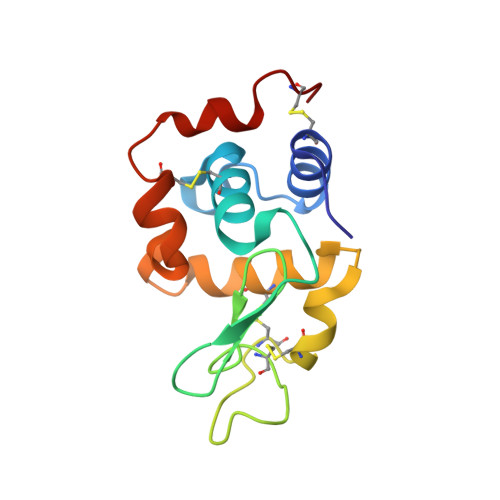
Crystal Structure of Gadolinium derivative of HEWL solved using intense Free-Electron Laser radiation


Experimental Data Snapshot

  • Method: X-RAY DIFFRACTION
  • Resolution: 2.10 Å
  • R-Value Free: 
    0.280 (Depositor), 0.276 (DCC) 
  • R-Value Work: 
    0.219 (Depositor), 0.227 (DCC) 
  • R-Value Observed: 
    0.222 (Depositor) 

wwPDB Validation 3D Report Full Report

Validation slider image for 5C6L

Ligand Structure Quality Assessment 


This is version 1.4 of the entry. See complete history

Literature

Towards phasing using high X-ray intensity.

Galli, L.Son, S.K.Barends, T.R.White, T.A.Barty, A.Botha, S.Boutet, S.Caleman, C.Doak, R.B.Nanao, M.H.Nass, K.Shoeman, R.L.Timneanu, N.Santra, R.Schlichting, I.Chapman, H.N.

(2015) IUCrJ 2: 627-634

  • DOI: https://doi.org/10.1107/S2052252515014049
  • Primary Citation Related Structures: 
    5C6I, 5C6J, 5C6L

  • PubMed Abstract: 

    X-ray free-electron lasers (XFELs) show great promise for macromolecular structure determination from sub-micrometre-sized crystals, using the emerging method of serial femtosecond crystallography. The extreme brightness of the XFEL radiation can multiply ionize most, if not all, atoms in a protein, causing their scattering factors to change during the pulse, with a preferential 'bleaching' of heavy atoms. This paper investigates the effects of electronic damage on experimental data collected from a Gd derivative of lysozyme microcrystals at different X-ray intensities, and the degree of ionization of Gd atoms is quantified from phased difference Fourier maps. A pattern sorting scheme is proposed to maximize the ionization contrast and the way in which the local electronic damage can be used for a new experimental phasing method is discussed.


  • Organizational Affiliation
    • Center for Free-Electron Laser Science, Deutsches Elektronen-Synchrotron DESY , Notkestrasse 85, Hamburg, 22607, Germany ; Department of Physics, University of Hamburg , Luruper Chaussee 149, Hamburg, 22761, Germany.

Macromolecule Content 

  • Total Structure Weight: 15.6 kDa 
  • Atom Count: 1,063 
  • Modeled Residue Count: 129 
  • Deposited Residue Count: 129 
  • Unique protein chains: 1

Macromolecules

Find similar proteins by:|  3D Structure
Entity ID: 1
MoleculeChains  Sequence LengthOrganismDetailsImage
Lysozyme C129Gallus gallusMutation(s): 0 
EC: 3.2.1.17
UniProt
Find proteins for P00698 (Gallus gallus)
Explore P00698 
Go to UniProtKB:  P00698
Entity Groups
Sequence Clusters30% Identity50% Identity70% Identity90% Identity95% Identity100% Identity
UniProt GroupP00698
Sequence Annotations
Expand
Reference Sequence

Small Molecules

Ligands 3 Unique
IDChains Name / Formula / InChI Key2D Diagram3D Interactions
DO3

Query on DO3


Download:Ideal Coordinates CCD File
B [auth A],
C [auth A]
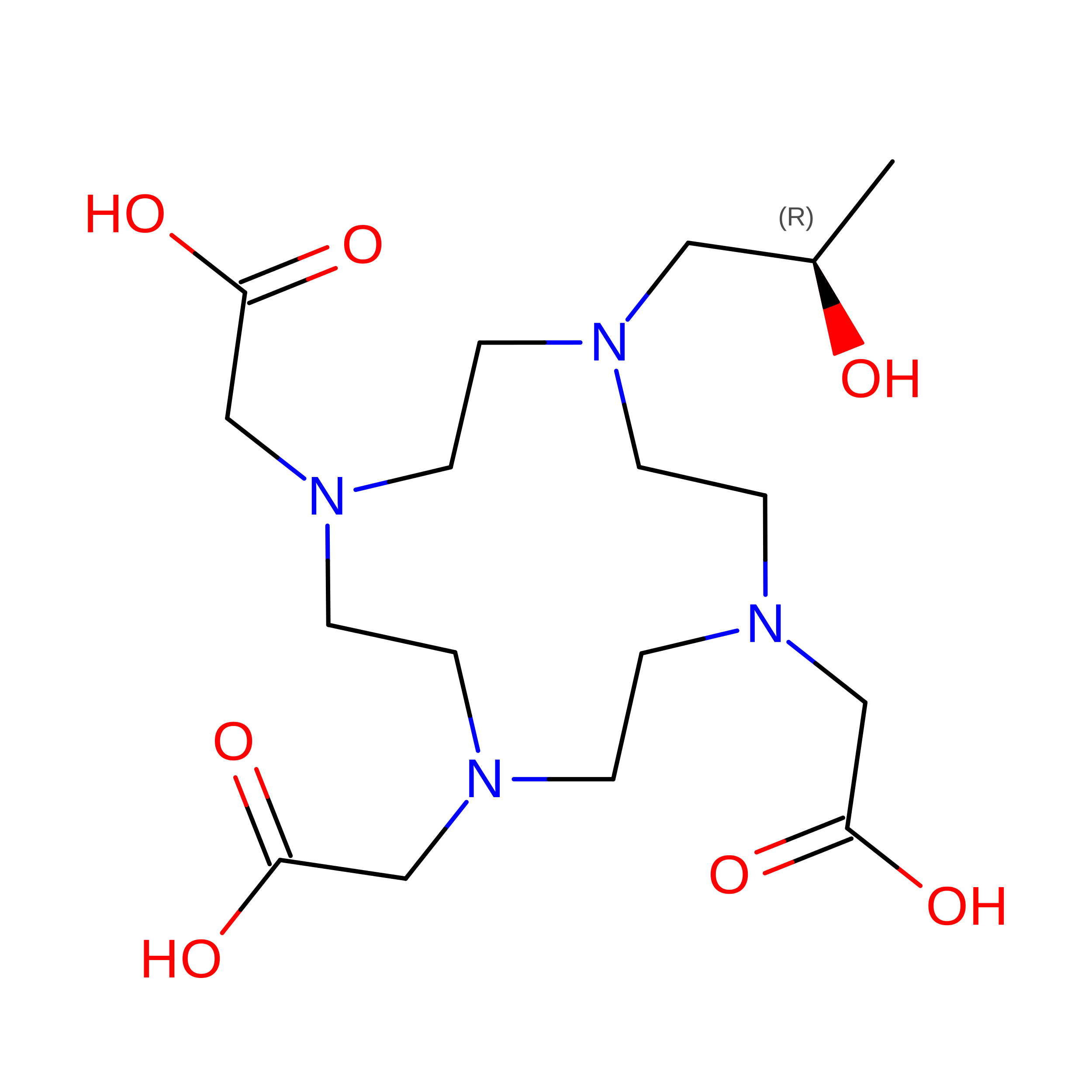
10-((2R)-2-HYDROXYPROPYL)-1,4,7,10-TETRAAZACYCLODODECANE 1,4,7-TRIACETIC ACID
C17 H32 N4 O7
IQUHNCOJRJBMSU-CQSZACIVSA-N
GD

Query on GD


Download:Ideal Coordinates CCD File
H [auth A],
I [auth A]
GADOLINIUM ATOM
Gd
UIWYJDYFSGRHKR-UHFFFAOYSA-N
CL

Query on CL


Download:Ideal Coordinates CCD File
D [auth A],
E [auth A],
F [auth A],
G [auth A]
CHLORIDE ION
Cl
VEXZGXHMUGYJMC-UHFFFAOYSA-M

Experimental Data & Validation

Experimental Data

  • Method: X-RAY DIFFRACTION
  • Resolution: 2.10 Å
  • R-Value Free:  0.280 (Depositor), 0.276 (DCC) 
  • R-Value Work:  0.219 (Depositor), 0.227 (DCC) 
  • R-Value Observed: 0.222 (Depositor) 
Space Group: P 43 21 2
Unit Cell:
Length ( Å )Angle ( ˚ )
a = 79.2α = 90
b = 79.2β = 90
c = 39.4γ = 90
Software Package:
Software NamePurpose
SCALAdata scaling
REFMACrefinement
PDB_EXTRACTdata extraction
SOLVEphasing
ARPmodel building
CrystFELdata reduction

Structure Validation

View Full Validation Report


Ligand Structure Quality Assessment 


Entry History 

Revision History  (Full details and data files)

  • Version 1.0: 2015-07-08
    Type: Initial release
  • Version 1.1: 2015-12-09
    Changes: Database references
  • Version 1.2: 2018-01-24
    Changes: Data collection
  • Version 1.3: 2018-11-14
    Changes: Data collection
  • Version 1.4: 2024-11-06
    Changes: Data collection, Database references, Structure summary