4U86 | pdb_00004u86

Human Pin1 with cysteine sulfonic acid 113


Experimental Data Snapshot

  • Method: X-RAY DIFFRACTION
  • Resolution: 1.60 Å
  • R-Value Free: 
    0.231 (Depositor) 
  • R-Value Work: 
    0.196 (Depositor) 
  • R-Value Observed: 
    0.198 (Depositor) 

wwPDB Validation 3D Report Full Report

Validation slider image for 4U86

This is version 1.1 of the entry. See complete history

Literature

Pin1 cysteine-113 oxidation inhibits its catalytic activity and cellular function in Alzheimer's disease.

Chen, C.H.Li, W.Sultana, R.You, M.H.Kondo, A.Shahpasand, K.Kim, B.M.Luo, M.L.Nechama, M.Lin, Y.M.Yao, Y.Lee, T.H.Zhou, X.Z.Swomley, A.M.Allan Butterfield, D.Zhang, Y.Lu, K.P.

(2015) Neurobiol Dis 76: 13-23

  • DOI: https://doi.org/10.1016/j.nbd.2014.12.027
  • Primary Citation Related Structures: 
    4U84, 4U85, 4U86

  • PubMed Abstract: 

    The unique proline isomerase Pin1 is pivotal for protecting against age-dependent neurodegeneration in Alzheimer's disease (AD), with its inhibition providing a molecular link between tangle and plaque pathologies. Pin1 is oxidatively modified in human AD brains, but little is known about its regulatory mechanisms and pathological significance of such Pin1 modification. In this paper, our determination of crystal structures of oxidized Pin1 reveals a series of Pin1 oxidative modifications on Cys113 in a sequential fashion. Cys113 oxidization is further confirmed by generating antibodies specifically recognizing oxidized Cys113 of Pin1. Furthermore, Pin1 oxidation on Cys113 inactivates its catalytic activity in vitro, and Ala point substitution of Cys113 inactivates the ability of Pin1 to isomerize tau as well as to promote protein turnover of tau and APP. Moreover, redox regulation affects Pin1 subcellular localization and Pin1-mediated neuronal survival in response to hypoxia treatment. Importantly, Cys113-oxidized Pin1 is significantly increased in human AD brain comparing to age-matched controls. These results not only identify a novel Pin1 oxidation site to be the critical catalytic residue Cys113, but also provide a novel oxidative regulation mechanism for inhibiting Pin1 activity in AD. These results suggest that preventing Pin1 oxidization might help to reduce the risk of AD.


  • Organizational Affiliation
    • Department of Medicine, Beth Israel Deaconess Medical Center, Harvard Medical School, Boston, MA 02215, USA.

Macromolecule Content 

  • Total Structure Weight: 20.51 kDa 
  • Atom Count: 1,282 
  • Modeled Residue Count: 145 
  • Deposited Residue Count: 181 
  • Unique protein chains: 1

Macromolecules

Find similar proteins by:|  3D Structure
Entity ID: 1
MoleculeChains  Sequence LengthOrganismDetailsImage
Peptidyl-prolyl cis-trans isomerase NIMA-interacting 1181Homo sapiensMutation(s): 0 
Gene Names: PIN1
EC: 5.2.1.8
UniProt & NIH Common Fund Data Resources
Find proteins for Q13526 (Homo sapiens)
Explore Q13526 
Go to UniProtKB:  Q13526
PHAROS:  Q13526
GTEx:  ENSG00000127445 
Entity Groups
Sequence Clusters30% Identity50% Identity70% Identity90% Identity95% Identity100% Identity
UniProt GroupQ13526
Sequence Annotations
Expand
Reference Sequence

Small Molecules

Ligands 1 Unique
IDChains Name / Formula / InChI Key2D Diagram3D Interactions
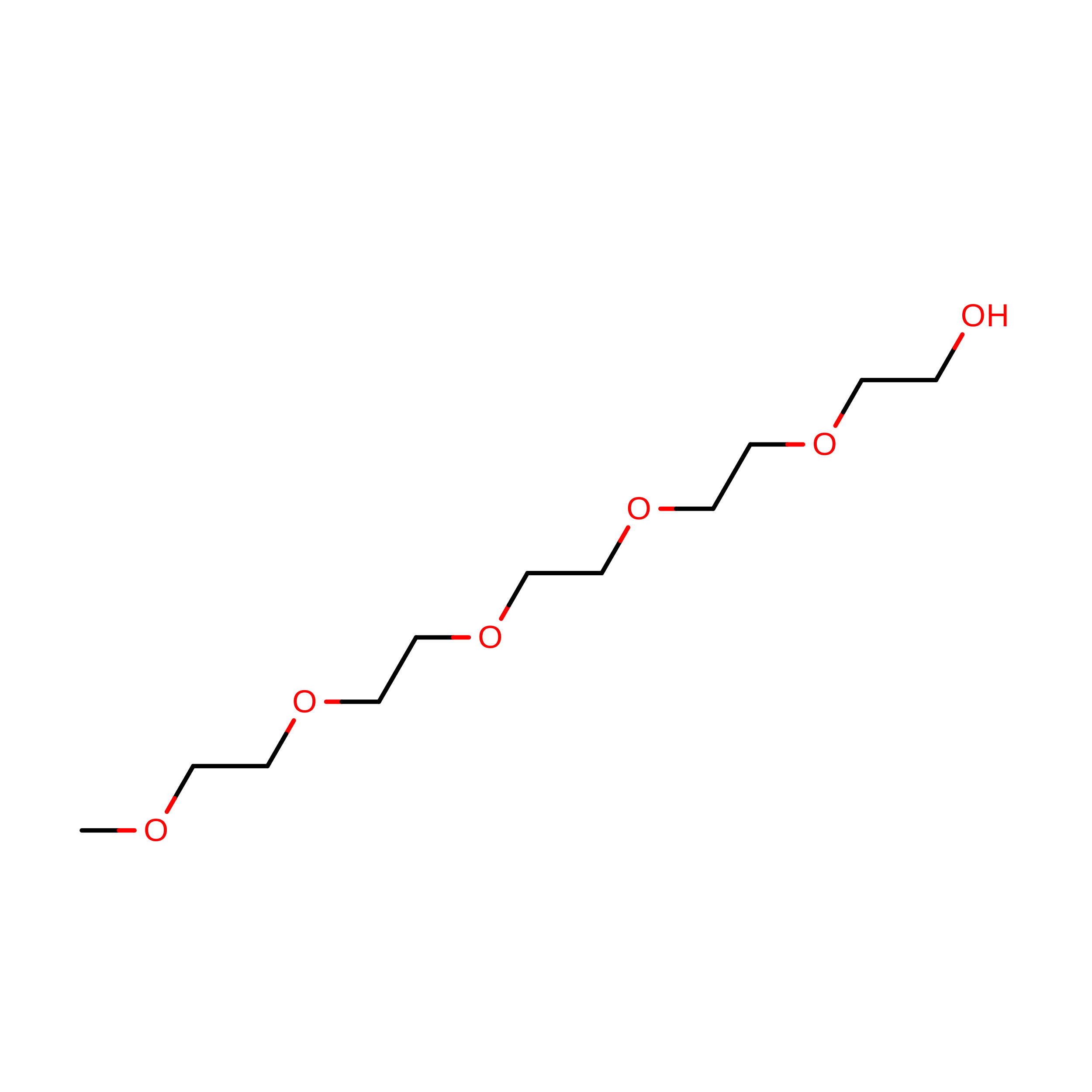
1PG

Query on 1PG


Download:Ideal Coordinates CCD File
B [auth A]2-(2-{2-[2-(2-METHOXY-ETHOXY)-ETHOXY]-ETHOXY}-ETHOXY)-ETHANOL
C11 H24 O6
SLNYBUIEAMRFSZ-UHFFFAOYSA-N
Modified Residues  1 Unique
IDChains TypeFormula2D DiagramParent
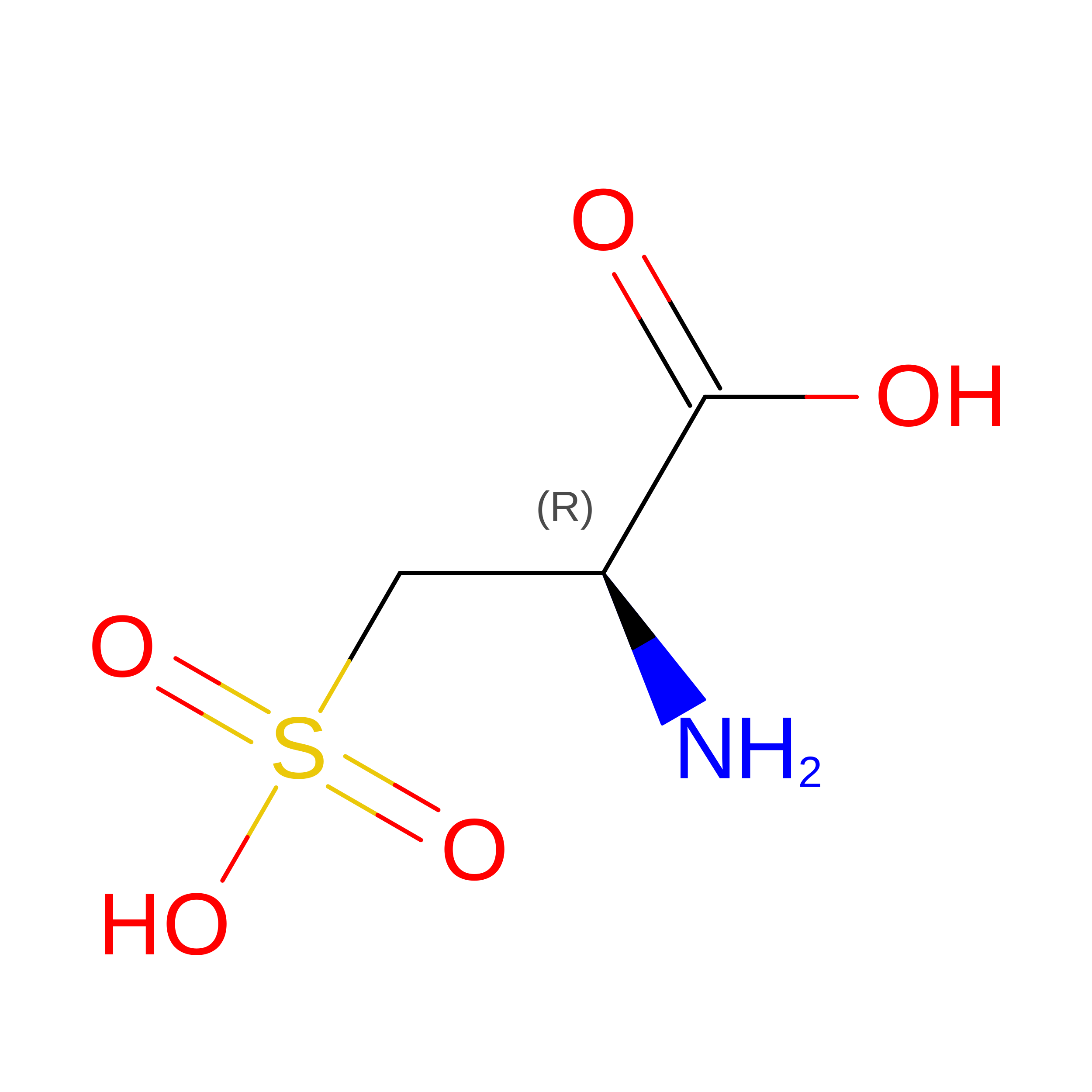
OCS
Query on OCS
A
L-PEPTIDE LINKINGC3 H7 N O5 SCYS

Experimental Data & Validation

Experimental Data

  • Method: X-RAY DIFFRACTION
  • Resolution: 1.60 Å
  • R-Value Free:  0.231 (Depositor) 
  • R-Value Work:  0.196 (Depositor) 
  • R-Value Observed: 0.198 (Depositor) 
Space Group: P 31 2 1
Unit Cell:
Length ( Å )Angle ( ˚ )
a = 69.073α = 90
b = 69.073β = 90
c = 79.727γ = 120
Software Package:
Software NamePurpose
REFMACrefinement

Structure Validation

View Full Validation Report


Entry History 

Deposition Data

Revision History  (Full details and data files)

  • Version 1.0: 2015-04-08
    Type: Initial release
  • Version 1.1: 2023-12-27
    Changes: Data collection, Database references, Derived calculations, Other, Refinement description, Source and taxonomy