4QDG | pdb_00004qdg

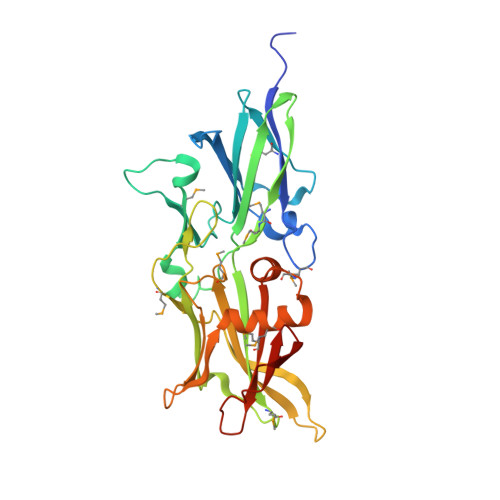
Crystal structure of a putative adhesin (BT2657) from Bacteroides thetaiotaomicron VPI-5482 at 2.20 A resolution (PSI Community Target, Nakayama)


Experimental Data Snapshot

  • Method: X-RAY DIFFRACTION
  • Resolution: 2.20 Å
  • R-Value Free: 
    0.215 (Depositor), 0.218 (DCC) 
  • R-Value Work: 
    0.167 (Depositor), 0.173 (DCC) 
  • R-Value Observed: 
    0.170 (Depositor) 

wwPDB Validation 3D Report Full Report

Validation slider image for 4QDG

This is version 1.4 of the entry. See complete history

Literature

A Distinct Type of Pilus from the Human Microbiome.

Xu, Q.Shoji, M.Shibata, S.Naito, M.Sato, K.Elsliger, M.A.Grant, J.C.Axelrod, H.L.Chiu, H.J.Farr, C.L.Jaroszewski, L.Knuth, M.W.Deacon, A.M.Godzik, A.Lesley, S.A.Curtis, M.A.Nakayama, K.Wilson, I.A.

(2016) Cell 165: 690-703

  • DOI: https://doi.org/10.1016/j.cell.2016.03.016
  • Primary Citation Related Structures: 
    3LIU, 3PAY, 3R4R, 3SY6, 3T2L, 3UFI, 3UP6, 4DGU, 4EPS, 4GPV, 4H40, 4JG5, 4JRF, 4K4K, 4Q98, 4QB7, 4QDG, 4RDB, 5CAG

  • PubMed Abstract: 

    Pili are proteinaceous polymers of linked pilins that protrude from the cell surface of many bacteria and often mediate adherence and virulence. We investigated a set of 20 Bacteroidia pilins from the human microbiome whose structures and mechanism of assembly were unknown. Crystal structures and biochemical data revealed a diverse protein superfamily with a common Greek-key β sandwich fold with two transthyretin-like repeats that polymerize into a pilus through a strand-exchange mechanism. The assembly mechanism of the central, structural pilins involves proteinase-assisted removal of their N-terminal β strand, creating an extended hydrophobic groove that binds the C-terminal donor strands of the incoming pilin. Accessory pilins at the tip and base have unique structural features specific to their location, allowing initiation or termination of the assembly. The Bacteroidia pilus, therefore, has a biogenesis mechanism that is distinct from other known pili and likely represents a different type of bacterial pilus.


  • Organizational Affiliation
    • Joint Center for Structural Genomics, http://www.jcsg.org; SLAC National Accelerator Laboratory, Stanford Synchrotron Radiation Lightsource, Menlo Park, CA 94025, USA.

Macromolecule Content 

  • Total Structure Weight: 72.97 kDa 
  • Atom Count: 5,316 
  • Modeled Residue Count: 602 
  • Deposited Residue Count: 620 
  • Unique protein chains: 1

Macromolecules

Find similar proteins by:|  3D Structure
Entity ID: 1
MoleculeChains  Sequence LengthOrganismDetailsImage
Putative adhesin
A, B
310Bacteroides thetaiotaomicron VPI-5482Mutation(s): 0 
Gene Names: BT_2657
UniProt
Find proteins for Q8A4E2 (Bacteroides thetaiotaomicron (strain ATCC 29148 / DSM 2079 / JCM 5827 / CCUG 10774 / NCTC 10582 / VPI-5482 / E50))
Explore Q8A4E2 
Go to UniProtKB:  Q8A4E2
Entity Groups
Sequence Clusters30% Identity50% Identity70% Identity90% Identity95% Identity100% Identity
UniProt GroupQ8A4E2
Sequence Annotations
Expand
Reference Sequence

Experimental Data & Validation

Experimental Data

  • Method: X-RAY DIFFRACTION
  • Resolution: 2.20 Å
  • R-Value Free:  0.215 (Depositor), 0.218 (DCC) 
  • R-Value Work:  0.167 (Depositor), 0.173 (DCC) 
  • R-Value Observed: 0.170 (Depositor) 
Space Group: P 1 21 1
Unit Cell:
Length ( Å )Angle ( ˚ )
a = 42.803α = 90
b = 102.324β = 98.35
c = 74.466γ = 90
Software Package:
Software NamePurpose
MolProbitymodel building
PDB_EXTRACTdata extraction
SHELXphasing
SHARPphasing
XSCALEdata scaling
XDSdata reduction
SHELXDphasing
BUSTERrefinement

Structure Validation

View Full Validation Report


Entry History 

Deposition Data

Revision History  (Full details and data files)

  • Version 1.0: 2014-06-11
    Type: Initial release
  • Version 1.1: 2017-10-11
    Changes: Data collection, Refinement description
  • Version 1.2: 2020-04-22
    Changes: Database references, Derived calculations
  • Version 1.3: 2023-02-01
    Changes: Database references, Derived calculations
  • Version 1.4: 2024-10-30
    Changes: Data collection, Structure summary