4PRY | pdb_00004pry

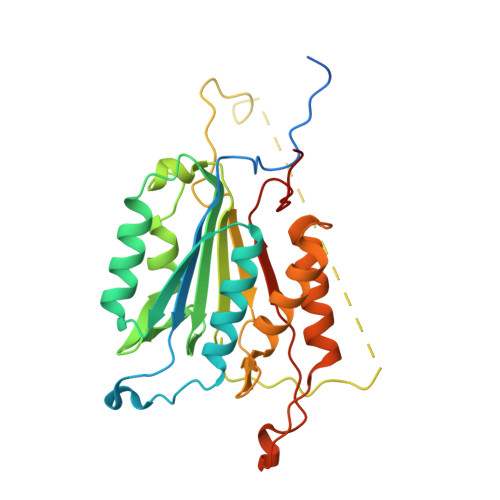
Caspase-8 specific unnatural amino acid peptides


Experimental Data Snapshot

  • Method: X-RAY DIFFRACTION
  • Resolution: 1.70 Å
  • R-Value Free: 
    0.187 (Depositor), 0.188 (DCC) 
  • R-Value Work: 
    0.155 (Depositor), 0.156 (DCC) 
  • R-Value Observed: 
    0.157 (Depositor) 

Starting Model: experimental
View more details

wwPDB Validation 3D Report Full Report

Validation slider image for 4PRY

This is version 1.3 of the entry. See complete history

Literature

Selective inhibition of initiator versus executioner caspases using small peptides containing unnatural amino acids.

Vickers, C.J.Gonzalez-Paez, G.E.Litwin, K.M.Umotoy, J.C.Coutsias, E.A.Wolan, D.W.

(2014) ACS Chem Biol 9: 2194-2198

  • DOI: https://doi.org/10.1021/cb5004256
  • Primary Citation Related Structures: 
    4PRY, 4PRZ, 4PS0, 4PS1

  • PubMed Abstract: 

    Caspases are fundamental to many essential biological processes, including apoptosis, differentiation, and inflammation. Unregulated caspase activity is also implicated in the development and progression of several diseases, such as cancer, neurodegenerative disorders, and sepsis. Unfortunately, it is difficult to determine exactly which caspase(s) of the 11 isoforms that humans express is responsible for specific biological functions. This lack of resolution is primarily due to highly homologous active sites and overlapping substrates. Currently available peptide-based inhibitors and probes are based on specificity garnered from peptide substrate libraries. For example, the canonical tetrapeptide LETD was discovered as the canonical sequence that is optimally recognized by caspase-8; however, LETD-based inhibitors and substrates promiscuously bind to other isoforms with equal affinity, including caspases-3, -6, and -9. In order to mitigate this problem, we report the identification of a new series of compounds that are >100-fold selective for inhibiting the initiator caspases-8 and -9 over the executioner caspases-3, -6, and -7.


  • Organizational Affiliation
    • Departments of Molecular and Experimental Medicine and Chemical Physiology, The Scripps Research Institute , La Jolla, California 92037, United States.

Macromolecule Content 

  • Total Structure Weight: 33.21 kDa 
  • Atom Count: 2,249 
  • Modeled Residue Count: 254 
  • Deposited Residue Count: 290 
  • Unique protein chains: 2

Macromolecules

Find similar proteins by:|  3D Structure
Entity ID: 1
MoleculeChains  Sequence LengthOrganismDetailsImage
Caspase-3285Homo sapiensMutation(s): 0 
Gene Names: CASP3CASPASE-3 CPP32CPP32
EC: 3.4.22.56
UniProt & NIH Common Fund Data Resources
Find proteins for P42574 (Homo sapiens)
Explore P42574 
Go to UniProtKB:  P42574
PHAROS:  P42574
GTEx:  ENSG00000164305 
Entity Groups
Sequence Clusters30% Identity50% Identity70% Identity90% Identity95% Identity100% Identity
UniProt GroupP42574
Sequence Annotations
Expand
Reference Sequence
Find similar proteins by:  Sequence   |   3D Structure  
Entity ID: 2
MoleculeChains  Sequence LengthOrganismDetailsImage
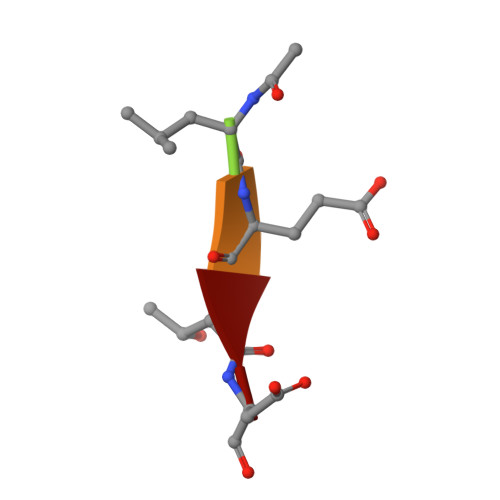
Ac-LETD-CHO5N/AMutation(s): 0 

Small Molecules

Modified Residues  1 Unique
IDChains TypeFormula2D DiagramParent
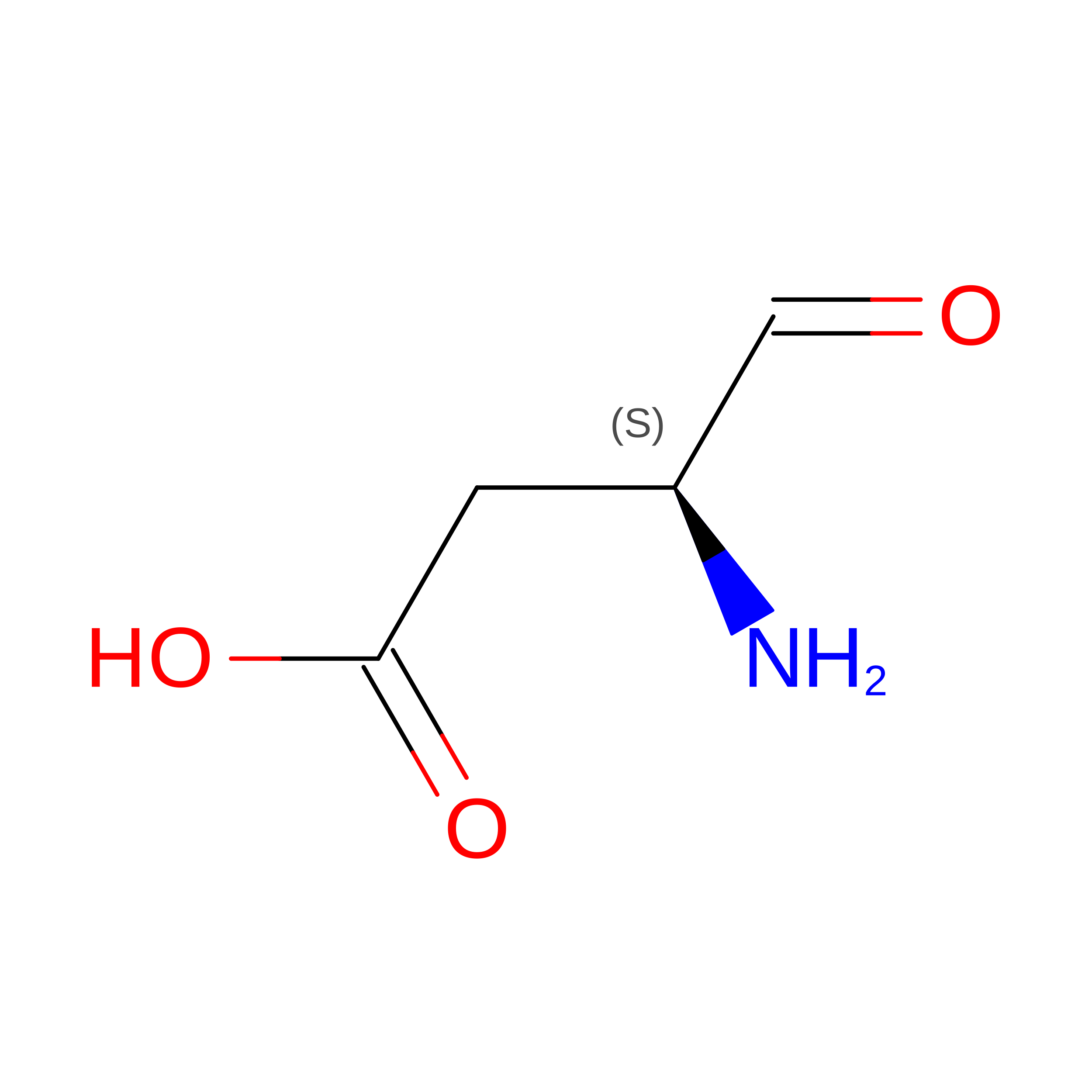
ASA
Query on ASA
B
L-PEPTIDE LINKINGC4 H7 N O3ASP

Experimental Data & Validation

Experimental Data

  • Method: X-RAY DIFFRACTION
  • Resolution: 1.70 Å
  • R-Value Free:  0.187 (Depositor), 0.188 (DCC) 
  • R-Value Work:  0.155 (Depositor), 0.156 (DCC) 
  • R-Value Observed: 0.157 (Depositor) 
Space Group: I 2 2 2
Unit Cell:
Length ( Å )Angle ( ˚ )
a = 69.041α = 90
b = 84.433β = 90
c = 96.127γ = 90
Software Package:
Software NamePurpose
HKL-2000data collection
PHASESphasing
PHENIXrefinement
HKL-2000data reduction
HKL-2000data scaling

Structure Validation

View Full Validation Report


Entry History 

Deposition Data

Revision History  (Full details and data files)

  • Version 1.0: 2015-01-21
    Type: Initial release
  • Version 1.1: 2023-09-20
    Changes: Data collection, Database references, Derived calculations, Refinement description
  • Version 1.2: 2023-12-06
    Changes: Data collection
  • Version 1.3: 2024-11-20
    Changes: Structure summary