4HQU | pdb_00004hqu

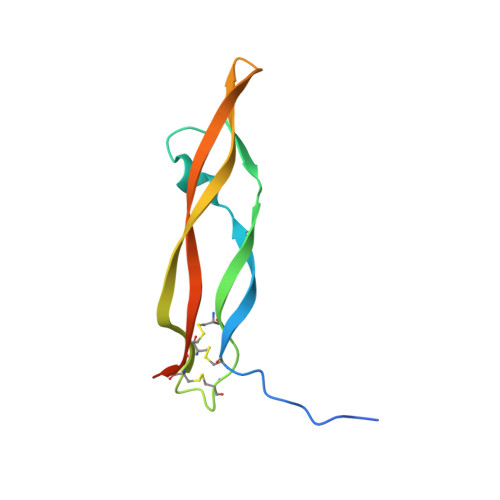
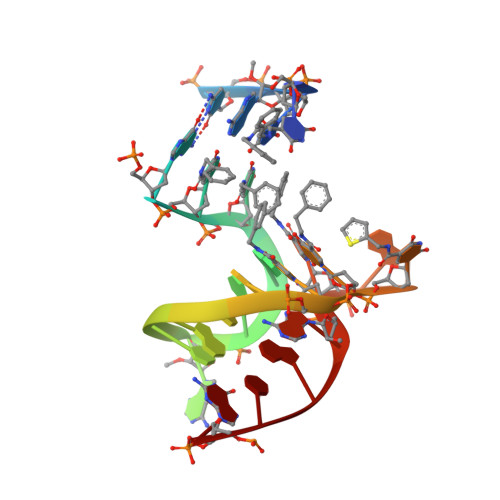
Crystal structure of human PDGF-BB in complex with a modified nucleotide aptamer (SOMAmer SL5)


Experimental Data Snapshot

  • Method: X-RAY DIFFRACTION
  • Resolution: 2.20 Å
  • R-Value Free: 
    0.262 (Depositor), 0.262 (DCC) 
  • R-Value Work: 
    0.225 (Depositor), 0.221 (DCC) 
  • R-Value Observed: 
    0.227 (Depositor) 

Starting Model: experimental
View more details

wwPDB Validation 3D Report Full Report

Validation slider image for 4HQU

This is version 1.3 of the entry. See complete history

Literature

Unique motifs and hydrophobic interactions shape the binding of modified DNA ligands to protein targets.

Davies, D.R.Gelinas, A.D.Zhang, C.Rohloff, J.C.Carter, J.D.O'Connell, D.Waugh, S.M.Wolk, S.K.Mayfield, W.S.Burgin, A.B.Edwards, T.E.Stewart, L.J.Gold, L.Janjic, N.Jarvis, T.C.

(2012) Proc Natl Acad Sci U S A 109: 19971-19976

  • DOI: https://doi.org/10.1073/pnas.1213933109
  • Primary Citation Related Structures: 
    4HQU, 4HQX

  • PubMed Abstract: 

    Selection of aptamers from nucleic acid libraries by in vitro evolution represents a powerful method of identifying high-affinity ligands for a broad range of molecular targets. Nevertheless, a sizeable fraction of proteins remain difficult targets due to inherently limited chemical diversity of nucleic acids. We have exploited synthetic nucleotide modifications that confer protein-like diversity on a nucleic acid scaffold, resulting in a new generation of binding reagents called SOMAmers (Slow Off-rate Modified Aptamers). Here we report a unique crystal structure of a SOMAmer bound to its target, platelet-derived growth factor B (PDGF-BB). The SOMAmer folds into a compact structure and exhibits a hydrophobic binding surface that mimics the interface between PDGF-BB and its receptor, contrasting sharply with mainly polar interactions seen in traditional protein-binding aptamers. The modified nucleotides circumvent the intrinsic diversity constraints of natural nucleic acids, thereby greatly expanding the structural vocabulary of nucleic acid ligands and considerably broadening the range of accessible protein targets.


  • Organizational Affiliation
    • Emerald BioStructures, Inc, Bainbridge Island, WA 98110, USA.

Macromolecule Content 

  • Total Structure Weight: 20.92 kDa 
  • Atom Count: 1,382 
  • Modeled Residue Count: 119 
  • Deposited Residue Count: 133 
  • Unique protein chains: 1
  • Unique nucleic acid chains: 1

Macromolecules


Find similar proteins by:|  3D Structure
Entity ID: 1
MoleculeChains  Sequence LengthOrganismDetailsImage
Platelet-derived growth factor subunit B109Homo sapiensMutation(s): 0 
Gene Names: PDGFBPDGF2SIS
UniProt & NIH Common Fund Data Resources
Find proteins for P01127 (Homo sapiens)
Explore P01127 
Go to UniProtKB:  P01127
PHAROS:  P01127
GTEx:  ENSG00000100311 
Entity Groups
Sequence Clusters30% Identity50% Identity70% Identity90% Identity95% Identity100% Identity
UniProt GroupP01127
Sequence Annotations
Expand
Reference Sequence
Find similar nucleic acids by:  Sequence
Entity ID: 2
MoleculeChains LengthOrganismImage
SOMAmer SL5B [auth C]24N/A
Sequence Annotations
Expand
Reference Sequence

Experimental Data & Validation

Experimental Data

  • Method: X-RAY DIFFRACTION
  • Resolution: 2.20 Å
  • R-Value Free:  0.262 (Depositor), 0.262 (DCC) 
  • R-Value Work:  0.225 (Depositor), 0.221 (DCC) 
  • R-Value Observed: 0.227 (Depositor) 
Space Group: P 41 21 2
Unit Cell:
Length ( Å )Angle ( ˚ )
a = 59.71α = 90
b = 59.71β = 90
c = 167.01γ = 90
Software Package:
Software NamePurpose
PHASERphasing
REFMACrefinement

Structure Validation

View Full Validation Report


Entry History 

Deposition Data

Revision History  (Full details and data files)

  • Version 1.0: 2012-11-21
    Type: Initial release
  • Version 1.1: 2012-12-19
    Changes: Database references
  • Version 1.2: 2023-09-20
    Changes: Advisory, Data collection, Database references, Derived calculations, Refinement description
  • Version 1.3: 2024-11-20
    Changes: Structure summary