3EZ2 | pdb_00003ez2

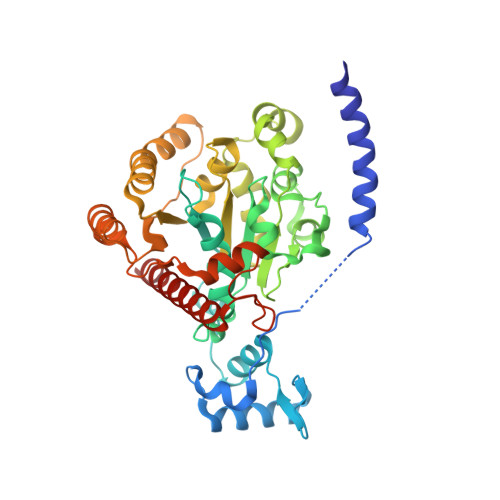
Partition protein-ADP complex


Experimental Data Snapshot

  • Method: X-RAY DIFFRACTION
  • Resolution: 2.05 Å
  • R-Value Free: 
    0.232 (Depositor), 0.231 (DCC) 
  • R-Value Work: 
    0.191 (Depositor), 0.192 (DCC) 
  • R-Value Observed: 
    0.191 (Depositor) 

Starting Model: experimental
View more details

wwPDB Validation 3D Report Full Report

Validation slider image for 3EZ2

Ligand Structure Quality Assessment 


This is version 1.2 of the entry. See complete history

Literature

Structural basis for ADP-mediated transcriptional regulation by P1 and P7 ParA.

Dunham, T.D.Xu, W.Funnell, B.E.Schumacher, M.A.

(2009) EMBO J 28: 1792-1802

  • DOI: https://doi.org/10.1038/emboj.2009.120
  • Primary Citation Related Structures: 
    3EZ2, 3EZ6, 3EZ7, 3EZ9, 3EZF

  • PubMed Abstract: 

    The accurate segregation of DNA is essential for the faithful inheritance of genetic information. Segregation of the prototypical P1 plasmid par system requires two proteins, ParA and ParB, and a centromere. When bound to ATP, ParA mediates segregation by interacting with centromere-bound ParB, but when bound to ADP, ParA fulfils a different function: DNA-binding transcription autoregulation. The structure of ParA is unknown as is how distinct nucleotides arbitrate its different functions. To address these questions, we carried out structural and biochemical studies. Crystal structures show that ParA consists of an elongated N-terminal alpha-helix, which unexpectedly mediates dimerization, a winged-HTH and a Walker-box containing C-domain. Biochemical data confirm that apoParA forms dimers at physiological concentrations. Comparisons of four apoParA structures reveal a strikingly flexible dimer interface that allows ParA to adopt multiple conformations. The ParA-ADP structure shows that ADP-binding activates DNA binding using a bipartite mechanism. First, it locks in one specific dimer conformation, and second, it induces the folding of two DNA-binding basic motifs that we show are critical for operator binding.


  • Organizational Affiliation
    • Department of Biochemistry and Molecular Biology, MD Anderson Cancer Center, University of Texas, Houston, TX 77030, USA.

Macromolecule Content 

  • Total Structure Weight: 90.83 kDa 
  • Atom Count: 6,799 
  • Modeled Residue Count: 782 
  • Deposited Residue Count: 796 
  • Unique protein chains: 1

Macromolecules

Find similar proteins by:|  3D Structure
Entity ID: 1
MoleculeChains  Sequence LengthOrganismDetailsImage
Plasmid partition protein A
A, B
398Escherichia coliMutation(s): 0 
UniProt
Find proteins for P07620 (Escherichia coli)
Explore P07620 
Go to UniProtKB:  P07620
Entity Groups
Sequence Clusters30% Identity50% Identity70% Identity90% Identity95% Identity100% Identity
UniProt GroupP07620
Sequence Annotations
Expand
Reference Sequence

Small Molecules

Ligands 4 Unique
IDChains Name / Formula / InChI Key2D Diagram3D Interactions
ADP

Query on ADP


Download:Ideal Coordinates CCD File
C [auth A],
E [auth A],
F [auth B],
I [auth B]
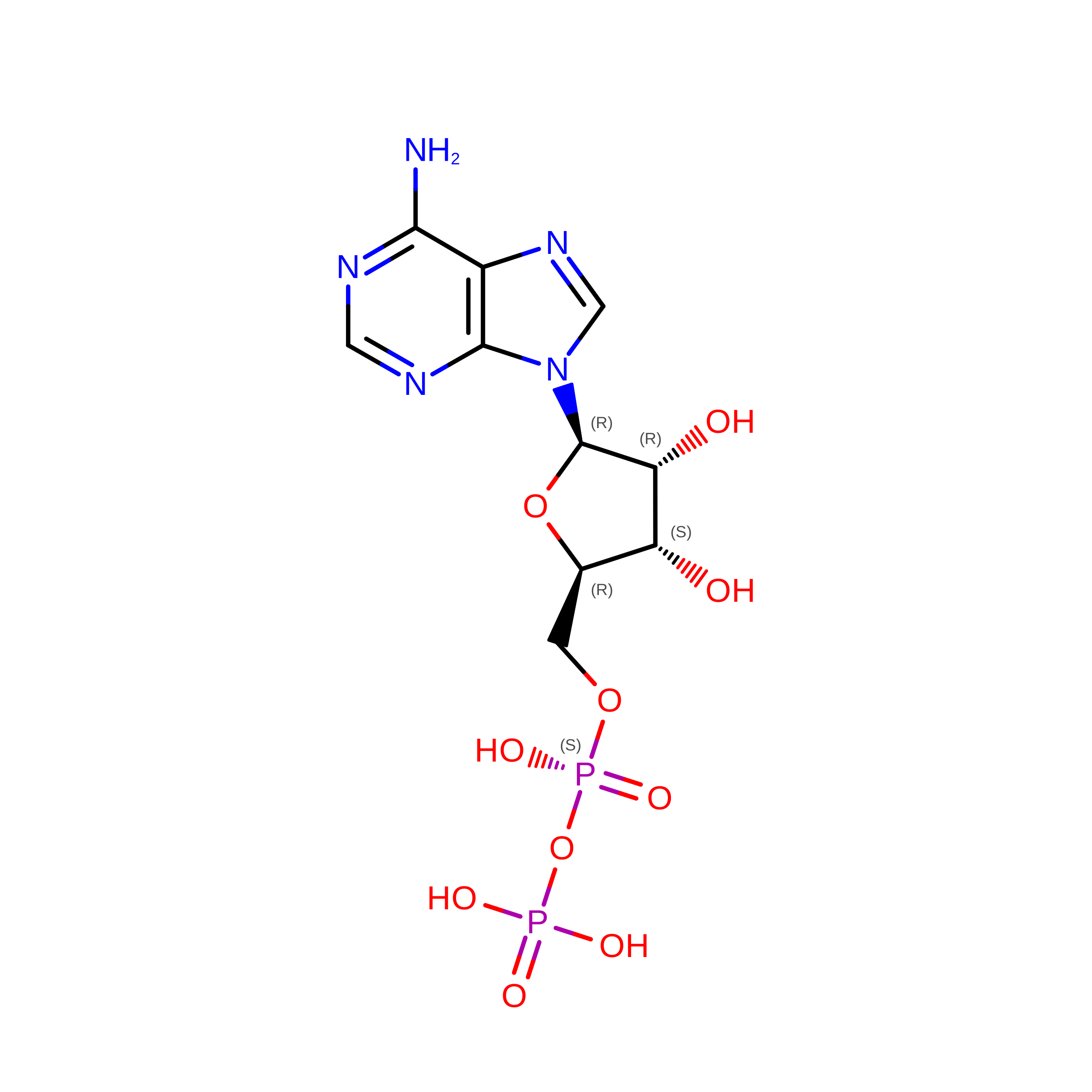
ADENOSINE-5'-DIPHOSPHATE
C10 H15 N5 O10 P2
XTWYTFMLZFPYCI-KQYNXXCUSA-N
EPE

Query on EPE


Download:Ideal Coordinates CCD File
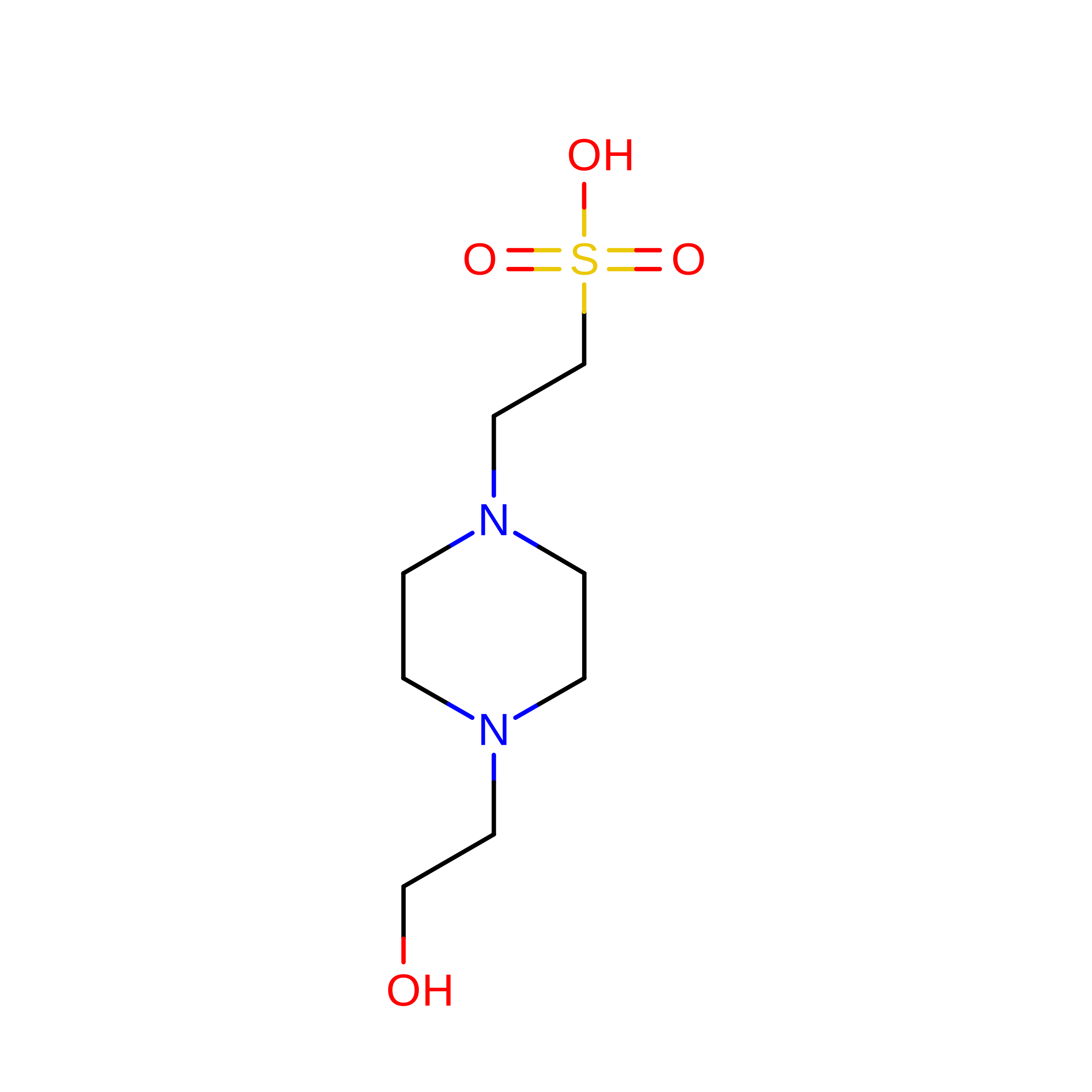
H [auth B]4-(2-HYDROXYETHYL)-1-PIPERAZINE ETHANESULFONIC ACID
C8 H18 N2 O4 S
JKMHFZQWWAIEOD-UHFFFAOYSA-N
GOL

Query on GOL


Download:Ideal Coordinates CCD File
J [auth B],
K [auth B]
GLYCEROL
C3 H8 O3
PEDCQBHIVMGVHV-UHFFFAOYSA-N
MG

Query on MG


Download:Ideal Coordinates CCD File
D [auth A],
G [auth B]
MAGNESIUM ION
Mg
JLVVSXFLKOJNIY-UHFFFAOYSA-N

Experimental Data & Validation

Experimental Data

  • Method: X-RAY DIFFRACTION
  • Resolution: 2.05 Å
  • R-Value Free:  0.232 (Depositor), 0.231 (DCC) 
  • R-Value Work:  0.191 (Depositor), 0.192 (DCC) 
  • R-Value Observed: 0.191 (Depositor) 
Space Group: P 21 21 21
Unit Cell:
Length ( Å )Angle ( ˚ )
a = 60.1α = 90
b = 125.9β = 90
c = 148.4γ = 90
Software Package:
Software NamePurpose
ADSCdata collection
MOLREPphasing
CNSrefinement
MOSFLMdata reduction
SCALAdata scaling

Structure Validation

View Full Validation Report


Ligand Structure Quality Assessment 


Entry History 

Deposition Data

Revision History  (Full details and data files)

  • Version 1.0: 2009-06-02
    Type: Initial release
  • Version 1.1: 2011-07-13
    Changes: Non-polymer description, Version format compliance
  • Version 1.2: 2023-09-06
    Changes: Data collection, Database references, Derived calculations, Refinement description