3EOA | pdb_00003eoa

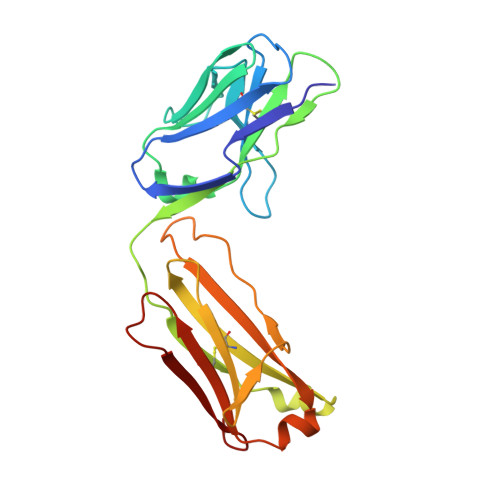
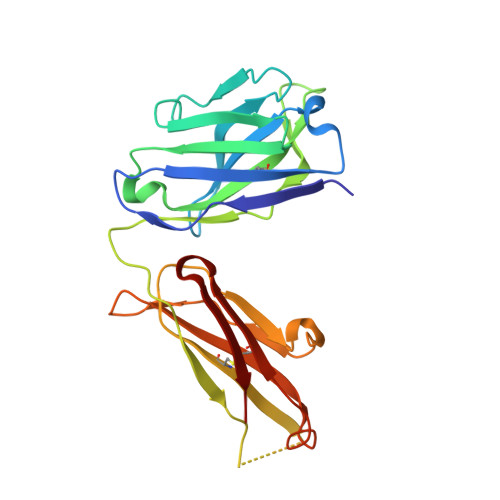
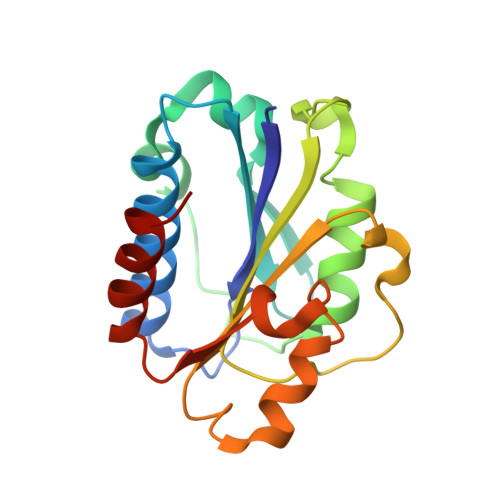
Crystal structure the Fab fragment of Efalizumab in complex with LFA-1 I domain, Form I


Experimental Data Snapshot

  • Method: X-RAY DIFFRACTION
  • Resolution: 2.80 Å
  • R-Value Free: 
    0.264 (Depositor), 0.242 (DCC) 
  • R-Value Work: 
    0.225 (Depositor), 0.233 (DCC) 
  • R-Value Observed: 
    0.227 (Depositor) 

Starting Models: experimental
View more details

wwPDB Validation 3D Report Full Report

Validation slider image for 3EOA

This is version 1.3 of the entry. See complete history

Literature

Efalizumab binding to the LFA-1 alphaL I domain blocks ICAM-1 binding via steric hindrance.

Li, S.Wang, H.Peng, B.Zhang, M.Zhang, D.Hou, S.Guo, Y.Ding, J.

(2009) Proc Natl Acad Sci U S A 106: 4349-4354

  • DOI: https://doi.org/10.1073/pnas.0810844106
  • Primary Citation Related Structures: 
    3EO9, 3EOA, 3EOB

  • PubMed Abstract: 

    Lymphocyte function-associated antigen 1 (LFA-1) plays important roles in immune cell adhesion, trafficking, and activation and is a therapeutic target for the treatment of multiple autoimmune diseases. Efalizumab is one of the most efficacious antibody drugs for treating psoriasis, a very common skin disease, through inhibition of the binding of LFA-1 to the ligand intercellular adhesion molecule 1 (ICAM-1). We report here the crystal structures of the Efalizumab Fab alone and in complex with the LFA-1 alpha(L) I domain, which reveal the molecular mechanism of inhibition of LFA-1 by Efalizumab. The Fab binds with an epitope on the inserted (I) domain that is distinct from the ligand-binding site. Efalizumab binding blocks the binding of LFA-1 to ICAM-1 via steric hindrance between its light chain and ICAM-1 domain 2 and thus inhibits the activities of LFA-1. These results have important implications for the development of improved antibodies and new therapeutic strategies for the treatment of autoimmune diseases.


  • Organizational Affiliation
    • State Key Laboratory of Molecular Biology and Research Center for Structural Biology, Institute of Biochemistry and Cell Biology, Chinese Academy of Sciences, 320 Yue-Yang Road, Shanghai 200031, China.

Macromolecule Content 

  • Total Structure Weight: 135.73 kDa 
  • Atom Count: 9,804 
  • Modeled Residue Count: 1,216 
  • Deposited Residue Count: 1,230 
  • Unique protein chains: 3

Macromolecules

Find similar proteins by:|  3D Structure
Entity ID: 1
MoleculeChains  Sequence LengthOrganismDetailsImage
Efalizumab Fab fragment, light chainA [auth L],
B [auth A]
214Homo sapiensMutation(s): 0 
Gene Names: IGG1
Find similar proteins by:|  3D Structure
Entity ID: 2
MoleculeChains  Sequence LengthOrganismDetailsImage
Efalizumab Fab fragment, heavy chainC [auth H],
D [auth B]
220Homo sapiensMutation(s): 0 
Gene Names: IGG1
Find similar proteins by:|  3D Structure
Entity ID: 3
MoleculeChains  Sequence LengthOrganismDetailsImage
Integrin alpha-LE [auth I],
F [auth J]
181Homo sapiensMutation(s): 0 
Gene Names: ITGALCD11A
UniProt & NIH Common Fund Data Resources
Find proteins for P20701 (Homo sapiens)
Explore P20701 
Go to UniProtKB:  P20701
PHAROS:  P20701
GTEx:  ENSG00000005844 
Entity Groups
Sequence Clusters30% Identity50% Identity70% Identity90% Identity95% Identity100% Identity
UniProt GroupP20701
Sequence Annotations
Expand
Reference Sequence

Experimental Data & Validation

Experimental Data

  • Method: X-RAY DIFFRACTION
  • Resolution: 2.80 Å
  • R-Value Free:  0.264 (Depositor), 0.242 (DCC) 
  • R-Value Work:  0.225 (Depositor), 0.233 (DCC) 
  • R-Value Observed: 0.227 (Depositor) 
Space Group: P 21 21 21
Unit Cell:
Length ( Å )Angle ( ˚ )
a = 64.719α = 90
b = 81.696β = 90
c = 281.882γ = 90
Software Package:
Software NamePurpose
HKL-2000data collection
CNSrefinement
REFMACrefinement
HKL-2000data reduction
HKL-2000data scaling
CNSphasing

Structure Validation

View Full Validation Report


Entry History 

Deposition Data

Revision History  (Full details and data files)

  • Version 1.0: 2009-04-14
    Type: Initial release
  • Version 1.1: 2011-07-13
    Changes: Version format compliance
  • Version 1.2: 2023-11-01
    Changes: Data collection, Database references, Derived calculations, Refinement description
  • Version 1.3: 2024-10-16
    Changes: Structure summary