2HU0 | pdb_00002hu0

N1 neuraminidase in complex with oseltamivir 1


Experimental Data Snapshot

  • Method: X-RAY DIFFRACTION
  • Resolution: 2.95 Å
  • R-Value Free: 
    0.295 (Depositor), 0.257 (DCC) 
  • R-Value Work: 
    0.218 (Depositor), 0.257 (DCC) 
  • R-Value Observed: 
    0.221 (Depositor) 

wwPDB Validation 3D Report Full Report

Validation slider image for 2HU0

Ligand Structure Quality Assessment 


This is version 1.4 of the entry. See complete history

Literature

The structure of H5N1 avian influenza neuraminidase suggests new opportunities for drug design.

Russell, R.J.Haire, L.F.Stevens, D.J.Collins, P.J.Lin, Y.P.Blackburn, G.M.Hay, A.J.Gamblin, S.J.Skehel, J.J.

(2006) Nature 443: 45-49

  • DOI: https://doi.org/10.1038/nature05114
  • Primary Citation Related Structures: 
    2HT5, 2HT7, 2HT8, 2HTQ, 2HTR, 2HTU, 2HTV, 2HTW, 2HTY, 2HU0, 2HU4

  • PubMed Abstract: 

    The worldwide spread of H5N1 avian influenza has raised concerns that this virus might acquire the ability to pass readily among humans and cause a pandemic. Two anti-influenza drugs currently being used to treat infected patients are oseltamivir (Tamiflu) and zanamivir (Relenza), both of which target the neuraminidase enzyme of the virus. Reports of the emergence of drug resistance make the development of new anti-influenza molecules a priority. Neuraminidases from influenza type A viruses form two genetically distinct groups: group-1 contains the N1 neuraminidase of the H5N1 avian virus and group-2 contains the N2 and N9 enzymes used for the structure-based design of current drugs. Here we show by X-ray crystallography that these two groups are structurally distinct. Group-1 neuraminidases contain a cavity adjacent to their active sites that closes on ligand binding. Our analysis suggests that it may be possible to exploit the size and location of the group-1 cavity to develop new anti-influenza drugs.


  • Organizational Affiliation
    • MRC National Institute for Medical Research, The Ridgeway, Mill Hill, London NW7 1AA, UK.

Macromolecule Content 

  • Total Structure Weight: 339.72 kDa 
  • Atom Count: 23,716 
  • Modeled Residue Count: 3,080 
  • Deposited Residue Count: 3,096 
  • Unique protein chains: 1

Macromolecules

Find similar proteins by:|  3D Structure
Entity ID: 1
MoleculeChains  Sequence LengthOrganismDetailsImage
Neuraminidase
A, B, C, D, E
A, B, C, D, E, F, G, H
387Influenza A virusMutation(s): 1 
EC: 3.2.1.18
UniProt
Find proteins for Q6DPL2 (Influenza A virus (strain A/Vietnam/1203/2004 H5N1))
Explore Q6DPL2 
Go to UniProtKB:  Q6DPL2
Entity Groups
Sequence Clusters30% Identity50% Identity70% Identity90% Identity95% Identity100% Identity
UniProt GroupQ6DPL2
Sequence Annotations
Expand
Reference Sequence

Small Molecules

Ligands 1 Unique
IDChains Name / Formula / InChI Key2D Diagram3D Interactions
G39

Query on G39


Download:Ideal Coordinates CCD File
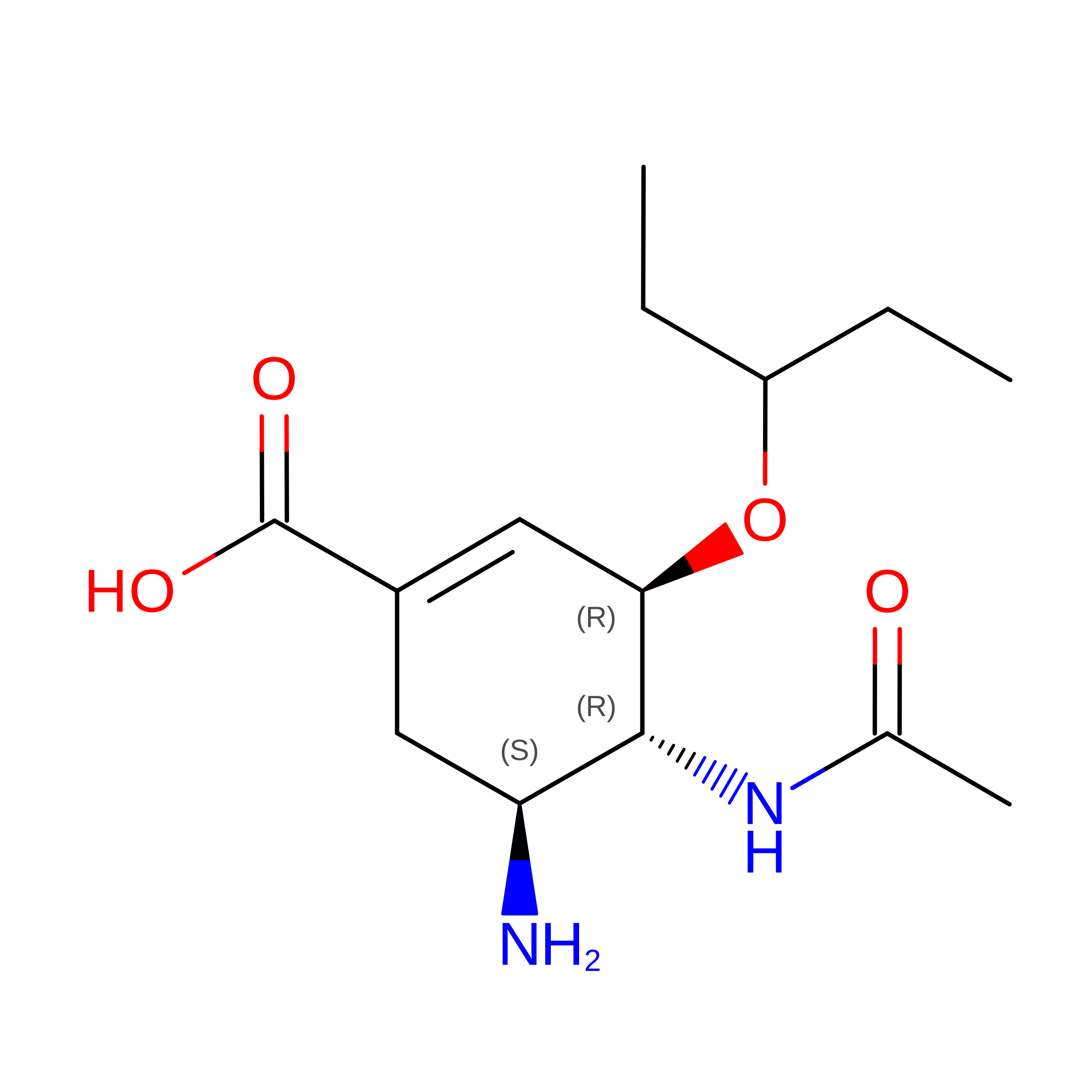
I [auth B](3R,4R,5S)-4-(acetylamino)-5-amino-3-(pentan-3-yloxy)cyclohex-1-ene-1-carboxylic acid
C14 H24 N2 O4
NENPYTRHICXVCS-YNEHKIRRSA-N

Experimental Data & Validation

Experimental Data

  • Method: X-RAY DIFFRACTION
  • Resolution: 2.95 Å
  • R-Value Free:  0.295 (Depositor), 0.257 (DCC) 
  • R-Value Work:  0.218 (Depositor), 0.257 (DCC) 
  • R-Value Observed: 0.221 (Depositor) 
Space Group: C 2 2 21
Unit Cell:
Length ( Å )Angle ( ˚ )
a = 198.083α = 90
b = 200.576β = 90
c = 210.417γ = 90
Software Package:
Software NamePurpose
REFMACrefinement
CrystalCleardata collection
CrystalCleardata reduction
CrystalCleardata scaling
AMoREphasing

Structure Validation

View Full Validation Report


Ligand Structure Quality Assessment 


Entry History 

Deposition Data

Revision History  (Full details and data files)

  • Version 1.0: 2006-09-05
    Type: Initial release
  • Version 1.1: 2008-05-01
    Changes: Version format compliance
  • Version 1.2: 2011-07-13
    Changes: Non-polymer description, Version format compliance
  • Version 1.3: 2021-10-20
    Changes: Database references, Derived calculations
  • Version 1.4: 2024-10-09
    Changes: Data collection, Structure summary