2OTE | pdb_00002ote

Crystal structure of a monomeric cyan fluorescent protein in the photobleached state


Experimental Data Snapshot

  • Method: X-RAY DIFFRACTION
  • Resolution: 1.47 Å
  • R-Value Free: 
    0.261 (Depositor), 0.174 (DCC) 
  • R-Value Work: 
    0.190 (Depositor), 0.168 (DCC) 
  • R-Value Observed: 
    0.192 (Depositor) 

Starting Model: experimental
View more details

wwPDB Validation 3D Report Full Report

Validation slider image for 2OTE

This is version 2.0 of the entry. See complete history

Literature

Structural basis for reversible photobleaching of a green fluorescent protein homologue.

Henderson, J.N.Ai, H.W.Campbell, R.E.Remington, S.J.

(2007) Proc Natl Acad Sci U S A 104: 6672-6677

  • DOI: https://doi.org/10.1073/pnas.0700059104
  • Primary Citation Related Structures: 
    2OTB, 2OTE

  • PubMed Abstract: 

    Fluorescent protein (FP) variants that can be reversibly converted between fluorescent and nonfluorescent states have proven to be a catalyst for innovation in the field of fluorescence microscopy. However, the structural basis of the process remains poorly understood. High-resolution structures of a FP derived from Clavularia in both the fluorescent and the light-induced nonfluorescent states reveal that the rapid and complete loss of fluorescence observed upon illumination with 450-nm light results from cis-trans isomerization of the chromophore. The photoinduced change in configuration from the well ordered cis isomer to the highly nonplanar and disordered trans isomer is accompanied by a dramatic rearrangement of internal side chains. Taken together, the structures provide an explanation for the loss of fluorescence upon illumination, the slow light-independent recovery, and the rapid light-induced recovery of fluorescence. The fundamental mechanism appears to be common to all of the photoactivatable and reversibly photoswitchable FPs reported to date.


  • Organizational Affiliation
    • Departments of Chemistry and Physics, and Institute of Molecular Biology, University of Oregon, Eugene, OR 97403, USA.

Macromolecule Content 

  • Total Structure Weight: 49.66 kDa 
  • Atom Count: 4,007 
  • Modeled Residue Count: 428 
  • Deposited Residue Count: 428 
  • Unique protein chains: 1

Macromolecules

Find similar proteins by:|  3D Structure
Entity ID: 1
MoleculeChains  Sequence LengthOrganismDetailsImage
GFP-like fluorescent chromoprotein cFP484
A, B
214Clavularia sp.Mutation(s): 21 
Gene Names: cFP484
UniProt
Find proteins for Q9U6Y3 (Clavularia sp.)
Explore Q9U6Y3 
Go to UniProtKB:  Q9U6Y3
Entity Groups
Sequence Clusters30% Identity50% Identity70% Identity90% Identity95% Identity100% Identity
UniProt GroupQ9U6Y3
Sequence Annotations
Expand
Reference Sequence

Small Molecules

Ligands 1 Unique
IDChains Name / Formula / InChI Key2D Diagram3D Interactions
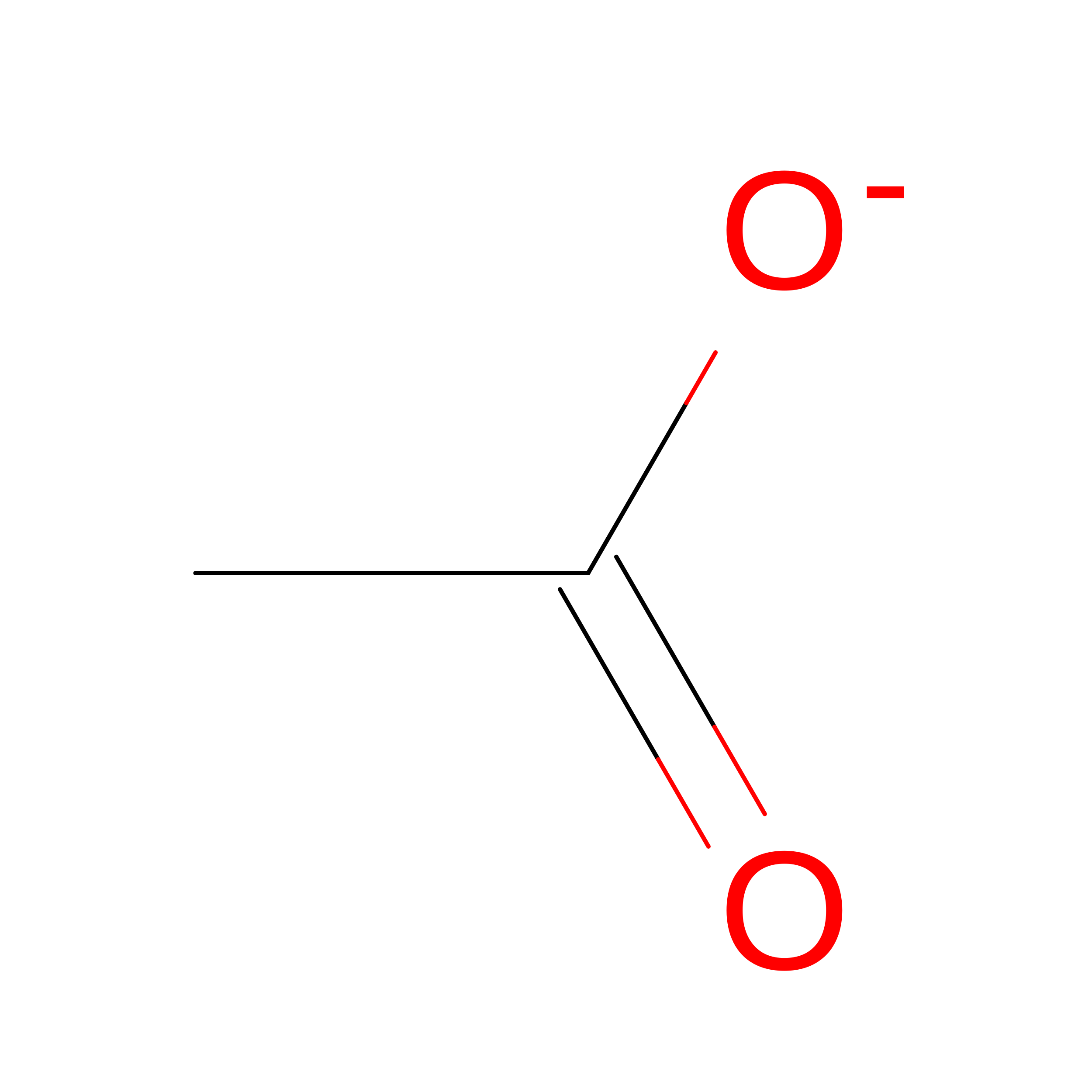
ACT

Query on ACT


Download:Ideal Coordinates CCD File
C [auth A]ACETATE ION
C2 H3 O2
QTBSBXVTEAMEQO-UHFFFAOYSA-M
Modified Residues  1 Unique
IDChains TypeFormula2D DiagramParent
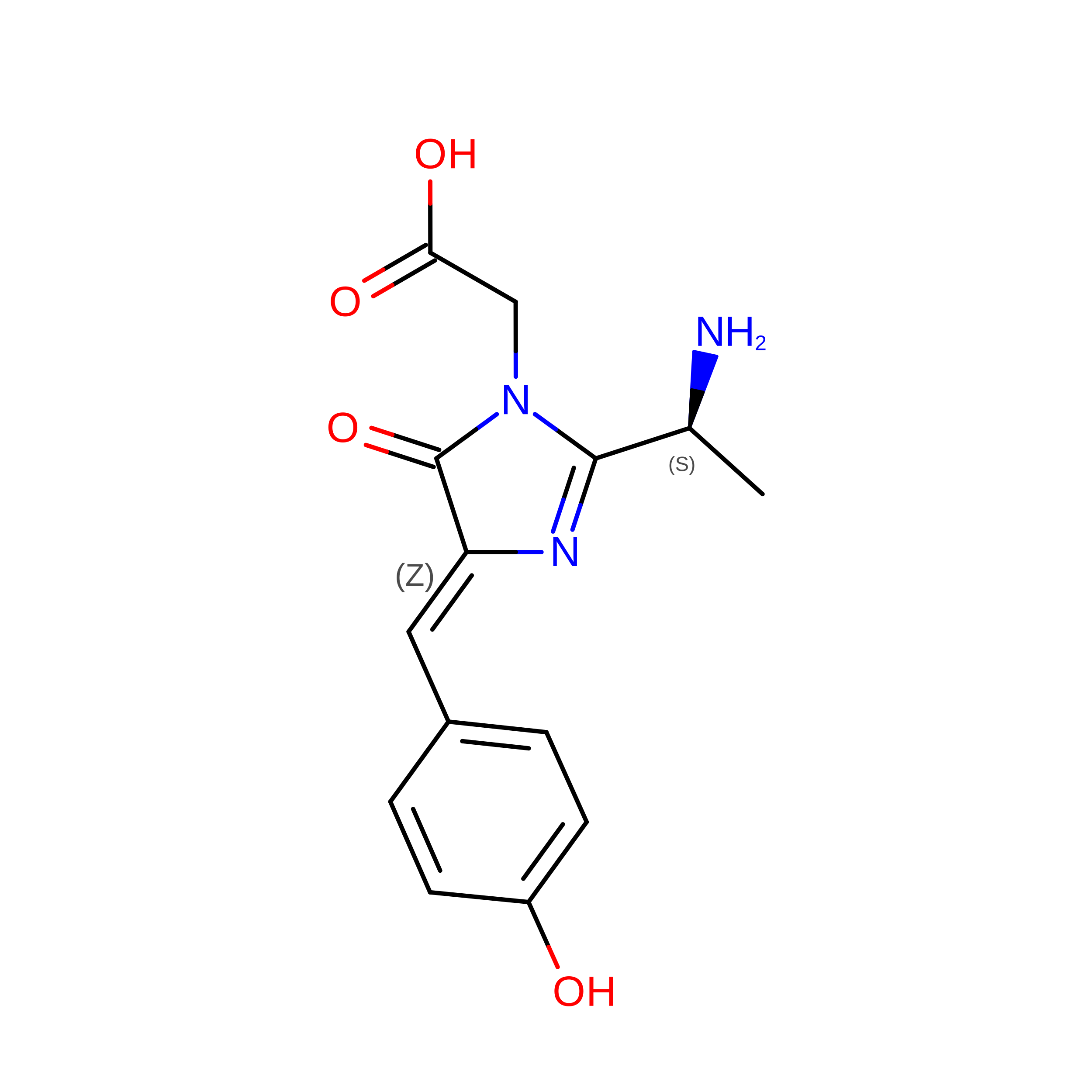
PIA
Query on PIA
A, B
L-PEPTIDE LINKINGC14 H15 N3 O4ALA, TYR, GLY

Experimental Data & Validation

Experimental Data

  • Method: X-RAY DIFFRACTION
  • Resolution: 1.47 Å
  • R-Value Free:  0.261 (Depositor), 0.174 (DCC) 
  • R-Value Work:  0.190 (Depositor), 0.168 (DCC) 
  • R-Value Observed: 0.192 (Depositor) 
Space Group: P 21 21 21
Unit Cell:
Length ( Å )Angle ( ˚ )
a = 65.489α = 90
b = 66.31β = 90
c = 97.203γ = 90
Software Package:
Software NamePurpose
DENZOdata reduction
SCALEPACKdata scaling
EPMRphasing
SHELXrefinement
PDB_EXTRACTdata extraction
HKL-2000data collection
HKL-2000data reduction
SHELXLrefinement

Structure Validation

View Full Validation Report


Entry History 

Deposition Data

Revision History  (Full details and data files)

  • Version 1.0: 2007-04-03
    Type: Initial release
  • Version 1.1: 2008-05-01
    Changes: Version format compliance
  • Version 1.2: 2011-07-13
    Changes: Version format compliance
  • Version 1.3: 2012-02-22
    Changes: Other
  • Version 1.4: 2017-10-18
    Changes: Refinement description
  • Version 1.5: 2023-08-30
    Changes: Data collection, Database references, Derived calculations, Refinement description
  • Version 1.6: 2023-11-15
    Changes: Data collection
  • Version 2.0: 2026-03-18
    Changes: Polymer sequence, Structure summary