2LNH | pdb_00002lnh

Enterohaemorrhagic E. coli (EHEC) exploits a tryptophan switch to hijack host F-actin assembly


Experimental Data Snapshot

  • Method: SOLUTION NMR
  • Conformers Calculated: 200 
  • Conformers Submitted: 20 
  • Selection Criteria: target function 

wwPDB Validation 3D Report Full Report

Validation slider image for 2LNH

This is version 1.3 of the entry. See complete history

Literature

Enterohaemorrhagic Escherichia coli exploits a tryptophan switch to hijack host f-actin assembly.

Aitio, O.Hellman, M.Skehan, B.Kesti, T.Leong, J.M.Saksela, K.Permi, P.

(2012) Structure 20: 1692-1703

  • DOI: https://doi.org/10.1016/j.str.2012.07.015
  • Primary Citation Related Structures: 
    2LNH

  • PubMed Abstract: 

    Intrinsically disordered protein (IDP)-mediated interactions are often characterized by low affinity but high specificity. These traits are essential in signaling and regulation that require reversibility. Enterohaemorrhagic Escherichia coli (EHEC) exploit this situation by commandeering host cytoskeletal signaling to stimulate actin assembly beneath bound bacteria, generating "pedestals" that promote intestinal colonization. EHEC translocates two proteins, EspF(U) and Tir, which form a complex with the host protein IRTKS. The interaction of this complex with N-WASP triggers localized actin polymerization. We show that EspF(U) is an IDP that contains a transiently α-helical N-terminus and dynamic C-terminus. Our structure shows that single EspF(U) repeat forms a high-affinity trimolecular complex with N-WASP and IRTKS. We demonstrate that bacterial and cellular ligands interact with IRTKS SH3 in a similar fashion, but the bacterial protein has evolved to outcompete cellular targets by utilizing a tryptophan switch that offers superior binding affinity enabling EHEC-induced pedestal formation.


  • Organizational Affiliation
    • Program in Structural Biology and Biophysics, Institute of Biotechnology, University of Helsinki, FI-00014, Helsinki, Finland.

Macromolecule Content 

  • Total Structure Weight: 20.12 kDa 
  • Atom Count: 1,411 
  • Modeled Residue Count: 179 
  • Deposited Residue Count: 180 
  • Unique protein chains: 3

Macromolecules

Find similar proteins by:|  3D Structure
Entity ID: 1
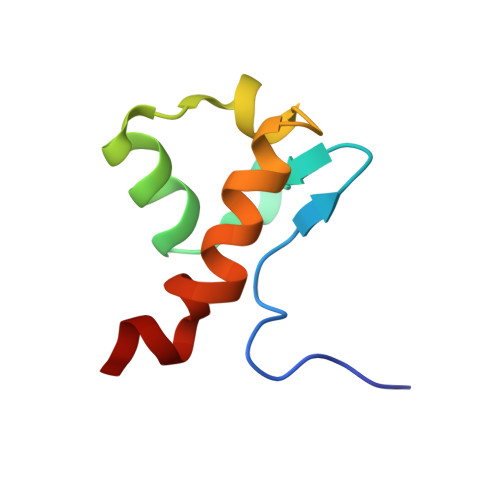
MoleculeChains  Sequence LengthOrganismDetailsImage
Neural Wiskott-Aldrich syndrome protein65Homo sapiensMutation(s): 0 
Gene Names: WASL
UniProt & NIH Common Fund Data Resources
Find proteins for O00401 (Homo sapiens)
Explore O00401 
Go to UniProtKB:  O00401
PHAROS:  O00401
GTEx:  ENSG00000106299 
Entity Groups
Sequence Clusters30% Identity50% Identity70% Identity90% Identity95% Identity100% Identity
UniProt GroupO00401
Sequence Annotations
Expand
Reference Sequence
Find similar proteins by:|  3D Structure
Entity ID: 2
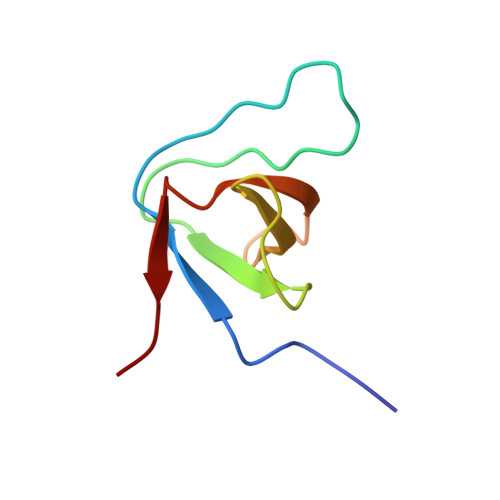
MoleculeChains  Sequence LengthOrganismDetailsImage
Brain-specific angiogenesis inhibitor 1-associated protein 2-like protein 167Homo sapiensMutation(s): 0 
Gene Names: BAIAP2L1IRTKS
UniProt & NIH Common Fund Data Resources
Find proteins for Q9UHR4 (Homo sapiens)
Explore Q9UHR4 
Go to UniProtKB:  Q9UHR4
PHAROS:  Q9UHR4
GTEx:  ENSG00000006453 
Entity Groups
Sequence Clusters30% Identity50% Identity70% Identity90% Identity95% Identity100% Identity
UniProt GroupQ9UHR4
Sequence Annotations
Expand
Reference Sequence
Find similar proteins by:|  3D Structure
Entity ID: 3
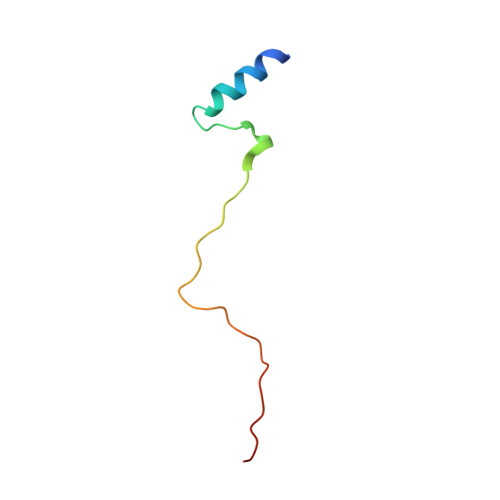
MoleculeChains  Sequence LengthOrganismDetailsImage
Secreted effector protein EspF(U)48Escherichia coli O157:H7Mutation(s): 0 
Gene Names: espF(U)tccP
UniProt
Find proteins for P0DJ89 (Escherichia coli O157:H7)
Explore P0DJ89 
Go to UniProtKB:  P0DJ89
Entity Groups
Sequence Clusters30% Identity50% Identity70% Identity90% Identity95% Identity100% Identity
UniProt GroupP0DJ89
Sequence Annotations
Expand
Reference Sequence

Experimental Data & Validation

Experimental Data

  • Method: SOLUTION NMR
  • Conformers Calculated: 200 
  • Conformers Submitted: 20 
  • Selection Criteria: target function 

Structure Validation

View Full Validation Report


Entry History 

Deposition Data

Revision History  (Full details and data files)

  • Version 1.0: 2012-08-29
    Type: Initial release
  • Version 1.1: 2012-09-12
    Changes: Database references
  • Version 1.2: 2012-10-31
    Changes: Database references
  • Version 1.3: 2024-05-01
    Changes: Data collection, Database references