1ZUN | pdb_00001zun

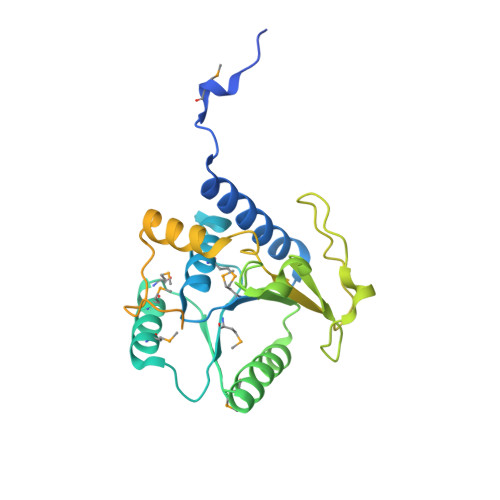
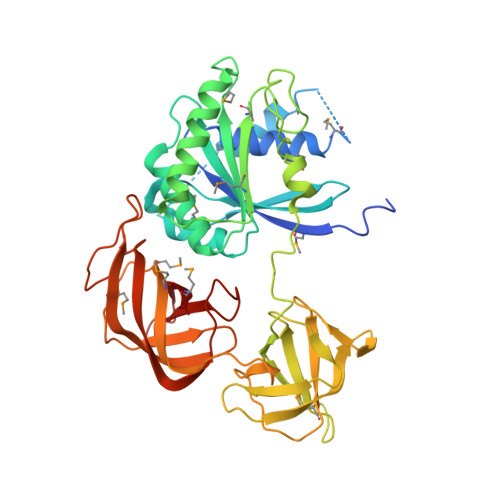
Crystal Structure of a GTP-Regulated ATP Sulfurylase Heterodimer from Pseudomonas syringae


Experimental Data Snapshot

  • Method: X-RAY DIFFRACTION
  • Resolution: 2.70 Å
  • R-Value Free: 
    0.276 (Depositor), 0.298 (DCC) 
  • R-Value Work: 
    0.222 (Depositor), 0.253 (DCC) 
  • R-Value Observed: 
    0.224 (Depositor) 

wwPDB Validation 3D Report Full Report

Validation slider image for 1ZUN

Ligand Structure Quality Assessment 


This is version 1.3 of the entry. See complete history

Literature

Molecular basis for g protein control of the prokaryotic ATP sulfurylase.

Mougous, J.D.Lee, D.H.Hubbard, S.C.Schelle, M.W.Vocadlo, D.J.Berger, J.M.Bertozzi, C.R.

(2006) Mol Cell 21: 109-122

  • DOI: https://doi.org/10.1016/j.molcel.2005.10.034
  • Primary Citation Related Structures: 
    1ZUN

  • PubMed Abstract: 

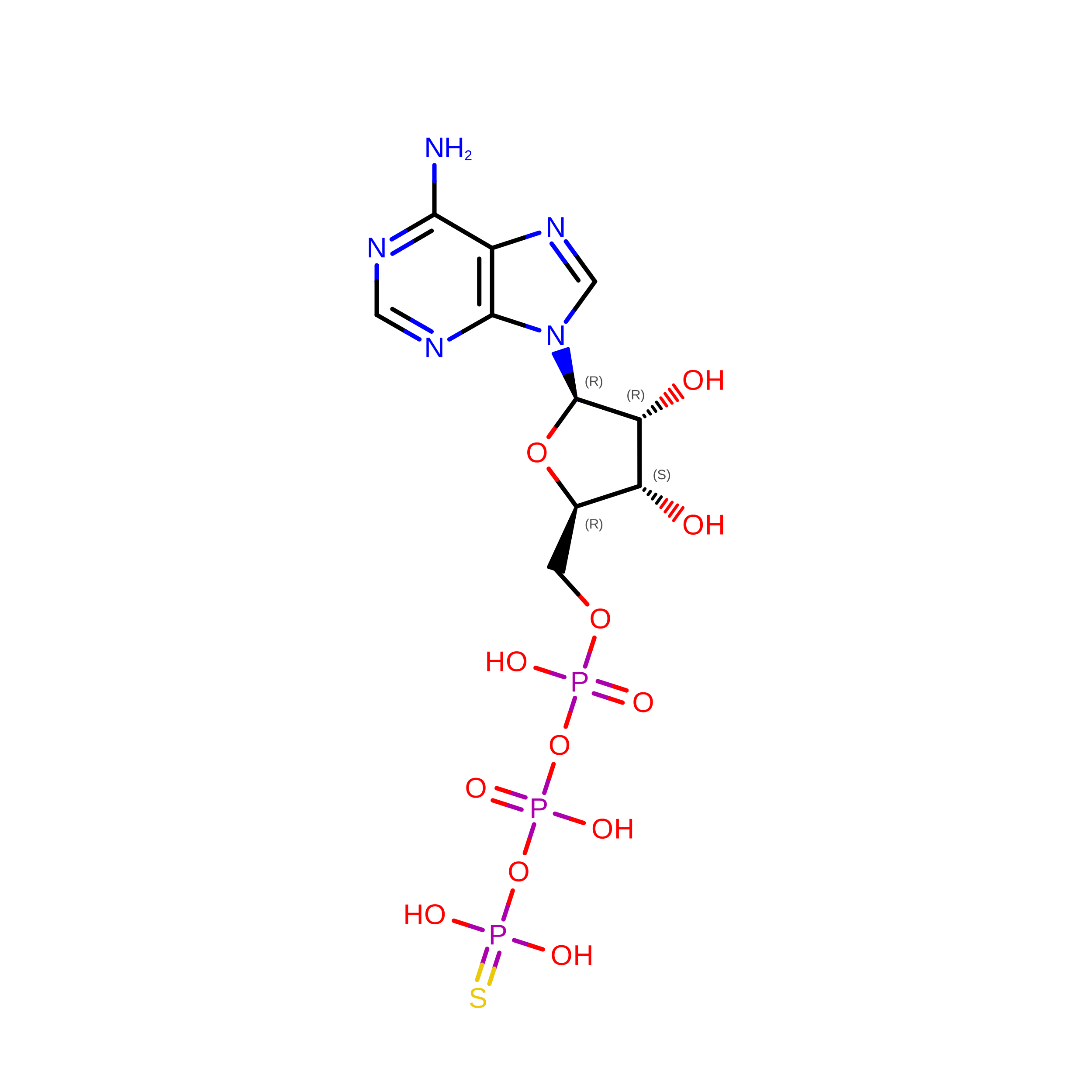
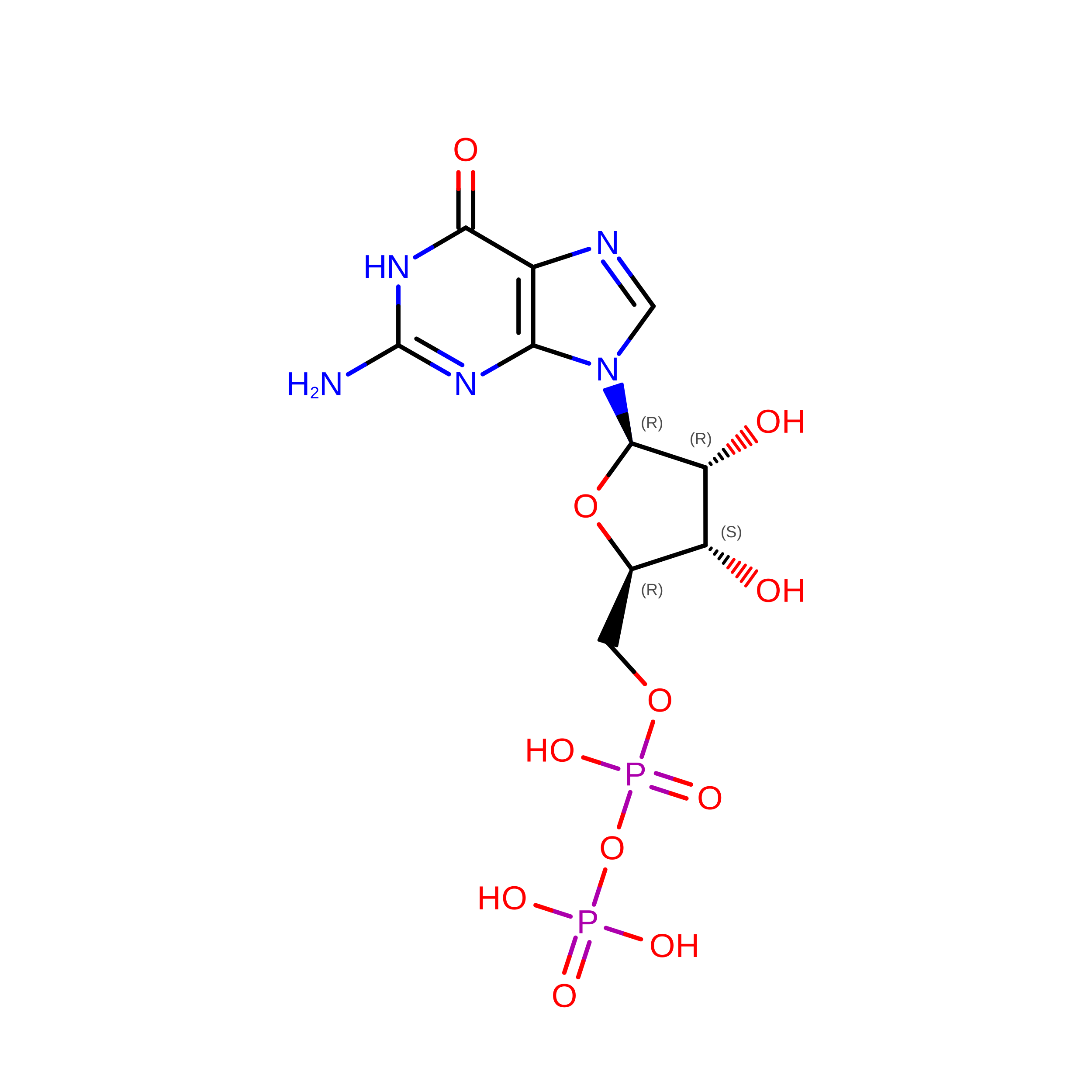
    Sulfate assimilation is a critical component of both primary and secondary metabolism. An essential step in this pathway is the activation of sulfate through adenylation by the enzyme ATP sulfurylase (ATPS), forming adenosine 5'-phosphosulfate (APS). Proteobacterial ATPS overcomes this energetically unfavorable reaction by associating with a regulatory G protein, coupling the energy of GTP hydrolysis to APS formation. To discover the molecular basis of this unusual role for a G protein, we biochemically characterized and solved the X-ray crystal structure of a complex between Pseudomonas syringae ATPS (CysD) and its associated regulatory G protein (CysN). The structure of CysN*D shows the two proteins in tight association; however, the nucleotides bound to each subunit are spatially segregated. We provide evidence that conserved switch motifs in the G domain of CysN allosterically mediate interactions between the nucleotide binding sites. This structure suggests a molecular mechanism by which conserved G domain architecture is used to energetically link GTP turnover to the production of an essential metabolite.


  • Organizational Affiliation
    • Howard Hughes Medical Institute, University of California, Berkeley, Berkeley, California 94720, USA.

Macromolecule Content 

  • Total Structure Weight: 87.23 kDa 
  • Atom Count: 4,836 
  • Modeled Residue Count: 598 
  • Deposited Residue Count: 759 
  • Unique protein chains: 2

Macromolecules

Find similar proteins by:|  3D Structure
Entity ID: 1
MoleculeChains  Sequence LengthOrganismDetailsImage
Sulfate adenylyltransferase subunit 2325Pseudomonas syringaeMutation(s): 8 
Gene Names: cysD
EC: 2.7.7.4
UniProt
Find proteins for Q87WW0 (Pseudomonas syringae pv. tomato (strain ATCC BAA-871 / DC3000))
Explore Q87WW0 
Go to UniProtKB:  Q87WW0
Entity Groups
Sequence Clusters30% Identity50% Identity70% Identity90% Identity95% Identity100% Identity
UniProt GroupQ87WW0
Sequence Annotations
Expand
Reference Sequence
Find similar proteins by:|  3D Structure
Entity ID: 2
MoleculeChains  Sequence LengthOrganismDetailsImage
sulfate adenylate transferase, subunit 1/adenylylsulfate kinase434Pseudomonas syringae pv. tomato str. DC3000Mutation(s): 12 
Gene Names: cysNC
EC: 2.7.7.4
UniProt
Find proteins for Q87WW1 (Pseudomonas syringae pv. tomato (strain ATCC BAA-871 / DC3000))
Explore Q87WW1 
Go to UniProtKB:  Q87WW1
Entity Groups
Sequence Clusters30% Identity50% Identity70% Identity90% Identity95% Identity100% Identity
UniProt GroupQ87WW1
Sequence Annotations
Expand
Reference Sequence

Small Molecules

Experimental Data & Validation

Experimental Data

  • Method: X-RAY DIFFRACTION
  • Resolution: 2.70 Å
  • R-Value Free:  0.276 (Depositor), 0.298 (DCC) 
  • R-Value Work:  0.222 (Depositor), 0.253 (DCC) 
  • R-Value Observed: 0.224 (Depositor) 
Space Group: H 3
Unit Cell:
Length ( Å )Angle ( ˚ )
a = 110.072α = 90
b = 110.072β = 90
c = 171.002γ = 120
Software Package:
Software NamePurpose
REFMACrefinement
HKL-2000data reduction
SCALEPACKdata scaling
SOLVEphasing

Structure Validation

View Full Validation Report


Ligand Structure Quality Assessment 


Entry History 

Deposition Data

Revision History  (Full details and data files)

  • Version 1.0: 2006-01-17
    Type: Initial release
  • Version 1.1: 2008-04-30
    Changes: Version format compliance
  • Version 1.2: 2011-07-13
    Changes: Version format compliance
  • Version 1.3: 2024-11-13
    Changes: Data collection, Database references, Derived calculations, Structure summary