1YM0 | pdb_00001ym0

Crystal Structure of Earthworm Fibrinolytic Enzyme Component B: a Novel, Glycosylated Two-chained Trypsin


Experimental Data Snapshot

  • Method: X-RAY DIFFRACTION
  • Resolution: 2.06 Å
  • R-Value Free: 
    0.192 (Depositor), 0.189 (DCC) 
  • R-Value Work: 
    0.181 (Depositor), 0.177 (DCC) 
  • R-Value Observed: 
    0.181 (Depositor) 

Starting Model: experimental
View more details

wwPDB Validation 3D Report Full Report

Validation slider image for 1YM0

This is version 3.2 of the entry. See complete history

Literature

Crystal structure of earthworm fibrinolytic enzyme component B: a novel, glycosylated two-chained trypsin.

Wang, F.Wang, C.Li, M.Zhang, J.P.Gui, L.L.An, X.M.Chang, W.R.

(2005) J Mol Biology 348: 671-685

  • DOI: https://doi.org/10.1016/j.jmb.2005.02.055
  • Primary Citation Related Structures: 
    1YM0

  • PubMed Abstract: 

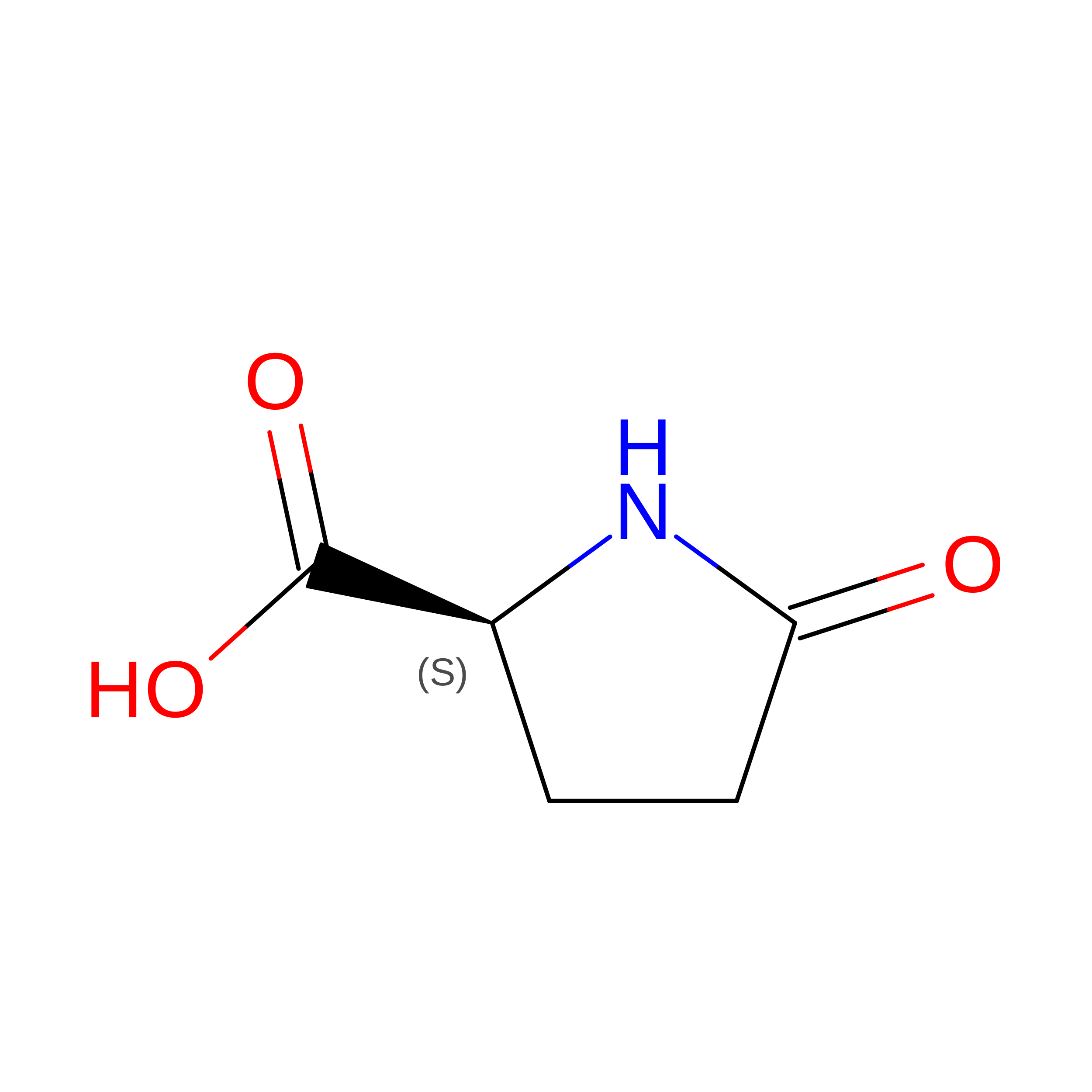
    The earthworm fibrinolytic enzyme (EFE), belonging to a group of serine proteases with strong fibrinolytic activity, has been used in a mixture as an oral drug for prevention and treatment of thrombosis in East Asia. The EFE component b (EFE-b) is one of seven EFE components from Eisenia fetida, and among them it has nearly the highest fibrinolytic activity. Here, we report its crystal structure at a resolution of 2.06A. The structural analysis shows that EFE-b should be classified as a trypsin from earthworm. However, it is distinct from other trypsins. It is a two-chained protease with an N-terminal, pyroglutamated light chain and an N-glycosylated heavy chain. Furthermore, the heavy chain contains a novel structural motif, an eight-membered ring resulting from a disulfide bridge between two neighboring cysteine residues, and a cis peptide bond exists between these two cysteine residues. The crystal structure of EFE-b provides the structural basis for its high level of stability and reveals its complicated post-translational modifications in earthworm. This structure is the first reported for a glycosylated two-chained trypsin, which may provide useful clues to explain the origin and evolution of the chymotrypsin family.


  • Organizational Affiliation
    • National Laboratory of Biomacromolecules, Institute of Biophysics, Chinese Academy of Sciences, Beijing 100101, P. R. China.

Macromolecule Content 

  • Total Structure Weight: 29.46 kDa 
  • Atom Count: 2,307 
  • Modeled Residue Count: 265 
  • Deposited Residue Count: 265 
  • Unique protein chains: 2

Macromolecules

Find similar proteins by:|  3D Structure
Entity ID: 1
MoleculeChains  Sequence LengthOrganismDetailsImage
fibrinotic enzyme component B238Eisenia fetidaMutation(s): 0 
EC: 3.4.21
UniProt
Find proteins for Q3HR18 (Eisenia fetida)
Explore Q3HR18 
Go to UniProtKB:  Q3HR18
Entity Groups
Sequence Clusters30% Identity50% Identity70% Identity90% Identity95% Identity100% Identity
UniProt GroupQ3HR18
Glycosylation
Glycosylation Sites: 1
Sequence Annotations
Expand
Reference Sequence
Find similar proteins by:|  3D Structure
Entity ID: 2
MoleculeChains  Sequence LengthOrganismDetailsImage
fibrinotic enzyme component B27Eisenia fetidaMutation(s): 0 
EC: 3.4.21

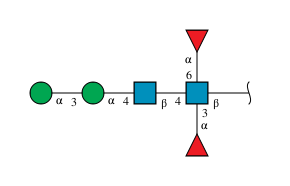
Oligosaccharides

Help  
Entity ID: 3
MoleculeChains Length2D Diagram GlycosylationD Interactions
alpha-D-mannopyranose-(1-3)-alpha-D-mannopyranose-(1-4)-2-acetamido-2-deoxy-beta-D-glucopyranose-(1-4)-[alpha-L-fucopyranose-(1-3)][alpha-L-fucopyranose-(1-6)]2-acetamido-2-deoxy-beta-D-glucopyranose
C
6N-Glycosylation
Glycosylation Resources
GlyTouCan: G51784HB
GlyCosmos: G51784HB
GlyGen: G51784HB

Experimental Data & Validation

Experimental Data

  • Method: X-RAY DIFFRACTION
  • Resolution: 2.06 Å
  • R-Value Free:  0.192 (Depositor), 0.189 (DCC) 
  • R-Value Work:  0.181 (Depositor), 0.177 (DCC) 
  • R-Value Observed: 0.181 (Depositor) 
Space Group: P 63 2 2
Unit Cell:
Length ( Å )Angle ( ˚ )
a = 96.353α = 90
b = 96.353β = 90
c = 150.809γ = 120
Software Package:
Software NamePurpose
DENZOdata reduction
SCALEPACKdata scaling
MOLREPphasing
CNSrefinement

Structure Validation

View Full Validation Report


Entry History 

Deposition Data

Revision History  (Full details and data files)

  • Version 1.0: 2005-04-19
    Type: Initial release
  • Version 1.1: 2008-04-30
    Changes: Version format compliance
  • Version 1.2: 2011-07-13
    Changes: Non-polymer description, Version format compliance
  • Version 2.0: 2019-12-25
    Changes: Data collection, Derived calculations, Polymer sequence
  • Version 3.0: 2020-07-29
    Type: Remediation
    Reason: Carbohydrate remediation
    Changes: Advisory, Atomic model, Data collection, Derived calculations, Structure summary
  • Version 3.1: 2023-10-25
    Changes: Data collection, Database references, Derived calculations, Refinement description, Structure summary
  • Version 3.2: 2024-10-16
    Changes: Structure summary