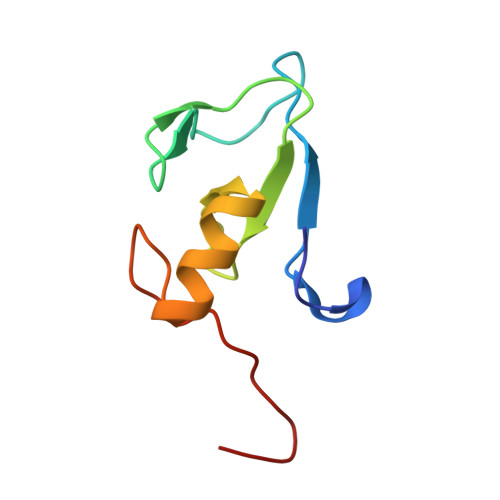
9Q88 | pdb_00009q88

High-resolution structure of RNF38 RING domain


Experimental Data Snapshot

  • Method: X-RAY DIFFRACTION
  • Resolution: 1.20 Å
  • R-Value Free: 
    0.168 (Depositor), 0.161 (DCC) 
  • R-Value Work: 
    0.151 (Depositor) 
  • R-Value Observed: 
    0.152 (Depositor) 

Starting Model: experimental
View more details

wwPDB Validation 3D Report Full Report

Validation slider image for 9Q88

This is version 1.1 of the entry. See complete history

Literature

Tuning ubiquitin transfer by RING E3 ubiquitin ligases through the linchpin residue.

Nakasone, M.A.Buetow, L.Gabrielsen, M.Ahmed, S.F.Majorek, K.A.Sibbet, G.J.Smith, B.O.Huang, D.T.

(2025) Life Sci Alliance 8

  • DOI: https://doi.org/10.26508/lsa.202503394
  • Primary Citation Related Structures: 
    9Q88, 9Q8Y

  • PubMed Abstract: 

    RING family ubiquitin ligases (E3s) employ the RING domain to recruit the E2 thioester ubiquitin (E2∼Ub) intermediate to catalyze the transfer of ubiquitin (Ub) to substrates. A cationic Arg linchpin (LP) residue in the RING domain plays a key role in stabilizing the interface with E2∼Ub, but the identity of the LP residue varies across E3s. Here, we investigate how the LP residue contributes to ubiquitination. Using the model RNF38 system, we demonstrate that substitution of LP Arg to the other 19 available amino acids modulates ubiquitination, ranging from minor reduction to complete abolition. The identity of the LP residue influences E2∼Ub binding but does not correlate with E3 activity. NMR and X-ray crystallography analyses reveal that RNF38 LP Arg variants stabilize E2∼Ub in a catalytically competent conformation to varying degrees. By altering the LP residue in XIAP, we show that the XIAP Y485R variant promotes E2∼Ub stabilization and enhances substrate ubiquitination in cells. Our work demonstrates the importance of the LP residue in modulating E2∼Ub conformation to control ubiquitination.


  • Organizational Affiliation
    • Cancer Research UK Scotland Institute, Glasgow, UK mark.nakasone@glasgow.ac.uk.

Macromolecule Content 

  • Total Structure Weight: 9.27 kDa 
  • Atom Count: 741 
  • Modeled Residue Count: 79 
  • Deposited Residue Count: 79 
  • Unique protein chains: 1

Macromolecules

Find similar proteins by:|  3D Structure
Entity ID: 1
MoleculeChains  Sequence LengthOrganismDetailsImage
E3 ubiquitin-protein ligase RNF3879Homo sapiensMutation(s): 0 
Gene Names: RNF38
EC: 2.3.2.27
UniProt & NIH Common Fund Data Resources
Find proteins for Q9H0F5 (Homo sapiens)
Explore Q9H0F5 
Go to UniProtKB:  Q9H0F5
PHAROS:  Q9H0F5
GTEx:  ENSG00000137075 
Entity Groups
Sequence Clusters30% Identity50% Identity70% Identity90% Identity95% Identity100% Identity
UniProt GroupQ9H0F5
Sequence Annotations
Expand
Reference Sequence

Experimental Data & Validation

Experimental Data

  • Method: X-RAY DIFFRACTION
  • Resolution: 1.20 Å
  • R-Value Free:  0.168 (Depositor), 0.161 (DCC) 
  • R-Value Work:  0.151 (Depositor) 
  • R-Value Observed: 0.152 (Depositor) 
Space Group: P 21 21 21
Unit Cell:
Length ( Å )Angle ( ˚ )
a = 31.82α = 90
b = 39.309β = 90
c = 53.208γ = 90
Software Package:
Software NamePurpose
PHENIXrefinement
PHENIXrefinement
xia2data reduction
Aimlessdata scaling
PHENIXphasing

Structure Validation

View Full Validation Report


Entry History 

& Funding Information

Deposition Data


Funding OrganizationLocationGrant Number
Cancer Research UKUnited Kingdom--

Revision History  (Full details and data files)

  • Version 1.0: 2025-07-30
    Type: Initial release
  • Version 1.1: 2025-08-20
    Changes: Database references