Download Mendeley
Tuning ubiquitin transfer by RING E3 ubiquitin ligases through the linchpin residue.
Nakasone, M.A., Buetow, L., Gabrielsen, M., Ahmed, S.F., Majorek, K.A., Sibbet, G.J., Smith, B.O., Huang, D.T.(2025) Life Sci Alliance 8
- PubMed: 40763985 Search on PubMedSearch on PubMed Central
- DOI: https://doi.org/10.26508/lsa.202503394
- Primary Citation Related Structures:
9Q88, 9Q8Y - PubMed Abstract:
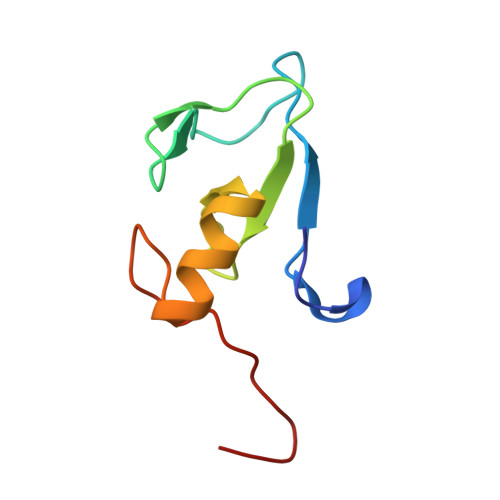
RING family ubiquitin ligases (E3s) employ the RING domain to recruit the E2 thioester ubiquitin (E2∼Ub) intermediate to catalyze the transfer of ubiquitin (Ub) to substrates. A cationic Arg linchpin (LP) residue in the RING domain plays a key role in stabilizing the interface with E2∼Ub, but the identity of the LP residue varies across E3s. Here, we investigate how the LP residue contributes to ubiquitination. Using the model RNF38 system, we demonstrate that substitution of LP Arg to the other 19 available amino acids modulates ubiquitination, ranging from minor reduction to complete abolition. The identity of the LP residue influences E2∼Ub binding but does not correlate with E3 activity. NMR and X-ray crystallography analyses reveal that RNF38 LP Arg variants stabilize E2∼Ub in a catalytically competent conformation to varying degrees. By altering the LP residue in XIAP, we show that the XIAP Y485R variant promotes E2∼Ub stabilization and enhances substrate ubiquitination in cells. Our work demonstrates the importance of the LP residue in modulating E2∼Ub conformation to control ubiquitination.
- Cancer Research UK Scotland Institute, Glasgow, UK mark.nakasone@glasgow.ac.uk.
Organizational Affiliation: