9EWL | pdb_00009ewl

The sTeLIC pentameric Ligand-Gated Ion Channel (wild-type) in complex with 4-bromoamphetamine


Experimental Data Snapshot

  • Method: X-RAY DIFFRACTION
  • Resolution: 3.20 Å
  • R-Value Free: 
    0.260 (Depositor), 0.261 (DCC) 
  • R-Value Work: 
    0.215 (Depositor), 0.223 (DCC) 

Starting Model: experimental
View more details

wwPDB Validation   3D Report Full Report


Ligand Structure Quality Assessment 


This is version 1.1 of the entry. See complete history


Literature

Vestibular modulation by stimulant derivatives in a pentameric ligand-gated ion channel.

Karlsson, E.Anden, O.Fan, C.Fourati, Z.Haouz, A.Zhuang, Y.Howard, R.J.Delarue, M.Lindahl, E.

(2025) Br J Pharmacol 182: 2790-2802

  • DOI: https://doi.org/10.1111/bph.70011
  • Primary Citation of Related Structures:  
    9EWA, 9EWL, 9EX4, 9EX6, 9F5N, 9F5O

  • PubMed Abstract: 

    Allosteric modulation of pentameric ligand-gated ion channels (pLGICs) are critical for the action of neurotransmitters and many psychoactive drugs. However, details of their modulatory mechanisms remain unclear, especially beyond the orthosteric neurotransmitter-binding sites. The recently reported prokaryotic symbiont of Tevnia jerichonana ligand-gated ion channel (sTeLIC), a pH-gated homologue of eukaryotic receptors in the pLGIC family, is thought to be modulated by aromatic compounds via a relatively uncharacterised modulatory site in the extracellular vestibule. We have characterised the effects of psychostimulant derivatives on sTeLIC using two-electrode voltage-clamp electrophysiology in the presence and absence of engineered mutations, and determined X-ray and cryo-EM structures of the channel in both closed and open states. We have shown that sTeLIC is sensitive to potentiation by several amphiphilic compounds, which preferentially bind to a vestibular pocket in the contracted open-state extracellular domain. This work provides a detailed structure-function mechanism for allosteric potentiation via a noncanonical ligand site, with potential conservation of the eukaryotic pentameric ligand-gated ion channels.


  • Organizational Affiliation
    • Department of Biochemistry and Biophysics, Science for Life Laboratory, Stockholm University, Solna, Sweden.

Macromolecules
Find similar proteins by:  (by identity cutoff)  |  3D Structure
Entity ID: 1
MoleculeChains Sequence LengthOrganismDetailsImage
Cys-loop ligand-gated ion channelA [auth AAA],
B [auth BBB],
C [auth CCC],
D [auth DDD],
E [auth EEE]
320endosymbiont of Tevnia jerichonana (vent Tica)Mutation(s): 0 
Gene Names: TevJSym_bc00020
UniProt
Find proteins for G2FID1 (endosymbiont of Tevnia jerichonana)
Explore G2FID1 
Go to UniProtKB:  G2FID1
Entity Groups  
Sequence Clusters30% Identity50% Identity70% Identity90% Identity95% Identity100% Identity
UniProt GroupG2FID1
Sequence Annotations
Expand
  • Reference Sequence
Small Molecules
Ligands 2 Unique
IDChains Name / Formula / InChI Key2D Diagram3D Interactions
BNG
Query on BNG

Download Ideal Coordinates CCD File 
F [auth AAA],
J [auth CCC],
K [auth DDD],
L [auth DDD]
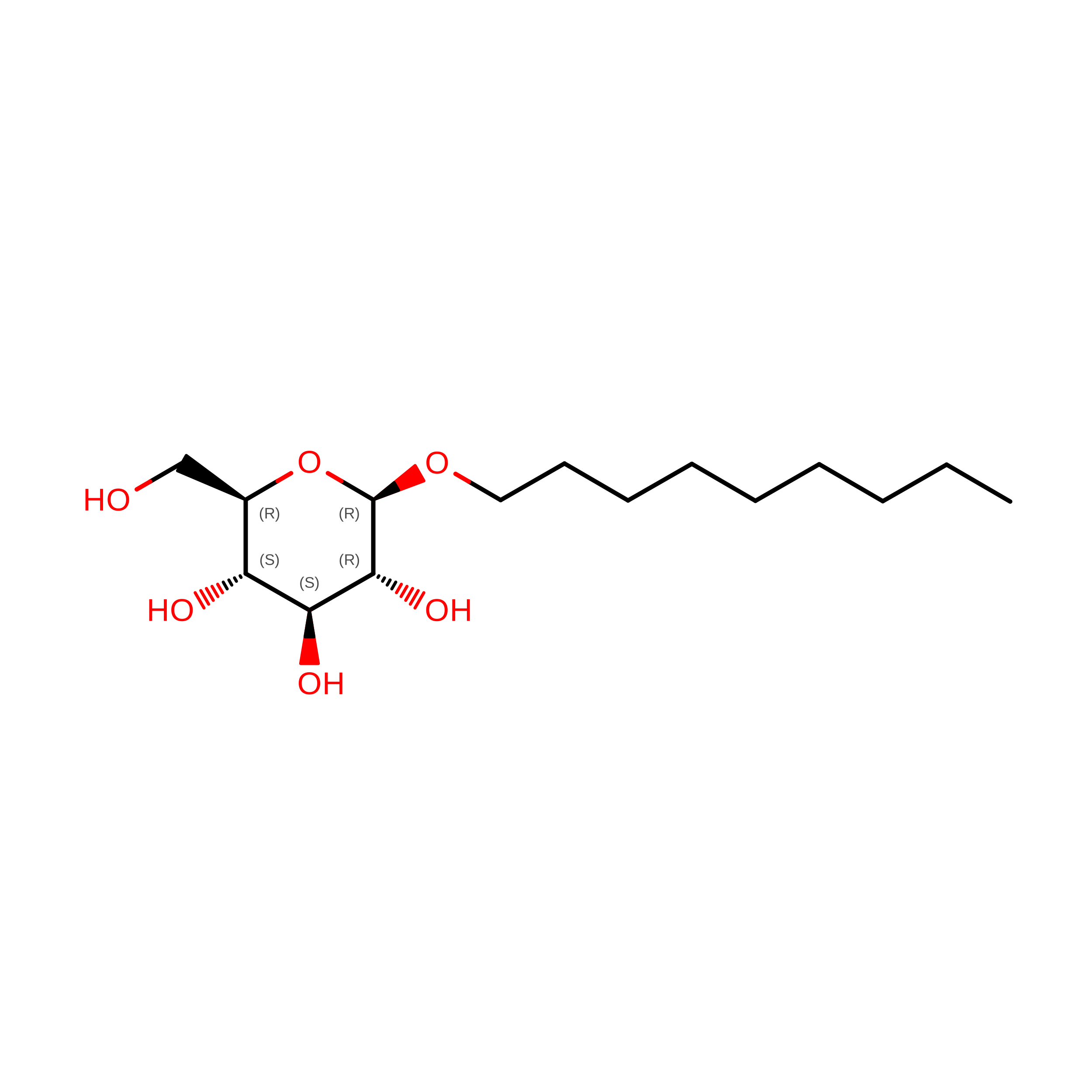
nonyl beta-D-glucopyranoside
C15 H30 O6
QFAPUKLCALRPLH-UXXRCYHCSA-N
A1H7R (Subject of Investigation/LOI)
Query on A1H7R

Download Ideal Coordinates CCD File 
G [auth AAA],
H [auth BBB],
I [auth CCC],
M [auth DDD],
N [auth EEE]
(2S)-1-(4-bromophenyl)propan-2-amine
C9 H12 Br N
SMNXUMMCCOZPPN-UHFFFAOYSA-N
Experimental Data & Validation

Experimental Data

  • Method: X-RAY DIFFRACTION
  • Resolution: 3.20 Å
  • R-Value Free:  0.260 (Depositor), 0.261 (DCC) 
  • R-Value Work:  0.215 (Depositor), 0.223 (DCC) 
Space Group: C 1 2 1
Unit Cell:
Length ( Å )Angle ( ˚ )
a = 218.38α = 90
b = 114.32β = 113.052
c = 142.44γ = 90
Software Package:
Software NamePurpose
REFMACrefinement
XDSdata reduction
Aimlessdata scaling
PHASERphasing

Structure Validation

View Full Validation Report


Ligand Structure Quality Assessment 


Entry History & Funding Information

Deposition Data


Funding OrganizationLocationGrant Number
Agence Nationale de la Recherche (ANR)France--

Revision History  (Full details and data files)

  • Version 1.0: 2025-03-26
    Type: Initial release
  • Version 1.1: 2025-05-28
    Changes: Database references