9EX4 | pdb_00009ex4

CryoEM structure of sTeLIC nanodisc in complex with fluorinated fos-choline-8 in open state


Experimental Data Snapshot

  • Method: ELECTRON MICROSCOPY
  • Resolution: 2.19 Å
  • Aggregation State: PARTICLE 
  • Reconstruction Method: SINGLE PARTICLE 

wwPDB Validation   3D Report Full Report


This is version 1.2 of the entry. See complete history


Literature

Vestibular modulation by stimulant derivatives in a pentameric ligand-gated ion channel.

Karlsson, E.Anden, O.Fan, C.Fourati, Z.Haouz, A.Zhuang, Y.Howard, R.J.Delarue, M.Lindahl, E.

(2025) Br J Pharmacol 182: 2790-2802

  • DOI: https://doi.org/10.1111/bph.70011
  • Primary Citation of Related Structures:  
    9EWA, 9EWL, 9EX4, 9EX6, 9F5N, 9F5O

  • PubMed Abstract: 

    Allosteric modulation of pentameric ligand-gated ion channels (pLGICs) are critical for the action of neurotransmitters and many psychoactive drugs. However, details of their modulatory mechanisms remain unclear, especially beyond the orthosteric neurotransmitter-binding sites. The recently reported prokaryotic symbiont of Tevnia jerichonana ligand-gated ion channel (sTeLIC), a pH-gated homologue of eukaryotic receptors in the pLGIC family, is thought to be modulated by aromatic compounds via a relatively uncharacterised modulatory site in the extracellular vestibule. We have characterised the effects of psychostimulant derivatives on sTeLIC using two-electrode voltage-clamp electrophysiology in the presence and absence of engineered mutations, and determined X-ray and cryo-EM structures of the channel in both closed and open states. We have shown that sTeLIC is sensitive to potentiation by several amphiphilic compounds, which preferentially bind to a vestibular pocket in the contracted open-state extracellular domain. This work provides a detailed structure-function mechanism for allosteric potentiation via a noncanonical ligand site, with potential conservation of the eukaryotic pentameric ligand-gated ion channels.


  • Organizational Affiliation
    • Department of Biochemistry and Biophysics, Science for Life Laboratory, Stockholm University, Solna, Sweden.

Macromolecules
Find similar proteins by:  (by identity cutoff)  |  3D Structure
Entity ID: 1
MoleculeChains Sequence LengthOrganismDetailsImage
Cys-loop ligand-gated ion channel
A, B, C, D, E
320endosymbiont of Tevnia jerichonana (vent Tica)Mutation(s): 0 
Gene Names: TevJSym_bc00020
UniProt
Find proteins for G2FID1 (endosymbiont of Tevnia jerichonana)
Explore G2FID1 
Go to UniProtKB:  G2FID1
Entity Groups  
Sequence Clusters30% Identity50% Identity70% Identity90% Identity95% Identity100% Identity
UniProt GroupG2FID1
Sequence Annotations
Expand
  • Reference Sequence
Small Molecules
Ligands 3 Unique
IDChains Name / Formula / InChI Key2D Diagram3D Interactions
A1H8K (Subject of Investigation/LOI)
Query on A1H8K

Download Ideal Coordinates CCD File 
AA [auth E],
F [auth A],
K [auth B],
P [auth C],
U [auth D]
fluorinated fos-choline-8
C13 H18 F13 N O4 P
PNELEOXACJRMOZ-UHFFFAOYSA-O
EPE
Query on EPE

Download Ideal Coordinates CCD File 
J [auth A],
O [auth B],
T [auth C],
Y [auth D],
Z [auth E]
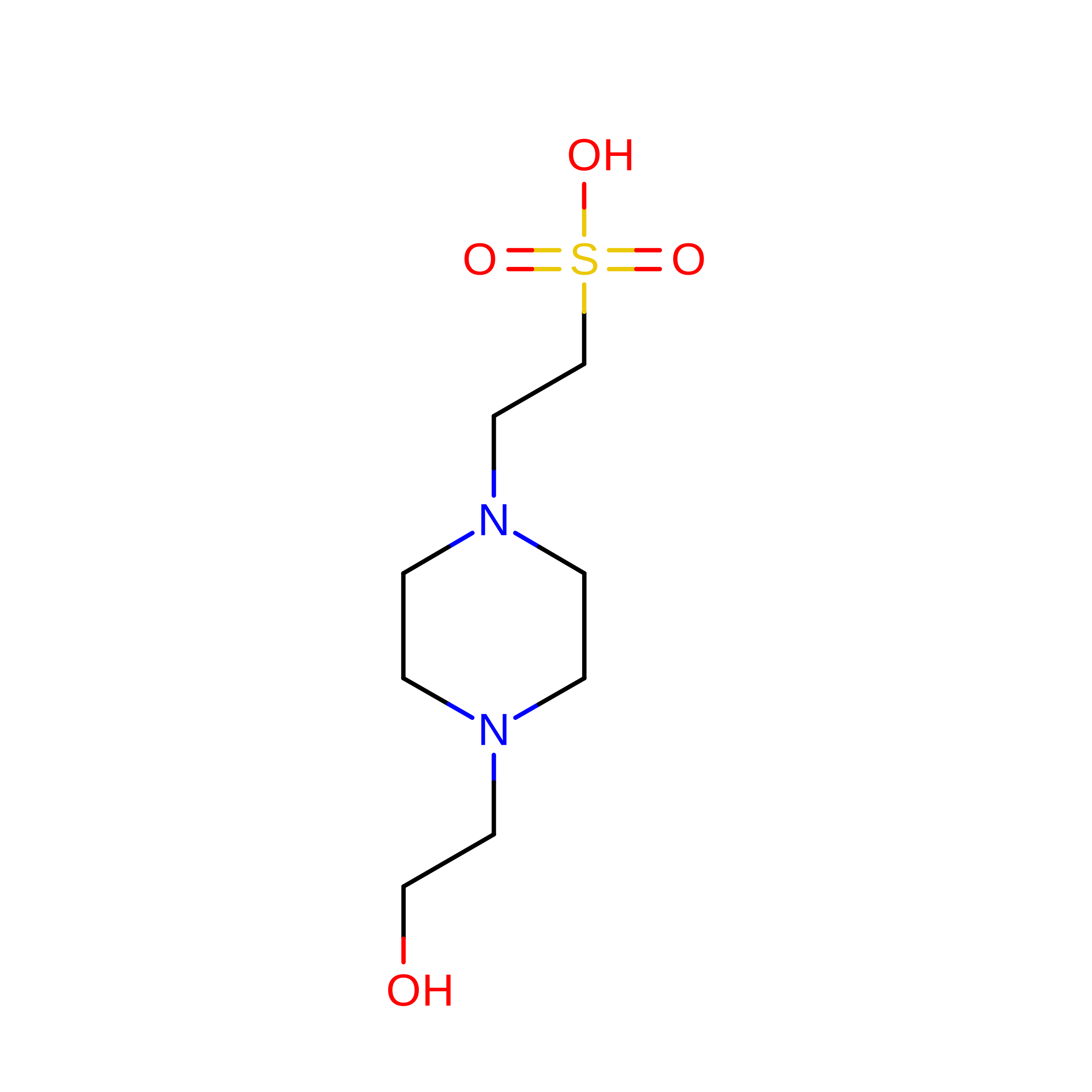
4-(2-HYDROXYETHYL)-1-PIPERAZINE ETHANESULFONIC ACID
C8 H18 N2 O4 S
JKMHFZQWWAIEOD-UHFFFAOYSA-N
HEX
Query on HEX

Download Ideal Coordinates CCD File 
BA [auth E]
CA [auth E]
DA [auth E]
G [auth A]
H [auth A]
BA [auth E],
CA [auth E],
DA [auth E],
G [auth A],
H [auth A],
I [auth A],
L [auth B],
M [auth B],
N [auth B],
Q [auth C],
R [auth C],
S [auth C],
V [auth D],
W [auth D],
X [auth D]
HEXANE
C6 H14
VLKZOEOYAKHREP-UHFFFAOYSA-N
Experimental Data & Validation

Experimental Data

  • Method: ELECTRON MICROSCOPY
  • Resolution: 2.19 Å
  • Aggregation State: PARTICLE 
  • Reconstruction Method: SINGLE PARTICLE 
EM Software:
TaskSoftware PackageVersion
MODEL REFINEMENTPHENIX

Structure Validation

View Full Validation Report


Entry History & Funding Information

Deposition Data


Funding OrganizationLocationGrant Number
Swedish Research Council--

Revision History  (Full details and data files)

  • Version 1.0: 2025-03-26
    Type: Initial release
  • Version 1.1: 2025-05-28
    Changes: Data collection, Database references
  • Version 1.2: 2025-07-09
    Changes: Data collection