9VZI | pdb_00009vzi

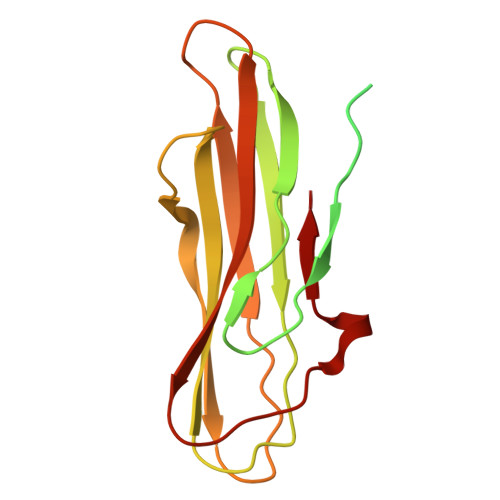
Cyanopodophage Pan3 Needle


Experimental Data Snapshot

  • Method: X-RAY DIFFRACTION
  • Resolution: 2.60 Å
  • R-Value Free: 
    0.220 (Depositor), 0.193 (DCC) 
  • R-Value Work: 
    0.181 (Depositor) 
  • R-Value Observed: 
    0.183 (Depositor) 

wwPDB Validation 3D Report Full Report

Validation slider image for 9VZI

This is version 1.2 of the entry. See complete history

Literature

Cryo-EM structure of cyanopodophage Pan3 reveals a modular tail architecture for host recognition.

Hou, P.Zhu, J.Yu, R.C.Yang, F.Du, K.Li, J.Kong, W.W.Wang, J.Chen, Y.Zhou, C.Z.Jiang, Y.L.

(2026) Structure 34: 220

  • DOI: https://doi.org/10.1016/j.str.2025.11.012
  • Primary Citation Related Structures: 
    9VYE, 9VYF, 9VYG, 9VYH, 9VZI

  • PubMed Abstract: 

    Cyanophages, which are bacteriophages that specifically infect host cyanobacteria, also utilize the tail to initiate host recognition and adsorption. Owing to the limited structural information on cyanophages, our understanding of the mechanism by which cyanophages specifically recognize their hosts remains largely unknown. Here, we determined the intact cryoelectron microscopy structure of a freshwater cyanopodophage Pan3, which consists of an icosahedral shell and a short tail comprising four modular components: the dodecameric adaptor, hexameric nozzle, trimeric needle, and six heterohexameric tailspikes. Notably, each tailspike features an SGNH esterase domain fused to a lectin domain, forming a continuous groove complementary to the host lipopolysaccharide. These findings provide insights into the receptor engagement in Podoviridae, and establish a structural framework for cyanophage and host interactions that may guide future antibacterial interventions against harmful blooms.


  • Organizational Affiliation
    • Hefei National Research Center for Physical Sciences at the Microscale, Division of Life Sciences and Medicine, University of Science and Technology of China, Hefei, China.

Macromolecule Content 

  • Total Structure Weight: 61.82 kDa 
  • Atom Count: 2,778 
  • Modeled Residue Count: 357 
  • Deposited Residue Count: 591 
  • Unique protein chains: 1

Macromolecules

Find similar proteins by:|  3D Structure
Entity ID: 1
MoleculeChains  Sequence LengthOrganismDetailsImage
Needle proteinA [auth B],
B [auth C],
C [auth D]
197Pseudanabaena phage Pan3Mutation(s): 0 
Gene Names: Pan3_08

Small Molecules

Ligands 2 Unique
IDChains Name / Formula / InChI Key2D Diagram3D Interactions
IOD

Query on IOD


Download:Ideal Coordinates CCD File
D [auth B],
G [auth C],
H [auth C],
M [auth D]
IODIDE ION
I
XMBWDFGMSWQBCA-UHFFFAOYSA-M
GOL

Query on GOL


Download:Ideal Coordinates CCD File
E [auth B]
F [auth B]
I [auth C]
J [auth C]
K [auth C]
E [auth B],
F [auth B],
I [auth C],
J [auth C],
K [auth C],
L [auth C]
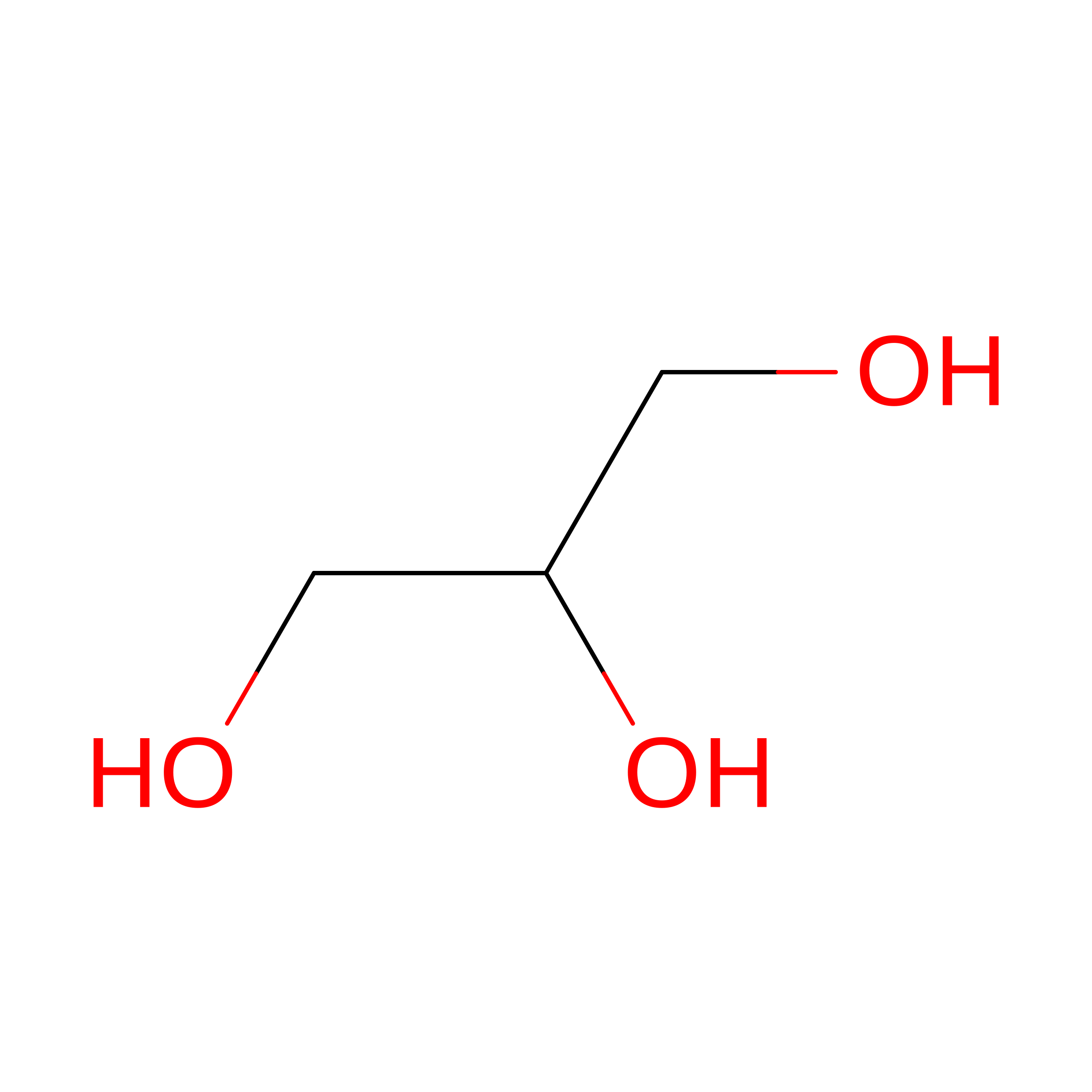
GLYCEROL
C3 H8 O3
PEDCQBHIVMGVHV-UHFFFAOYSA-N

Experimental Data & Validation

Experimental Data

  • Method: X-RAY DIFFRACTION
  • Resolution: 2.60 Å
  • R-Value Free:  0.220 (Depositor), 0.193 (DCC) 
  • R-Value Work:  0.181 (Depositor) 
  • R-Value Observed: 0.183 (Depositor) 
Space Group: P 41 2 2
Unit Cell:
Length ( Å )Angle ( ˚ )
a = 71.403α = 90
b = 71.403β = 90
c = 172.706γ = 90
Software Package:
Software NamePurpose
PHENIXrefinement
REFMACrefinement
CRANK2phasing
Cootmodel building
CrysalisProdata reduction
CrysalisProdata scaling
Aimlessdata scaling
CrysalisProdata collection

Structure Validation

View Full Validation Report


Entry History 

& Funding Information

Deposition Data


Funding OrganizationLocationGrant Number
National Natural Science Foundation of China (NSFC)China32430001
National Natural Science Foundation of China (NSFC)China92451302

Revision History  (Full details and data files)

  • Version 1.0: 2025-11-26
    Type: Initial release
  • Version 1.1: 2026-01-28
    Changes: Database references
  • Version 1.2: 2026-02-25
    Changes: Database references