9VEN | pdb_00009ven

structure of human KCNQ1-CaM-PIP2 complex with bent conformation

  • Classification: MEMBRANE PROTEIN
  • Organism(s): Homo sapiens
  • Expression System: Homo sapiens
  • Mutation(s): No 
  • Membrane Protein: Yes  MemProtMD

  • Deposited: 2025-06-09 Released: 2025-08-20 
  • Deposition Author(s): Cui, C., Kermani, A., Cui, J., Sun, J.
  • Funding Organization(s): National Institutes of Health/National Heart, Lung, and Blood Institute (NIH/NHLBI), United States - Israel Binational Science Foundation (BSF), Swedish Research Council

Experimental Data Snapshot

  • Method: ELECTRON MICROSCOPY
  • Resolution: 3.80 Å
  • Aggregation State: PARTICLE 
  • Reconstruction Method: SINGLE PARTICLE 

wwPDB Validation   3D Report Full Report


This is version 1.1 of the entry. See complete history


Literature

Mechanisms of KCNQ1 gating modulation by KCNE1/3 for cell-specific function.

Cui, C.Zhao, L.Kermani, A.A.Du, S.Pipatpolkai, T.Jiang, M.Chittori, S.Tan, Y.Z.Shi, J.Delemotte, L.Cui, J.Sun, J.

(2025) Cell Res 35: 876-886

  • DOI: https://doi.org/10.1038/s41422-025-01152-1
  • Primary Citation of Related Structures:  
    9VEC, 9VEI, 9VEN, 9VEO, 9WD8

  • PubMed Abstract: 

    KCNQ1 potassium channels are essential for physiological processes such as cardiac rhythm and intestinal chloride secretion. KCNE family subunits (KCNE1-5) associate with KCNQ1, conferring distinct properties across various tissues. KCNQ1 activation requires membrane depolarization and phosphatidylinositol 4,5-bisphosphate (PIP2) whose cellular levels are controlled by Gαq-coupled GPCR activation. While modulation of KCNQ1's voltage-dependent activation by KCNE1/3 is well-characterized, their effects on PIP2-dependent gating of KCNQ1 via GPCR signaling remain less understood. Here we resolved structures of KCNQ1-KCNE1 and reassessed the reported KCNQ1-KCNE3 structures with and without PIP2. We revealed that KCNQ1-KCNE1/3 complexes feature two PIP2-binding sites, with KCNE1/3 contributing to a previously overlooked, uncharacterized site involving residues critical for coupling voltage sensor and pore domains. Via this site, KCNE1 and KCNE3 distinctly modulate the PIP2-dependent gating, in addition to the voltage sensitivity, of KCNQ1. Consequently, KCNE3 converts KCNQ1 into a voltage-insensitive PIP2-gated channel governed by GPCR signaling to maintain ion homeostasis in non-excitable cells. KCNE1, by significantly enhancing KCNQ1's PIP2 affinity and resistance to GPCR regulation, forms predominantly voltage-gated channels with KCNQ1 for conducting the slow-delayed rectifier current in excitable cardiac cells. Our study highlights how KCNE1/3 modulates KCNQ1 gating in different cellular contexts, providing insights into tissue-specifically targeting multi-functional channels.


  • Organizational Affiliation
    • Department of Biological Sciences, National University of Singapore, Singapore, Singapore.

Macromolecules
Find similar proteins by:  (by identity cutoff)  |  3D Structure
Entity ID: 1
MoleculeChains Sequence LengthOrganismDetailsImage
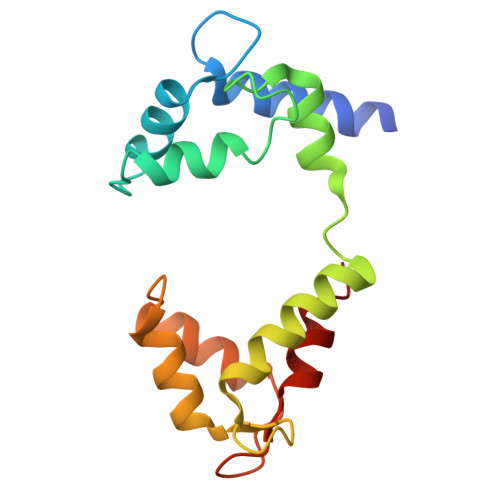
Calmodulin-1A [auth B],
B [auth D],
C [auth F],
D [auth H]
149Homo sapiensMutation(s): 0 
Gene Names: CALM1CALMCAMCAM1
UniProt & NIH Common Fund Data Resources
Find proteins for P0DP23 (Homo sapiens)
Explore P0DP23 
Go to UniProtKB:  P0DP23
PHAROS:  P0DP23
GTEx:  ENSG00000198668 
Entity Groups  
Sequence Clusters30% Identity50% Identity70% Identity90% Identity95% Identity100% Identity
UniProt GroupP0DP23
Sequence Annotations
Expand
  • Reference Sequence
Find similar proteins by:  (by identity cutoff)  |  3D Structure
Entity ID: 2
MoleculeChains Sequence LengthOrganismDetailsImage
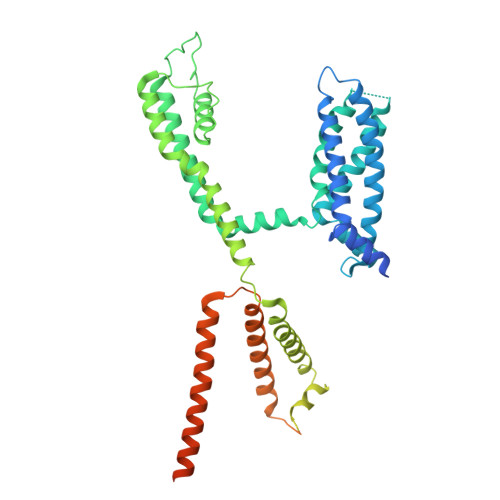
Potassium voltage-gated channel subfamily KQT member 1E [auth A],
F [auth C],
G,
H [auth E]
546Homo sapiensMutation(s): 0 
Gene Names: KCNQ1KCNA8KCNA9KVLQT1
Membrane Entity: Yes 
UniProt & NIH Common Fund Data Resources
Find proteins for P51787 (Homo sapiens)
Explore P51787 
Go to UniProtKB:  P51787
PHAROS:  P51787
GTEx:  ENSG00000053918 
Entity Groups  
Sequence Clusters30% Identity50% Identity70% Identity90% Identity95% Identity100% Identity
UniProt GroupP51787
Sequence Annotations
Expand
  • Reference Sequence
Small Molecules
Ligands 2 Unique
IDChains Name / Formula / InChI Key2D Diagram3D Interactions
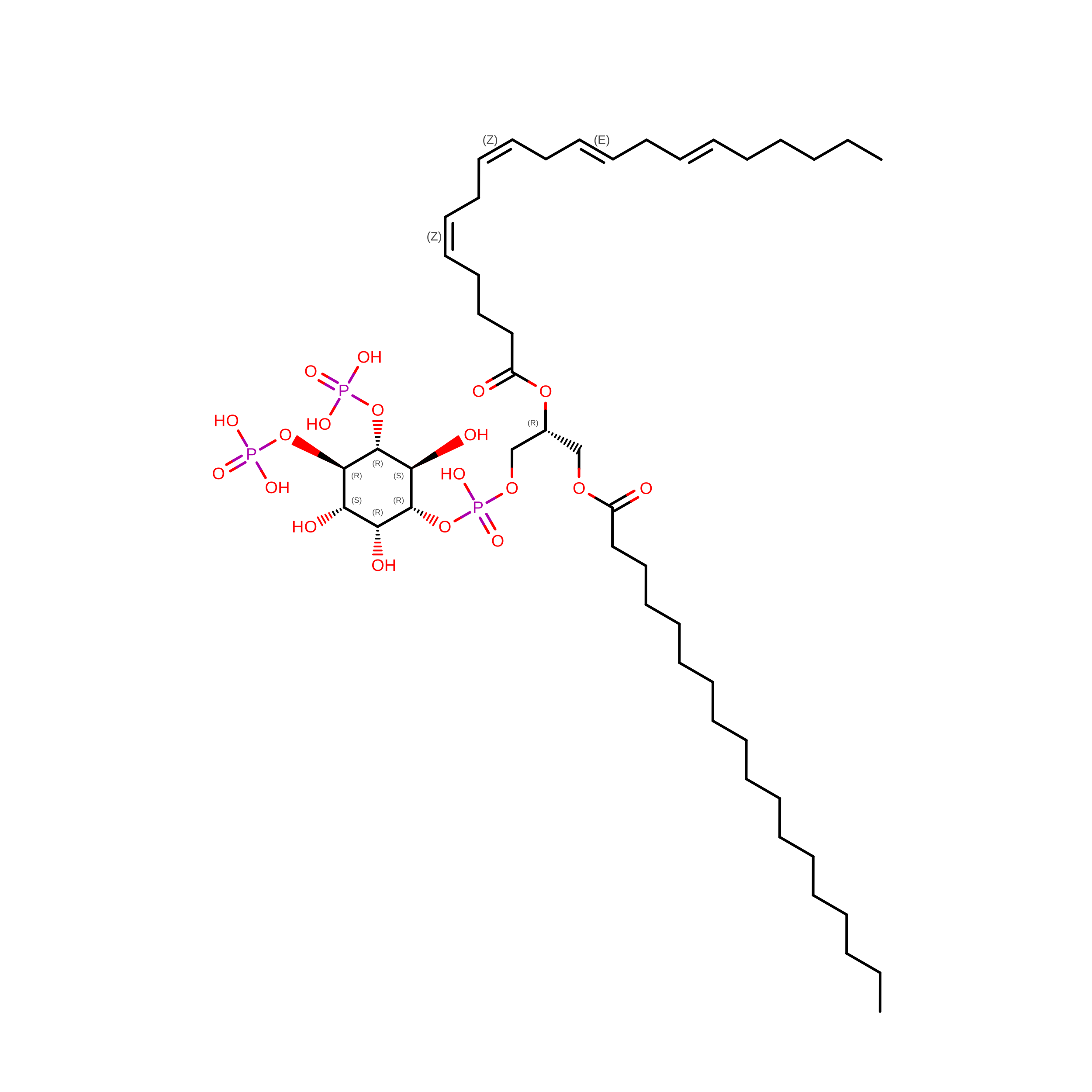
PT5 (Subject of Investigation/LOI)
Query on PT5

Download Ideal Coordinates CCD File 
Q [auth A],
R [auth C],
S [auth G],
T [auth E]
[(2R)-1-octadecanoyloxy-3-[oxidanyl-[(1R,2R,3S,4R,5R,6S)-2,3,6-tris(oxidanyl)-4,5-diphosphonooxy-cyclohexyl]oxy-phospho ryl]oxy-propan-2-yl] (8Z)-icosa-5,8,11,14-tetraenoate
C47 H85 O19 P3
CNWINRVXAYPOMW-HJBQCNPJSA-N
CA (Subject of Investigation/LOI)
Query on CA

Download Ideal Coordinates CCD File 
I [auth B]
J [auth B]
K [auth D]
L [auth D]
M [auth F]
I [auth B],
J [auth B],
K [auth D],
L [auth D],
M [auth F],
N [auth F],
O [auth H],
P [auth H]
CALCIUM ION
Ca
BHPQYMZQTOCNFJ-UHFFFAOYSA-N
Experimental Data & Validation

Experimental Data

  • Method: ELECTRON MICROSCOPY
  • Resolution: 3.80 Å
  • Aggregation State: PARTICLE 
  • Reconstruction Method: SINGLE PARTICLE 
EM Software:
TaskSoftware PackageVersion
RECONSTRUCTIONcryoSPARC
MODEL REFINEMENTPHENIX1.21.2-5419-000

Structure Validation

View Full Validation Report


Entry History & Funding Information

Deposition Data


Funding OrganizationLocationGrant Number
National Institutes of Health/National Heart, Lung, and Blood Institute (NIH/NHLBI)United StatesR00HL143037
United States - Israel Binational Science Foundation (BSF)United States2019159
National Institutes of Health/National Heart, Lung, and Blood Institute (NIH/NHLBI)United StatesR01 HL155398
National Institutes of Health/National Heart, Lung, and Blood Institute (NIH/NHLBI)United StatesR01 HL166628
Swedish Research CouncilSweden2022-04305
Swedish Research CouncilSwedenno. 2022-06725

Revision History  (Full details and data files)

  • Version 1.0: 2025-08-20
    Type: Initial release
  • Version 1.1: 2025-11-19
    Changes: Data collection, Database references