Download Mendeley
Unraveling the Link Between Thermal Adaptation and Latent Allostery in Malate Dehydrogenase From Methanococcales.
Pereira, C.S., Coquille, S., Brochier-Armanet, C., Sterpone, F., Madern, D.(2026) J Mol Biol 438: 169552-169552
- PubMed: 41274549 Search on PubMed
- DOI: https://doi.org/10.1016/j.jmb.2025.169552
- Primary Citation Related Structures:
9S3K, 9S3Y, 9SA7, 9SC9, 9SD3 - PubMed Abstract:
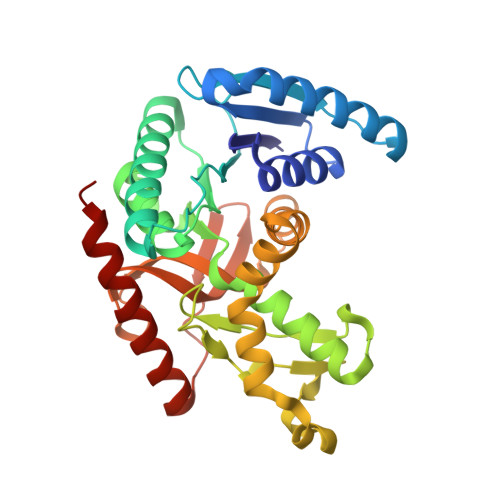
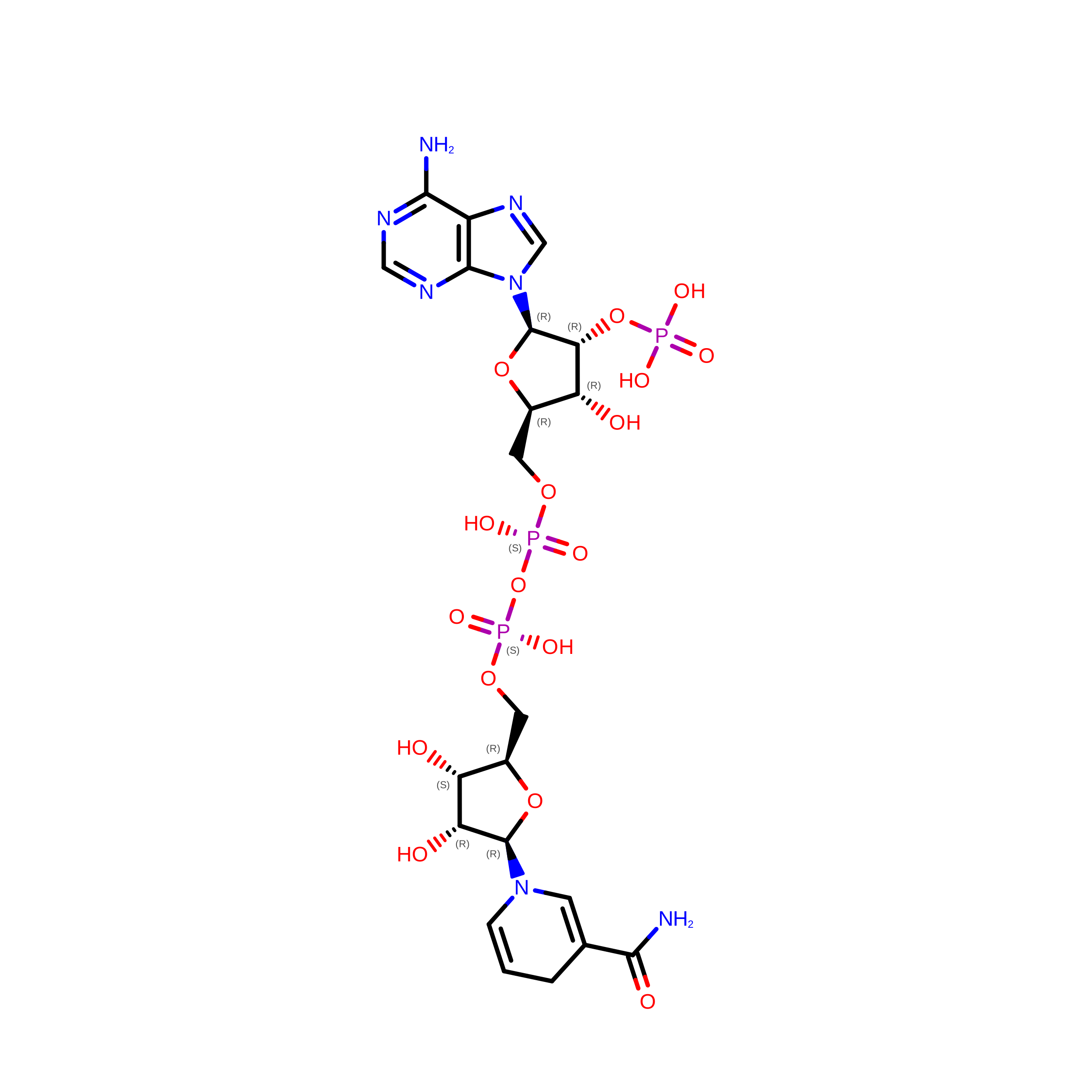
Malate dehydrogenase (MalDH) (EC.1.1.1.37) is an enzyme engaged in the central metabolism of cells, catalyzing the interconversion between oxaloacetate and malate using NADH or NADPH as coenzyme. These enzymes are particularly interesting models for studying how proteins adapt to physical and chemical environmental constraints. In this study, we investigated the molecular mechanisms that have enabled MalDHs to adapt to changes in temperature, using Methanococcales archaea as a model organism. We solved the crystal structure of ancestral MalDHs in these archaea. Structural comparison with present-day MalDHs such as those from Methanocaldococcus infernus (M. inf) and Methanocaldococcus jannaschii (M. jan), highlights the role salt-bridges in thermal adaptation. We also found that present-day MalDHs from M. inf and M. jan, show structural features that resemble the extended or compact states typical of allosteric lactate dehydrogenases. To test hypotheses about a possible link between thermal adaptation and the emergence of allosteric regulation, we characterized structurally two M. jan MalDH mesophilic-like mutants. Molecular dynamics simulations using the Wt M. jan and mutant MalDHs were used to rationalize the experimental data. The results indicate that uncompetent and competent catalytic site configurations are in an equilibrium that depends on temperature conditions. At low temperature the Wt M. jan MalDH select non-competent conformers, whereas high temperature favours active conformers. In contrast, the M. jan MalDH mutants explore competent conformers for catalysis at a lowest temperature, a phenomenon that fits well with their biochemical behaviour. Our work reveals that thermal adaptation and evolution of allostery are strongly linked via the modulation of the protein conformational landscape.
- CNRS, Université de Paris, UPR 9080, Laboratoire de Biochimie Théorique, Paris, France; Institut de Biologie Physico-Chimique-Fondation Edmond de Rothschild, PSL Research University, Paris, France.
Organizational Affiliation: