9QWZ | pdb_00009qwz

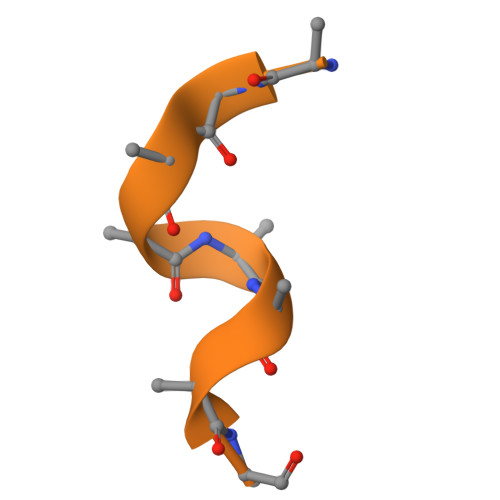
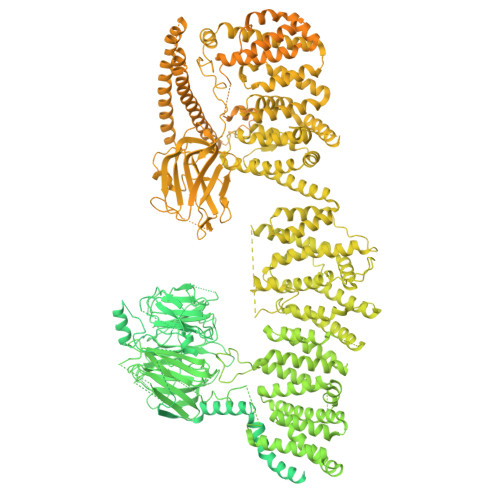
Cryo-EM structure of the human UBR4/KCMF1/CALM1 complex (BP focused refinement)

  • Classification: LIGASE
  • Organism(s): Homo sapiens
  • Expression System: Trichoplusia ni
  • Mutation(s): No 

  • Deposited: 2025-04-15 Released: 2025-09-03 
  • Deposition Author(s): Grabarczyk, D.B., Clausen, T.
  • Funding Organization(s): Austrian Research Promotion Agency, H2020 Marie Curie Actions of the European Commission

Experimental Data Snapshot

  • Method: ELECTRON MICROSCOPY
  • Resolution: 4.80 Å
  • Aggregation State: PARTICLE 
  • Reconstruction Method: SINGLE PARTICLE 

wwPDB Validation   3D Report Full Report


This is version 1.3 of the entry. See complete history


Literature

Architecture of the UBR4 complex, a giant E4 ligase central to eukaryotic protein quality control.

Grabarczyk, D.B.Ehrmann, J.F.Murphy, P.Yang, W.S.Kurzbauer, R.Bell, L.E.Deszcz, L.Neuhold, J.Schleiffer, A.Shulkina, A.Lee, J.Shin, J.S.Meinhart, A.Versteeg, G.A.Zavodszky, E.Song, H.K.Hegde, R.S.Clausen, T.

(2025) Science 389: 909-914

  • DOI: https://doi.org/10.1126/science.adv9309
  • Primary Citation of Related Structures:  
    9JNI, 9LGS, 9QT9, 9QWS, 9QWU, 9QWX, 9QWZ, 9QX0, 9QX1, 9QX2, 9QX5, 9UPZ

  • PubMed Abstract: 

    Eukaryotic cells have evolved sophisticated quality control mechanisms to eliminate aggregation-prone proteins that compromise cellular health. Central to this defense is the ubiquitin-proteasome system, where UBR4 acts as an essential E4 ubiquitin ligase, amplifying degradation marks on defective proteins. Cryo-electron microscopy analysis of UBR4 in complex with its cofactors KCMF1 and CALM1 reveals a massive 1.3-megadalton ring structure, featuring a central substrate-binding arena and flexibly attached catalytic units. Our structure shows how UBR4 binds substrate and extends lysine-48-specific ubiquitin chains. Efficient substrate targeting depends on both preubiquitination and specific N-degrons, with KCMF1 acting as a key substrate filter. The architecture of the E4 megacomplex is conserved across eukaryotes, but species-specific adaptations allow UBR4 to perform its precisely tuned quality control function in diverse cellular environments.


  • Organizational Affiliation
    • Research Institute of Molecular Pathology, Vienna BioCenter (VBC), Vienna, Austria.

Macromolecules
Find similar proteins by:  (by identity cutoff)  |  3D Structure
Entity ID: 1
MoleculeChains Sequence LengthOrganismDetailsImage
E3 ubiquitin-protein ligase KCMF1A [auth D]391Homo sapiensMutation(s): 0 
Gene Names: KCMF1FIGCZZZ1
EC: 2.3.2.27
UniProt & NIH Common Fund Data Resources
Find proteins for Q9P0J7 (Homo sapiens)
Explore Q9P0J7 
Go to UniProtKB:  Q9P0J7
PHAROS:  Q9P0J7
GTEx:  ENSG00000176407 
Entity Groups  
Sequence Clusters30% Identity50% Identity70% Identity90% Identity95% Identity100% Identity
UniProt GroupQ9P0J7
Sequence Annotations
Expand
  • Reference Sequence
Find similar proteins by:  (by identity cutoff)  |  3D Structure
Entity ID: 2
MoleculeChains Sequence LengthOrganismDetailsImage
E3 ubiquitin-protein ligase UBR45,193Homo sapiensMutation(s): 0 
Gene Names: UBR4KIAA0462KIAA1307RBAF600
EC: 2.3.2.27
UniProt & NIH Common Fund Data Resources
Find proteins for Q5T4S7 (Homo sapiens)
Explore Q5T4S7 
Go to UniProtKB:  Q5T4S7
PHAROS:  Q5T4S7
GTEx:  ENSG00000127481 
Entity Groups  
Sequence Clusters30% Identity50% Identity70% Identity90% Identity95% Identity100% Identity
UniProt GroupQ5T4S7
Sequence Annotations
Expand
  • Reference Sequence
Experimental Data & Validation

Experimental Data

  • Method: ELECTRON MICROSCOPY
  • Resolution: 4.80 Å
  • Aggregation State: PARTICLE 
  • Reconstruction Method: SINGLE PARTICLE 
EM Software:
TaskSoftware PackageVersion
MODEL REFINEMENTPHENIX

Structure Validation

View Full Validation Report


Entry History & Funding Information

Deposition Data


Funding OrganizationLocationGrant Number
Austrian Research Promotion AgencyAustria852936
H2020 Marie Curie Actions of the European CommissionEuropean Union847548

Revision History  (Full details and data files)

  • Version 1.0: 2025-09-03
    Type: Initial release
  • Version 1.1: 2025-09-10
    Changes: Data collection, Database references
  • Version 1.2: 2025-09-17
    Changes: Data collection, Database references
  • Version 1.3: 2025-10-22
    Changes: Data collection