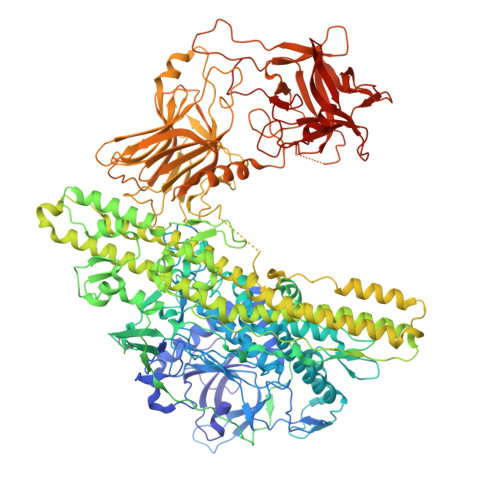
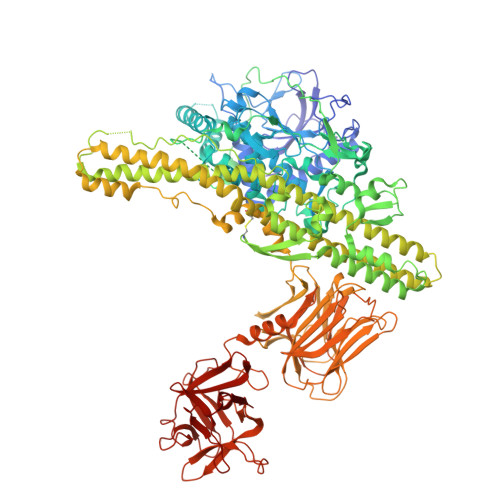
9QC7 | pdb_00009qc7

BoNT-NTNH complex from Clostridium botulinum Serotype B1


Experimental Data Snapshot

  • Method: ELECTRON MICROSCOPY
  • Resolution: 2.67 Å
  • Aggregation State: PARTICLE 
  • Reconstruction Method: SINGLE PARTICLE 

Starting Model: in silico
View more details

wwPDB Validation   3D Report Full Report


This is version 1.0 of the entry. See complete history


Literature

Structure of the complete 14-subunit botulinum neurotoxin B complex reveals a unique anchoring through the narrow central pore of HA70.

Krc, A.Kosenina, S.P.Nowakowska, M.B.Masuyer, G.Stenmark, P.

(2025) Sci Adv 11: eadx5058-eadx5058

  • DOI: https://doi.org/10.1126/sciadv.adx5058
  • Primary Citation of Related Structures:  
    9QC7, 9QC8, 9QCE, 9QCM, 9QCN, 9QCO

  • PubMed Abstract: 

    Botulinum neurotoxin serotype B1 (BoNT/B) is a highly potent neurotoxin and therapeutic agent. Here, we present the structure of the complete 14-subunit (780 kDa) progenitor toxin complex (L-PTC) and of five subcomplexes. The structures show how the toxin interacts with its associated components in their role to protect and deliver BoNT/B across epithelial barriers. Each subcomplex, including the M-PTC, M-PTC-HA70, NTNH-HA70, and HA70 trimer, provides detailed understanding of the assembly mechanism, in which the NTNH-nLoop adopts a unique fold that locks the M-PTC into a central pore formed by HA70. The HA subcomplex presents a tripod architecture with flexible legs that may adapt to the rugged cell surface. Mass photometry reveals the pH dependence of BoNT/B release from the complex which is unexpectedly influenced by the presence of HA70. This study provides the complete L-PTC structure, offering insights into its assemblage and supporting the development of countermeasures and therapeutic applications.


  • Organizational Affiliation
    • Department of Biochemistry and Biophysics, Stockholm University, Stockholm, Sweden.

Macromolecules
Find similar proteins by:  (by identity cutoff)  |  3D Structure
Entity ID: 1
MoleculeChains Sequence LengthOrganismDetailsImage
Botulinum neurotoxin type B1,302Clostridium botulinumMutation(s): 2 
Gene Names: botBCLD_A0068
UniProt
Find proteins for P10844 (Clostridium botulinum)
Explore P10844 
Go to UniProtKB:  P10844
Entity Groups  
Sequence Clusters30% Identity50% Identity70% Identity90% Identity95% Identity100% Identity
UniProt GroupP10844
Sequence Annotations
Expand
  • Reference Sequence
Find similar proteins by:  (by identity cutoff)  |  3D Structure
Entity ID: 2
MoleculeChains Sequence LengthOrganismDetailsImage
Non-toxic non-hemagglutinin component1,197Clostridium botulinumMutation(s): 0 
Gene Names: ntnh
UniProt
Find proteins for Q33CP4 (Clostridium botulinum B)
Explore Q33CP4 
Go to UniProtKB:  Q33CP4
Entity Groups  
Sequence Clusters30% Identity50% Identity70% Identity90% Identity95% Identity100% Identity
UniProt GroupQ33CP4
Sequence Annotations
Expand
  • Reference Sequence
Experimental Data & Validation

Experimental Data

  • Method: ELECTRON MICROSCOPY
  • Resolution: 2.67 Å
  • Aggregation State: PARTICLE 
  • Reconstruction Method: SINGLE PARTICLE 

Structure Validation

View Full Validation Report


Entry History & Funding Information

Deposition Data


Funding OrganizationLocationGrant Number
Swedish Research CouncilSweden2022-03681
Novo Nordisk FoundationDenmarkNNF20OC0064789

Revision History  (Full details and data files)

  • Version 1.0: 2025-09-10
    Type: Initial release