9QBP | pdb_00009qbp

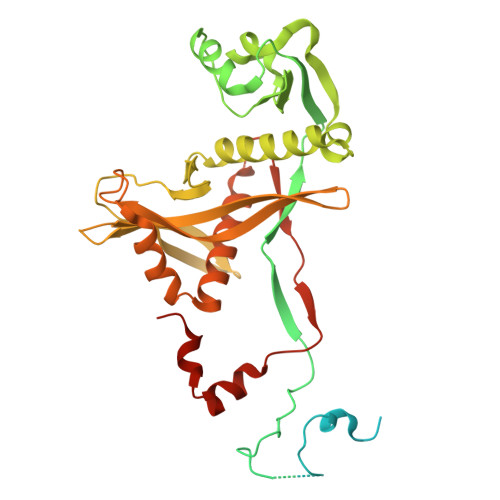
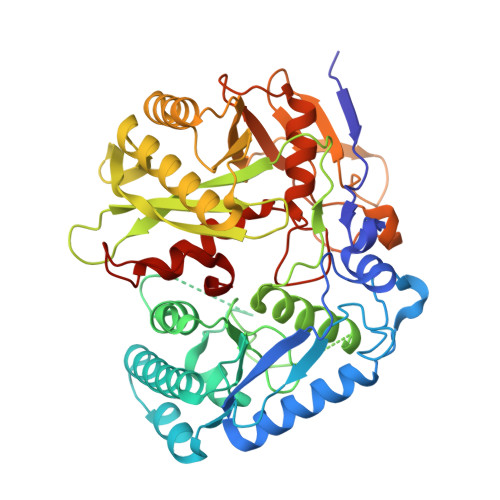
Crystal structure of Enhydrobacter aerosaccus apo SPARDA complex


Experimental Data Snapshot

  • Method: X-RAY DIFFRACTION
  • Resolution: 2.45 Å
  • R-Value Free: 
    0.248 (Depositor), 0.253 (DCC) 
  • R-Value Work: 
    0.205 (Depositor), 0.211 (DCC) 
  • R-Value Observed: 
    0.209 (Depositor) 

Starting Model: experimental
View more details

wwPDB Validation   3D Report Full Report


This is version 1.1 of the entry. See complete history


Literature

Activation of the SPARDA defense system by filament assembly using a beta-relay signaling mechanism widespread in prokaryotic Argonautes.

Jurgelaitis, E.Zagorskaite, E.Kopustas, A.Asmontas, S.Manakova, E.Dalgediene, I.Tylenyte, U.Silanskas, A.Toliusis, P.Grybauskas, A.Tutkus, M.Venclovas, C.Zaremba, M.

(2025) Cell Res 35: 1056-1078

  • DOI: https://doi.org/10.1038/s41422-025-01198-1
  • Primary Citation of Related Structures:  
    9QBL, 9QBP, 9QBQ, 9QCC

  • PubMed Abstract: 

    Present in all three domains of life, Argonaute proteins use short oligonucleotides as guides to recognize complementary nucleic acid targets. In eukaryotes, Argonautes are involved in RNA silencing, whereas in prokaryotes, they function in host defense against invading DNA. Here, we show that SPARDA (short prokaryotic Argonaute, DNase associated) systems from Xanthobacter autotrophicus (Xau) and Enhydrobacter aerosaccus (Eae) function in anti-plasmid defense. Upon activation, SPARDA nonspecifically degrades both invader and genomic DNA, causing host death, thereby preventing further spread of the invader in the population. X-ray structures of the apo Xau and EaeSPARDA complexes show that they are dimers, unlike other apo short pAgo systems, which are monomers. We show that dimerization in the apo state is essential for inhibition of XauSPARDA activity. We demonstrate by cryo-EM that activated XauSPARDA forms a filament. Upon activation, the recognition signal of the bound guide/target duplex is relayed to other functional XauSPARDA sites through a structural region that we termed the "beta-relay". Owing to dramatic conformational changes associated with guide/target binding, XauSPARDA undergoes a "dimer-monomer-filament" transition as the apo dimer dissociates into the guide/target-loaded monomers that subsequently assemble into the filament. Within the activated filament, the DREN nuclease domains form tetramers that are poised to cleave dsDNA. We show that other SPARDAs also form filaments during activation. Furthermore, we identify the presence of the beta-relay in pAgo from all clades, providing new insights into the structural mechanisms of pAgo proteins. Taken together, these findings reveal the detailed structural mechanism of SPARDA and highlight the importance of the beta-relay mechanism in signal transduction in Argonautes.


  • Organizational Affiliation
    • Institute of Biotechnology, Life Sciences Center, Vilnius University, Vilnius, Lithuania.

Macromolecules
Find similar proteins by:  (by identity cutoff)  |  3D Structure
Entity ID: 1
MoleculeChains Sequence LengthOrganismDetailsImage
DUF4365 domain-containing protein
A, C
467Enhydrobacter aerosaccusMutation(s): 0 
Gene Names: SAMN02745126_06076
UniProt
Find proteins for A0A1T4TDU6 (Enhydrobacter aerosaccus)
Explore A0A1T4TDU6 
Go to UniProtKB:  A0A1T4TDU6
Entity Groups  
Sequence Clusters30% Identity50% Identity70% Identity90% Identity95% Identity100% Identity
UniProt GroupA0A1T4TDU6
Sequence Annotations
Expand
  • Reference Sequence
Find similar proteins by:  (by identity cutoff)  |  3D Structure
Entity ID: 2
MoleculeChains Sequence LengthOrganismDetailsImage
Protein argonaute
B, D
484Enhydrobacter aerosaccusMutation(s): 0 
Gene Names: SAMN02745126_06077
UniProt
Find proteins for A0A1T4TEP4 (Enhydrobacter aerosaccus)
Explore A0A1T4TEP4 
Go to UniProtKB:  A0A1T4TEP4
Entity Groups  
Sequence Clusters30% Identity50% Identity70% Identity90% Identity95% Identity100% Identity
UniProt GroupA0A1T4TEP4
Sequence Annotations
Expand
  • Reference Sequence
Small Molecules
Ligands 3 Unique
IDChains Name / Formula / InChI Key2D Diagram3D Interactions
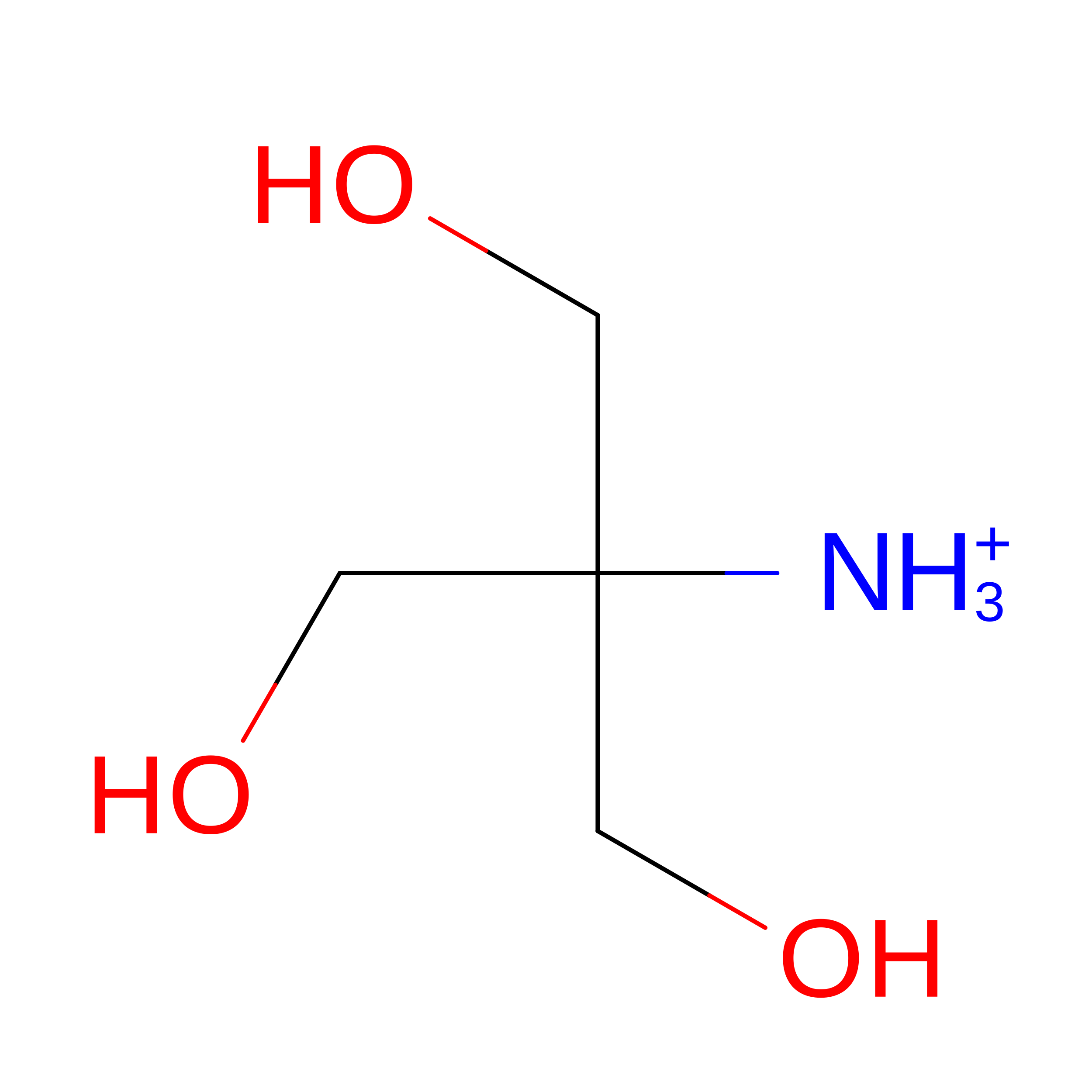
TRS
Query on TRS

Download Ideal Coordinates CCD File 
J [auth B]2-AMINO-2-HYDROXYMETHYL-PROPANE-1,3-DIOL
C4 H12 N O3
LENZDBCJOHFCAS-UHFFFAOYSA-O
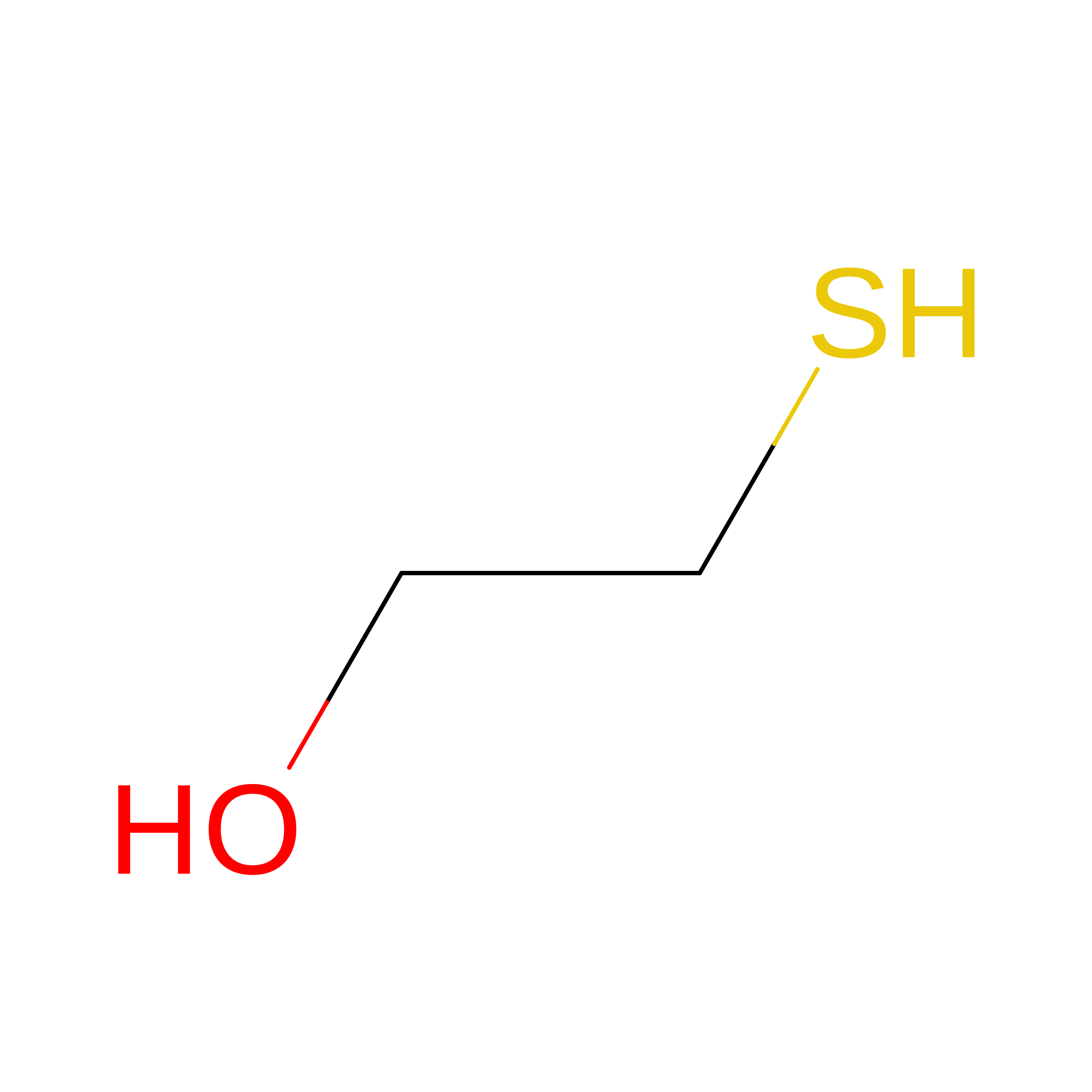
BME
Query on BME

Download Ideal Coordinates CCD File 
M [auth D],
N [auth D],
O [auth D]
BETA-MERCAPTOETHANOL
C2 H6 O S
DGVVWUTYPXICAM-UHFFFAOYSA-N
CL
Query on CL

Download Ideal Coordinates CCD File 
E [auth A]
F [auth A]
G [auth B]
H [auth B]
I [auth B]
E [auth A],
F [auth A],
G [auth B],
H [auth B],
I [auth B],
K [auth C],
L [auth D]
CHLORIDE ION
Cl
VEXZGXHMUGYJMC-UHFFFAOYSA-M
Experimental Data & Validation

Experimental Data

  • Method: X-RAY DIFFRACTION
  • Resolution: 2.45 Å
  • R-Value Free:  0.248 (Depositor), 0.253 (DCC) 
  • R-Value Work:  0.205 (Depositor), 0.211 (DCC) 
  • R-Value Observed: 0.209 (Depositor) 
Space Group: P 21 21 21
Unit Cell:
Length ( Å )Angle ( ˚ )
a = 108.179α = 90
b = 127.241β = 90
c = 191.336γ = 90
Software Package:
Software NamePurpose
PHENIXrefinement
XDSdata reduction
Aimlessdata scaling
MOLREPphasing

Structure Validation

View Full Validation Report


Entry History & Funding Information

Deposition Data


Funding OrganizationLocationGrant Number
iNEXTEuropean UnionH2020 Grant # 653706

Revision History  (Full details and data files)

  • Version 1.0: 2025-12-17
    Type: Initial release
  • Version 1.1: 2025-12-24
    Changes: Database references