9Q1F | pdb_00009q1f

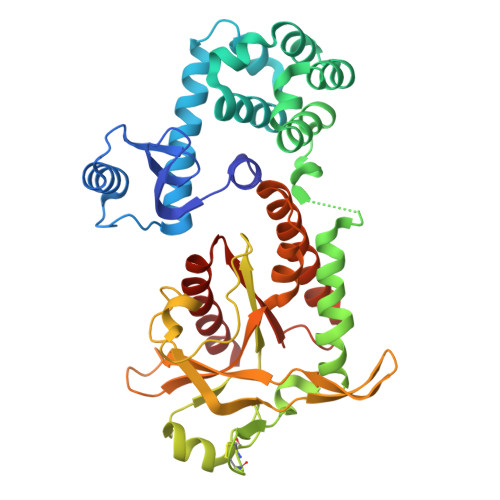
Choanoflagellate Salpingoeca macrocollata STING


Experimental Data Snapshot

  • Method: X-RAY DIFFRACTION
  • Resolution: 2.65 Å
  • R-Value Free: 
    0.275 (Depositor), 0.273 (DCC) 
  • R-Value Work: 
    0.243 (Depositor), 0.244 (DCC) 
  • R-Value Observed: 
    0.246 (Depositor) 

wwPDB Validation   3D Report Full Report


Ligand Structure Quality Assessment 


This is version 1.0 of the entry. See complete history


Literature

A choanoflagellate cGLR-STING pathway reveals evolutionary links between bacterial and animal immunity.

Li, Y.Toyoda, H.C.Fernandez, S.G.Tiwari, B.McNairy, C.Woznica, A.Kranzusch, P.J.

(2025) bioRxiv 

  • DOI: https://doi.org/10.1101/2025.09.04.674280
  • Primary Citation of Related Structures:  
    9Q1F

  • PubMed Abstract: 

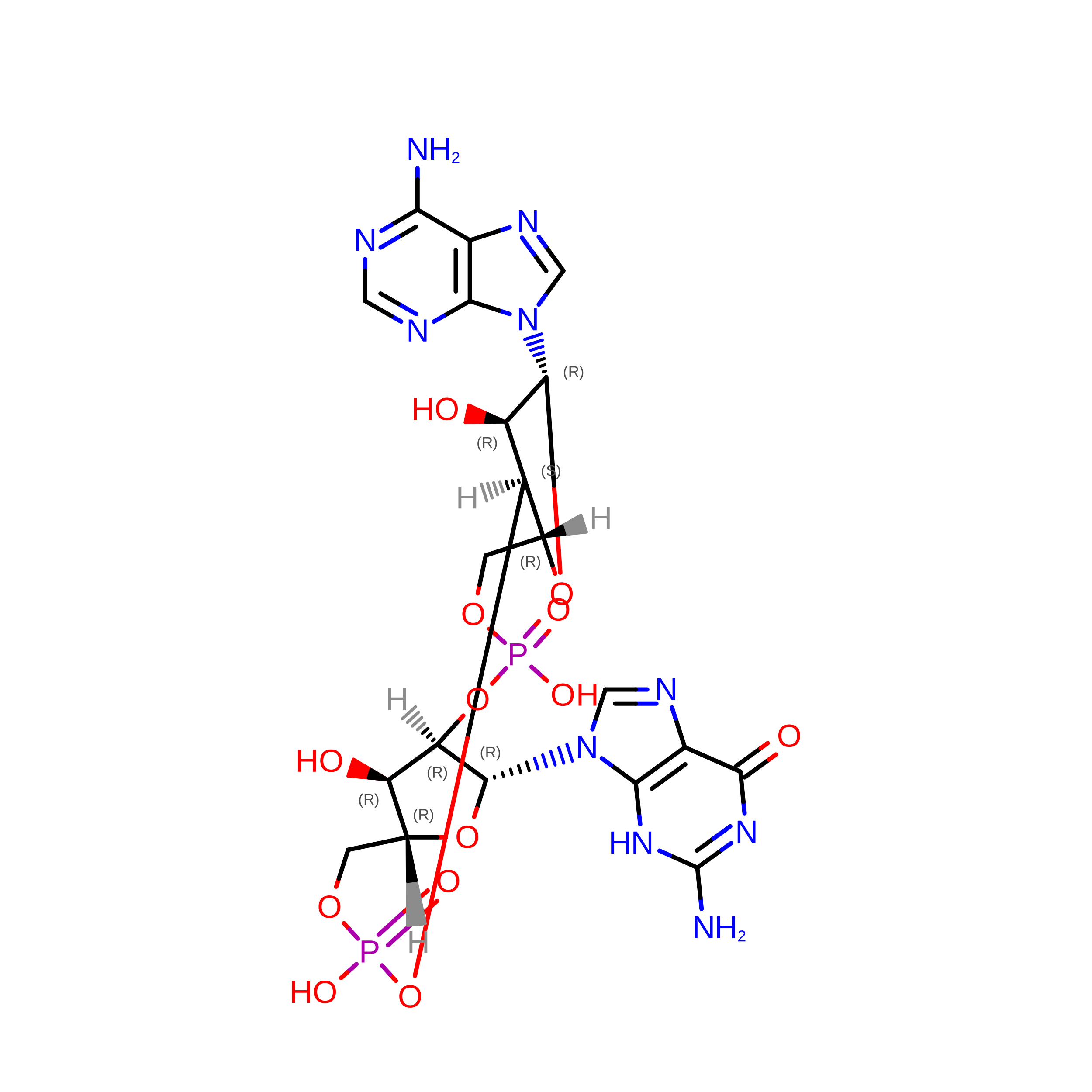
    Animal innate immunity evolved from ancient pathways in bacterial anti-phage defense. How bacterial immune components were first acquired and adapted within eukaryotic cells remains poorly understood. Here we identify a complete cGLR-STING signaling axis in choanoflagellates, the closest living relatives of animals, that exhibits a mosaic of features from both bacterial and animal immunity. Comparative genomics reveals choanoflagellate cGLR and STING genes organized in operon-like arrangements reminiscent of bacterial defense loci. Reconstitution of choanoflagellate cGLR-STING signaling in vitro demonstrates that activation occurs through the conserved nucleotide immune signal 2'3'-cGAMP. Structural analysis of a choanoflagellate STING-2'3'-cGAMP complex explains how retention of bacterial-like features in early eukaryotic proteins shapes ligand specificity and receptor activation. We analyze cGLR and STING evolution in unicellular eukaryotes and identify further STING homologs in choanoflagellates and fungi that support additional independent acquisition events. Our results reveal molecular fossils that bridge bacterial and animal immunity and illuminate early eukaryotic immune system evolution.


  • Organizational Affiliation
    • Department of Microbiology, Harvard Medical School, Boston, MA 02115, USA.

Macromolecules
Find similar proteins by:  (by identity cutoff)  |  3D Structure
Entity ID: 1
MoleculeChains Sequence LengthOrganismDetailsImage
Endolysin,Stimulator of interferon genes
A, B
379Salpingoeca macrocollataMutation(s): 0 
EC: 3.2.1.17
UniProt
Find proteins for P00720 (Enterobacteria phage T4)
Explore P00720 
Go to UniProtKB:  P00720
Entity Groups  
Sequence Clusters30% Identity50% Identity70% Identity90% Identity95% Identity100% Identity
UniProt GroupP00720
Sequence Annotations
Expand
  • Reference Sequence
Small Molecules
Experimental Data & Validation

Experimental Data

  • Method: X-RAY DIFFRACTION
  • Resolution: 2.65 Å
  • R-Value Free:  0.275 (Depositor), 0.273 (DCC) 
  • R-Value Work:  0.243 (Depositor), 0.244 (DCC) 
  • R-Value Observed: 0.246 (Depositor) 
Space Group: P 1 21 1
Unit Cell:
Length ( Å )Angle ( ˚ )
a = 66.946α = 90
b = 88.743β = 94.143
c = 76.023γ = 90
Software Package:
Software NamePurpose
PHENIXrefinement
autoPROCdata reduction
autoPROCdata scaling
PHENIXphasing

Structure Validation

View Full Validation Report


Ligand Structure Quality Assessment 


Entry History & Funding Information

Deposition Data


Funding OrganizationLocationGrant Number
National Institutes of Health/National Institute of General Medical Sciences (NIH/NIGMS)United States1DP2GM146250-01

Revision History  (Full details and data files)

  • Version 1.0: 2025-10-01
    Type: Initial release