Download Mendeley
Functional genomics and structural insights into maize aldo-keto reductase-4 family: Stress metabolism and substrate specificity in embryos.
Morais de Sousa, S., Oliveira de Giuseppe, P., Murakami, M.T., Guan, J.C., Saunders, J.W., Kiyota, E., Santos, M.L., Schmelz, E.A., Yunes, J.A., Koch, K.E.(2025) J Biol Chem 301: 110404-110404
- PubMed: 40544997 Search on PubMedSearch on PubMed Central
- DOI: https://doi.org/10.1016/j.jbc.2025.110404
- Primary Citation Related Structures:
9OU1 - PubMed Abstract:
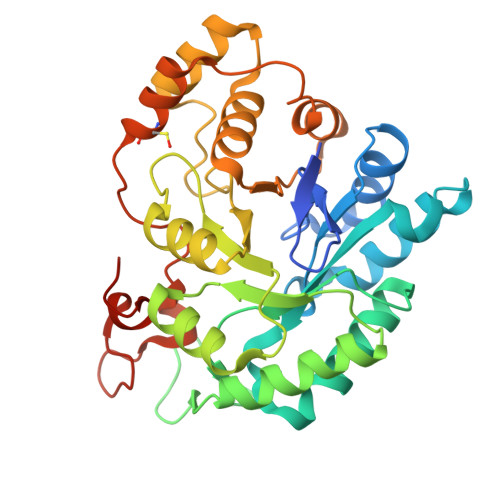
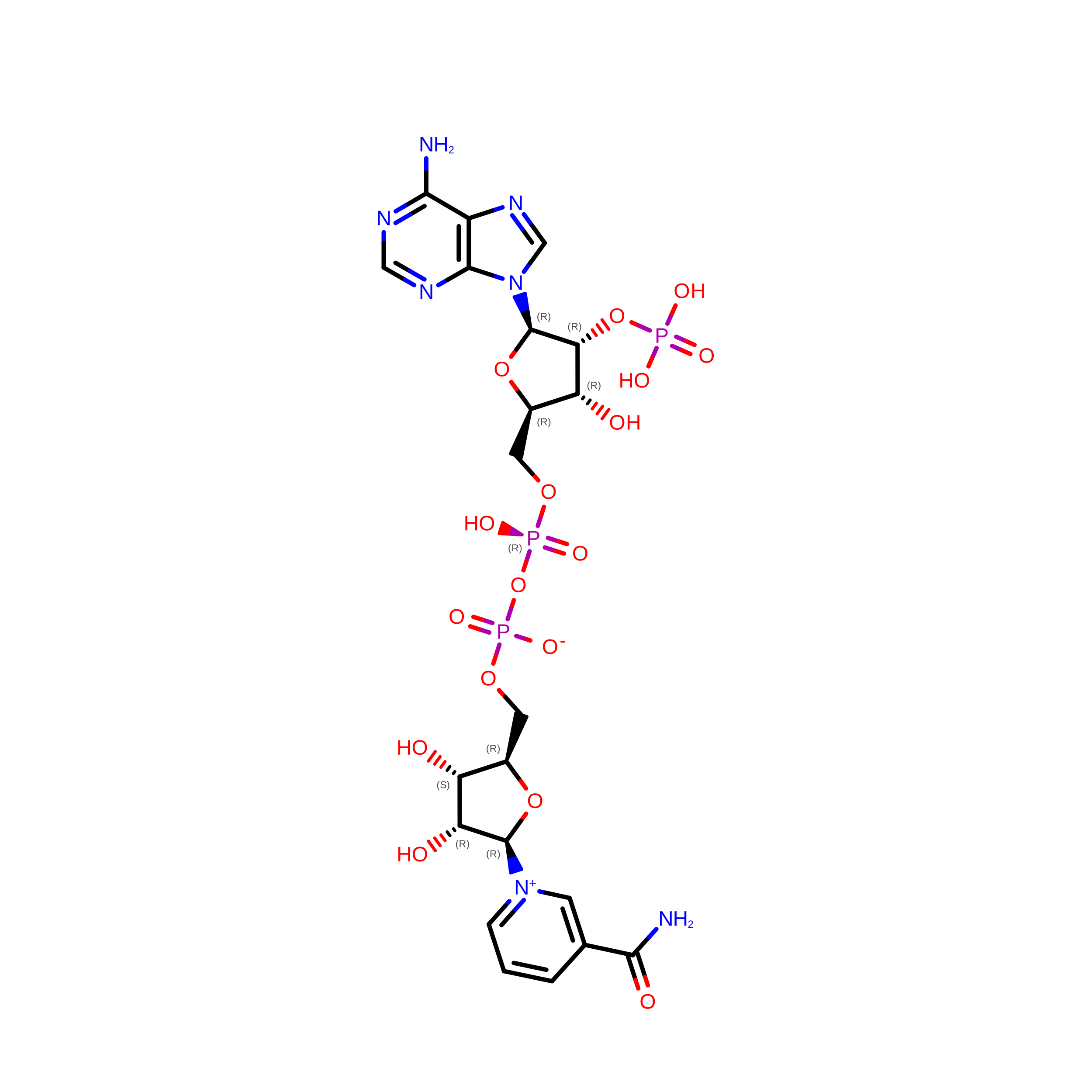
Aldo-keto reductases (AKRs) are ubiquitous in nature and are able to reduce a wide range of substrates, from simple sugars to potentially toxic aldehydes. In plants, AKRs are involved in key metabolic processes including reactive aldehyde detoxification. This study aimed to (i) delineate a maize gene family encoding aldo keto reductase-4s (AKR4s) (ii) help bridge sequence-to-function gaps among them, and (iii) focus on a family member implicated in embryo specific stress metabolism. We employed a genome-wide analysis approach to identify maize genes encoding AKR4s, defining and annotating a 15-member gene family that clustered into three subgroups. Expression profiling, validated through wet lab experiments, revealed distinct functional roles: (i) AKR4C Zm-1 functions in aldehyde detoxification during stress, (ii) AKR4C Zm-2 includes stress-responsive AKRs with diverse substrate affinities, and (iii) AKR4A/B Zm-3 contributes to specialized metabolites like phytosiderophores for iron transport. To investigate the impact of sequence variation on function, we characterized ZmAKR4C13, a representative of AKR4C Zm-1. Its mRNA and protein were predominantly localized in embryos, suggesting a specialized role. Recombinant ZmAKR4C13 efficiently reduced methylglyoxal and small aldehydes but showed poor activity toward aldoses larger than four carbons. Crystallographic analysis identified a size constraint at the active site, attributed to the bulkier LEU residue at position 294. Collectively, our results emphasize how subtle modifications in active-site architecture influence AKR substrate specificity. They also demonstrate a potential role of maize ZmAKR4C13 in detoxifying methylglyoxal and other small metabolites that could contribute to stress signaling in embryos.
- Embrapa Maize and Sorghum, Sete Lagoas, MG, Brazil. Electronic address: sylvia.sousa@embrapa.br.
Organizational Affiliation: