9OLA | pdb_00009ola

Backbone-modified parallel beta hairpin (PBH): N-alpha-amino Tyrosine at position 15

  • Classification: DE NOVO PROTEIN
  • Organism(s): synthetic construct
  • Mutation(s): No 

  • Deposited: 2025-05-12 Released: 2025-12-03 
  • Deposition Author(s): Starnes, S.K., Horne, W.S., Del Valle, J.R.
  • Funding Organization(s): National Science Foundation (NSF, United States), National Institutes of Health/National Institute on Aging (NIH/NIA), National Institutes of Health/National Institute of General Medical Sciences (NIH/NIGMS)

Experimental Data Snapshot

  • Method: SOLUTION NMR
  • Conformers Calculated: 100 
  • Conformers Submitted: 10 
  • Selection Criteria: structures with the lowest energy 

wwPDB Validation 3D Report Full Report

Validation slider image for 9OLA

This is version 1.1 of the entry. See complete history

Literature

Impact of Strand Edge N-Amination on the Stability of a Parallel beta-Hairpin Fold.

Starnes, S.K.Horne, W.S.Del Valle, J.R.

(2025) J Org Chem 90: 17214-17220

  • DOI: https://doi.org/10.1021/acs.joc.5c02479
  • Primary Citation Related Structures: 
    9OL7, 9OL8, 9OL9, 9OLA

  • PubMed Abstract: 

    Peptide backbone N-amination has emerged as a useful strategy to stabilize antiparallel β-sheet structure. Here, we used circular dichroism and NMR to evaluate the impact of amide-to-hydrazide substitution on the folded population of a parallel β-hairpin model. Outer-edge N-amination was well tolerated and resulted in enhanced stability relative to N-methylation. High-resolution NMR structures confirmed that the α-hydrazino acid residues adopt canonical parallel β-strand torsions that are compatible with the formation of intraresidue C6 hydrogen bonds involving the hydrazide NH 2 group.


  • Organizational Affiliation
    • Department of Chemistry & Biochemistry, University of Notre Dame, Notre Dame, Indiana 46556, United States.

Macromolecule Content 

  • Total Structure Weight: 2.01 kDa 
  • Atom Count: 143 
  • Modeled Residue Count: 18 
  • Deposited Residue Count: 18 
  • Unique protein chains: 2

Macromolecules

Find similar proteins by:  Sequence   |   3D Structure  
Entity ID: 1
MoleculeChains  Sequence LengthOrganismDetailsImage
(ACE)SKTFIQV(DPR)(4G6) peptide10synthetic constructMutation(s): 0 
Entity Groups
Sequence Clusters30% Identity50% Identity70% Identity90% Identity95% Identity100% Identity
Sequence Annotations
Expand
Reference Sequence
Find similar proteins by:  Sequence   |   3D Structure  
Entity ID: 2
MoleculeChains  Sequence LengthOrganismDetailsImage
(ACE)KNVL(A1CCQ)RR peptide8synthetic constructMutation(s): 0 
Sequence Annotations
Expand
Reference Sequence

Small Molecules

Modified Residues  2 Unique
IDChains TypeFormula2D DiagramParent
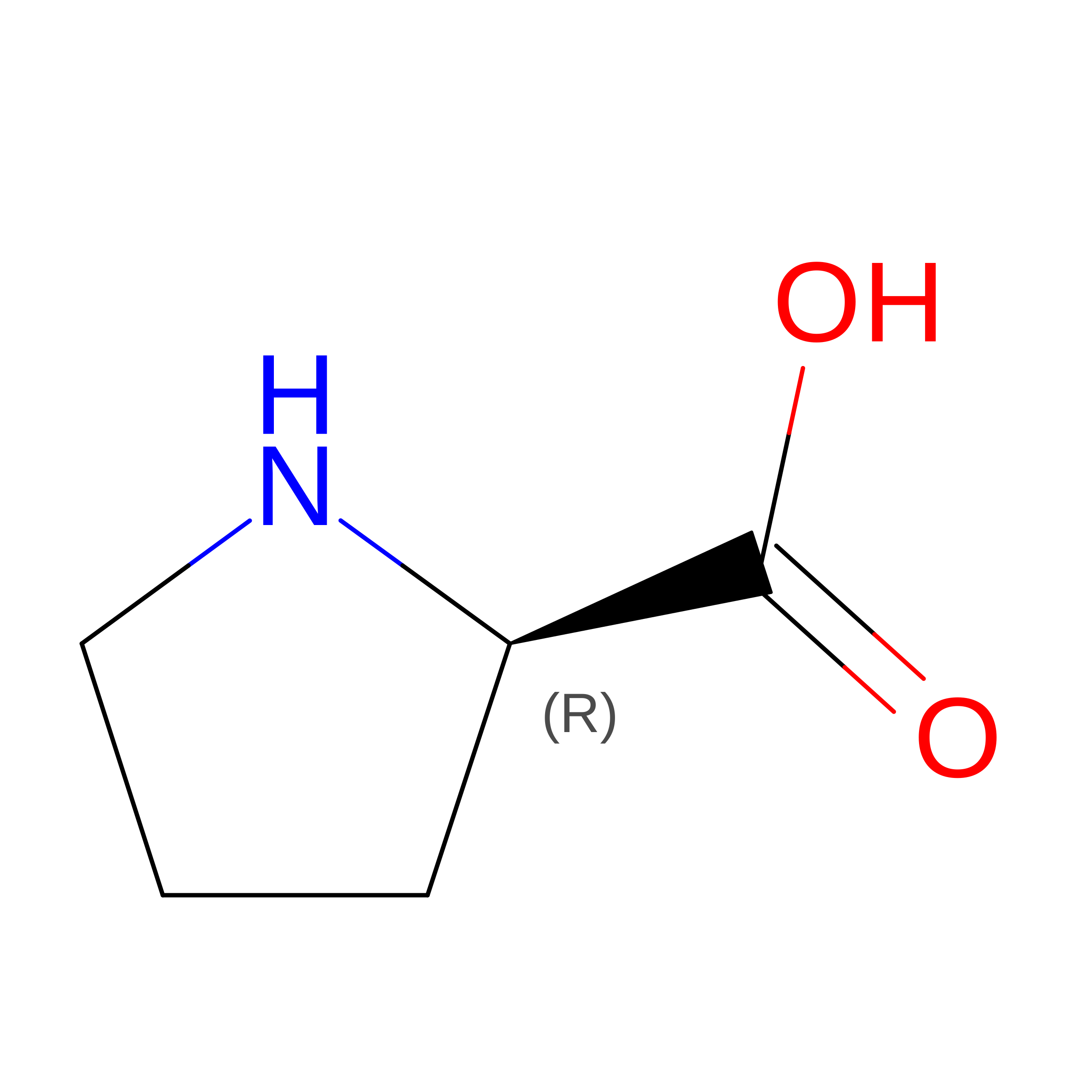
DPR
Query on DPR
A
D-PEPTIDE LINKINGC5 H9 N O2

--

A1CCQ
Query on A1CCQ
B
L-PEPTIDE LINKINGC9 H12 N2 O3TYR

Experimental Data & Validation

Experimental Data

  • Method: SOLUTION NMR
  • Conformers Calculated: 100 
  • Conformers Submitted: 10 
  • Selection Criteria: structures with the lowest energy 

Structure Validation

View Full Validation Report


Entry History 

& Funding Information

Deposition Data


Funding OrganizationLocationGrant Number
National Science Foundation (NSF, United States)United StatesCHE2109008
National Institutes of Health/National Institute on Aging (NIH/NIA)United StatesR01 AG074570
National Institutes of Health/National Institute of General Medical Sciences (NIH/NIGMS)United StatesR35GM149220

Revision History  (Full details and data files)

  • Version 1.0: 2025-12-03
    Type: Initial release
  • Version 1.1: 2025-12-17
    Changes: Database references