9OG4 | pdb_00009og4

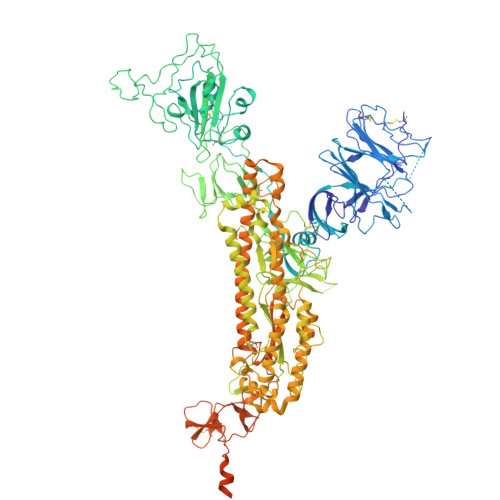
SARS-COV-2-6P-MUT7 S PROTEIN-DY-III-281 complex closed conformation


Experimental Data Snapshot

  • Method: ELECTRON MICROSCOPY
  • Resolution: 3.56 Å
  • Aggregation State: PARTICLE 
  • Reconstruction Method: SINGLE PARTICLE 

Starting Model: experimental
View more details

wwPDB Validation 3D Report Full Report

Validation slider image for 9OG4

This is version 1.2 of the entry. See complete history

Literature

Optimization of VE607 to generate analogs with improved neutralization activities against SARS-CoV-2 variants.

Ding, S.Yang, D.Ullah, I.Niu, L.Unger, M.Diaz-Salinas, M.A.Chandravanshi, M.Zhou, F.Beaudoin-Bussieres, G.Benlarbi, M.Tolbert, W.D.Yoon, K.-.W.Xu, R.Laroche, G.Gaudette, F.Morton, A.J.Lang, Z.C.Son, A.Abrams, C.Cote, M.Smith 3rd, A.B.Huang, R.K.Matthies, D.Munro, J.B.Pazgier, M.Uchil, P.D.Finzi, A.

(2025) J Virol 99: e0103425-e0103425

  • DOI: https://doi.org/10.1128/jvi.01034-25
  • Primary Citation Related Structures: 
    9OG4, 9OG5, 9OG6, 9OG7

  • PubMed Abstract: 

    Severe acute respiratory syndrome coronavirus 2 (SARS-CoV-2) infection remains a threat to human health, particularly among immunocompromised and elderly individuals, given their heightened vulnerability to coronavirus disease 2019 (COVID-19)-associated morbidity and mortality. Recently, omicron subvariants such as KP.3.1.1 and XEC have emerged with an enhanced ability to evade humoral immunity. The development of new strategies against these variants of concern remains an intense area of research. The small molecule VE607 is an entry inhibitor that targets the Spike glycoprotein and delays virus spread in vivo . To improve the potency of this new class of SARS-CoV-2 entry inhibitors, we generated and characterized VE607 analogs and identified candidates with enhanced activity against variants, including KP.3.1.1 and XEC. Promising analogs exhibited higher inhibitory potency than the original compound and stabilized the receptor-binding domain in its "up" conformation. Among these, DY-III-281 also reduced viral burden and delayed death in SARS-CoV-2-challenged K18-hACE2 transgenic mice. Furthermore, combining DY-III-281 with a non-neutralizing antibody engineered for Fc-enhanced functions exhibited an additive effect in reducing SARS-CoV-2-induced disease burden in mice. Our findings support the continued development of small-molecule entry inhibitors, alone or in combination with antibody-based therapies, as a promising strategy to counteract emerging SARS-CoV-2 variants. Mutations in the Spike glycoprotein drive viral evolution and confer resistance to current vaccines and some therapeutic interventions against severe acute respiratory syndrome coronavirus 2 (SARS-CoV-2). Here, we report new analogs of the SARS-CoV-2 small-molecule entry inhibitor VE607. These analogs exhibited improved potency against emerging SARS-CoV-2 variants, including KP.3.1.1 and XEC. One analog, DY-III-281, delayed viral replication in SARS-CoV-2 WA1 -challenged K18-hACE2 transgenic mice, suggesting that small-molecule compounds targeting viral entry might be useful in fighting evolving SARS-CoV-2 variants.


  • Organizational Affiliation
    • Centre de Recherche du CHUM, Montreal, Québec, Canada.

Macromolecule Content 

  • Total Structure Weight: 438.47 kDa 
  • Atom Count: 25,594 
  • Modeled Residue Count: 3,157 
  • Deposited Residue Count: 3,840 
  • Unique protein chains: 1

Macromolecules

Find similar proteins by:|  3D Structure
Entity ID: 1
MoleculeChains  Sequence LengthOrganismDetailsImage
Spike glycoproteinA,
B [auth C],
C [auth B]
1,280Severe acute respiratory syndrome coronavirus 2Mutation(s): 11 
Gene Names: S2
UniProt
Find proteins for P0DTC2 (Severe acute respiratory syndrome coronavirus 2)
Explore P0DTC2 
Go to UniProtKB:  P0DTC2
Entity Groups
Sequence Clusters30% Identity50% Identity70% Identity90% Identity95% Identity100% Identity
UniProt GroupP0DTC2
Glycosylation
Glycosylation Sites: 16Go to GlyGen: P0DTC2-1
Sequence Annotations
Expand
Reference Sequence

Oligosaccharides

Help  
Entity ID: 2
MoleculeChains Length2D Diagram GlycosylationD Interactions
2-acetamido-2-deoxy-beta-D-glucopyranose-(1-4)-2-acetamido-2-deoxy-beta-D-glucopyranose
D,
E,
G [auth L],
H,
I [auth G],
D,
E,
G [auth L],
H,
I [auth G],
K [auth J],
L [auth K],
M,
N,
O,
P,
Q,
T
2N-Glycosylation
Glycosylation Resources
GlyTouCan: G42666HT
GlyCosmos: G42666HT
GlyGen: G42666HT
Entity ID: 3
MoleculeChains Length2D Diagram GlycosylationD Interactions
beta-D-mannopyranose-(1-4)-2-acetamido-2-deoxy-beta-D-glucopyranose-(1-4)-2-acetamido-2-deoxy-beta-D-glucopyranose
F,
J [auth I],
R,
S,
U,
F,
J [auth I],
R,
S,
U,
V,
W
3N-Glycosylation
Glycosylation Resources
GlyTouCan: G15407YE
GlyCosmos: G15407YE
GlyGen: G15407YE

Small Molecules

Ligands 1 Unique
IDChains Name / Formula / InChI Key2D Diagram3D Interactions
NAG

Query on NAG


Download:Ideal Coordinates CCD File
AA [auth A]
BA [auth C]
CA [auth C]
DA [auth C]
EA [auth C]
AA [auth A],
BA [auth C],
CA [auth C],
DA [auth C],
EA [auth C],
FA [auth C],
GA [auth C],
HA [auth C],
IA [auth C],
JA [auth C],
KA [auth B],
LA [auth B],
MA [auth B],
NA [auth B],
OA [auth B],
PA [auth B],
QA [auth B],
RA [auth B],
SA [auth B],
X [auth A],
Y [auth A],
Z [auth A]
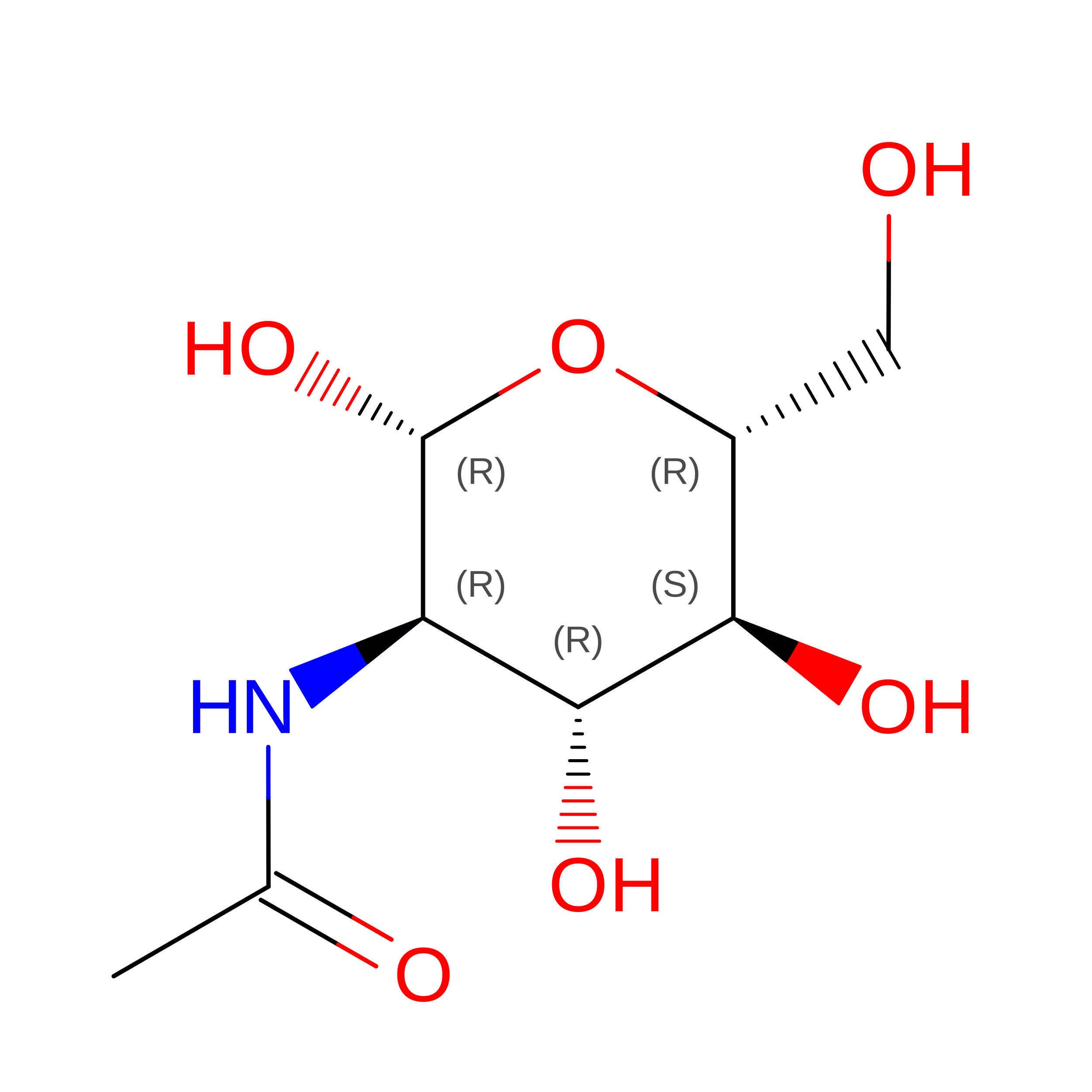
2-acetamido-2-deoxy-beta-D-glucopyranose
C8 H15 N O6
OVRNDRQMDRJTHS-FMDGEEDCSA-N

Experimental Data & Validation

Experimental Data

  • Method: ELECTRON MICROSCOPY
  • Resolution: 3.56 Å
  • Aggregation State: PARTICLE 
  • Reconstruction Method: SINGLE PARTICLE 
EM Software:
TaskSoftware PackageVersion
RECONSTRUCTIONcryoSPARC
MODEL REFINEMENTPHENIX1.21.2_5419

Structure Validation

View Full Validation Report


Entry History 

& Funding Information

Deposition Data


Funding OrganizationLocationGrant Number
Canadian Institutes of HealthCanada460529

Revision History  (Full details and data files)

  • Version 1.0: 2025-10-01
    Type: Initial release
  • Version 1.1: 2025-10-29
    Changes: Data collection, Database references
  • Version 1.2: 2025-12-10
    Changes: Data collection, Database references