9O93 | pdb_00009o93

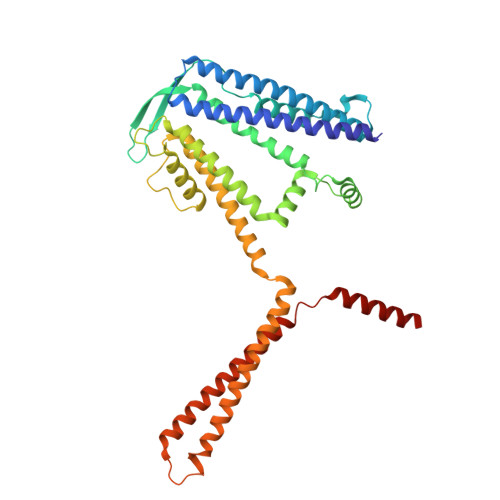
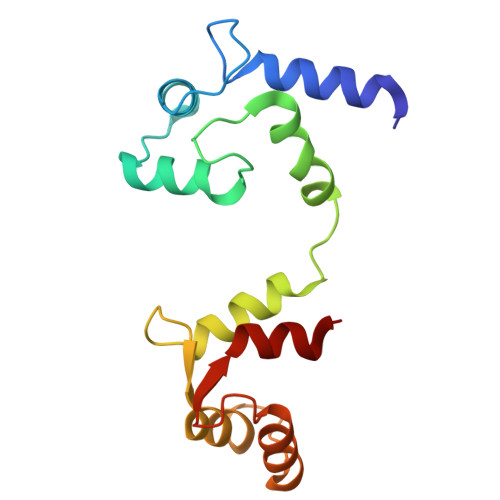
Cryo-EM structure of KCa2.2_II/calmodulin channel in complex with rimtuzalcap

  • Classification: TRANSPORT PROTEIN
  • Organism(s): Rattus norvegicus
  • Expression System: Homo sapiens
  • Mutation(s): No 

  • Deposited: 2025-04-17 Released: 2025-06-18 
  • Deposition Author(s): Nam, Y.W., Zhang, M.
  • Funding Organization(s): American Heart Association, National Institutes of Health/National Institute of Neurological Disorders and Stroke (NIH/NINDS)

Experimental Data Snapshot

  • Method: ELECTRON MICROSCOPY
  • Resolution: 2.96 Å
  • Aggregation State: PARTICLE 
  • Reconstruction Method: SINGLE PARTICLE 

wwPDB Validation   3D Report Full Report


This is version 1.2 of the entry. See complete history


Literature

Structural basis for the subtype-selectivity of K Ca 2.2 channel activators.

Zhang, M.Nam, Y.W.Ramanishka, A.Xu, Y.Yasuda, R.M.Im, D.Cui, M.Chandy, G.Wulff, H.

(2025) Res Sq 

  • DOI: https://doi.org/10.21203/rs.3.rs-6568445/v1
  • Primary Citation of Related Structures:  
    9O7S, 9O85, 9O93, 9OA8

  • PubMed Abstract: 

    Small-conductance (K Ca 2.2) and intermediate-conductance (K Ca 3.1) Ca 2+ -activated K + channels are gated by a Ca 2+ -calmodulin dependent mechanism. NS309 potentiates the activity of both K Ca 2.2 and K Ca 3.1, while rimtuzalcap selectively activates K Ca 2.2. Rimtuzalcap has been used in clinical trials for the treatment of spinocerebellar ataxia and essential tremor. We report cryo-electron microscopy structures of K Ca 2.2 channels bound with NS309 and rimtuzalcap, in addition to K Ca 3.1 channels with NS309. The different conformations of calmodulin and the cytoplasmic HC helices in the two channels underlie the subtype-selectivity of rimtuzalcap for K Ca 2.2. Calmodulin's N-lobes in the K Ca 2.2 structure are far apart and undergo conformational changes to accommodate either NS309 or rimtuzalcap. Calmodulin's Nlobes in the K Ca 3.1 structure are closer to each other and are constrained by the HC helices of K Ca 3.1, which allows binding of NS309 but not of the bulkier rimtuzalcap. These structures provide a framework for structure-based drug design targeting K Ca 2.2 channels.


  • Organizational Affiliation
    • Chapman University.

Macromolecules
Find similar proteins by:  (by identity cutoff)  |  3D Structure
Entity ID: 1
MoleculeChains Sequence LengthOrganismDetailsImage
Small conductance calcium-activated potassium channel protein 2
A, B, C, D
380Rattus norvegicusMutation(s): 0 
Gene Names: Kcnn2
UniProt
Find proteins for P70604 (Rattus norvegicus)
Explore P70604 
Go to UniProtKB:  P70604
Entity Groups  
Sequence Clusters30% Identity50% Identity70% Identity90% Identity95% Identity100% Identity
UniProt GroupP70604
Sequence Annotations
Expand
  • Reference Sequence
Find similar proteins by:  (by identity cutoff)  |  3D Structure
Entity ID: 2
MoleculeChains Sequence LengthOrganismDetailsImage
Calmodulin-1
E, F, G, H
144Rattus norvegicusMutation(s): 0 
Gene Names: Calm1CalmCamCam1CaMI
UniProt
Find proteins for P0DP29 (Rattus norvegicus)
Explore P0DP29 
Go to UniProtKB:  P0DP29
Entity Groups  
Sequence Clusters30% Identity50% Identity70% Identity90% Identity95% Identity100% Identity
UniProt GroupP0DP29
Sequence Annotations
Expand
  • Reference Sequence
Experimental Data & Validation

Experimental Data

  • Method: ELECTRON MICROSCOPY
  • Resolution: 2.96 Å
  • Aggregation State: PARTICLE 
  • Reconstruction Method: SINGLE PARTICLE 
EM Software:
TaskSoftware PackageVersion
MODEL REFINEMENTPHENIX1.21.1_5286

Structure Validation

View Full Validation Report


Entry History & Funding Information

Deposition Data


Funding OrganizationLocationGrant Number
American Heart AssociationUnited States23AIREA1039423
American Heart AssociationUnited States24CDA1260237
National Institutes of Health/National Institute of Neurological Disorders and Stroke (NIH/NINDS)United States4R33 NS101182-03
National Institutes of Health/National Institute of Neurological Disorders and Stroke (NIH/NINDS)United StatesR15 NS130420-01A1

Revision History  (Full details and data files)

  • Version 1.0: 2025-06-18
    Type: Initial release
  • Version 1.1: 2025-06-25
    Changes: Data collection, Database references
  • Version 1.2: 2025-11-19
    Changes: Data collection, Derived calculations, Structure summary