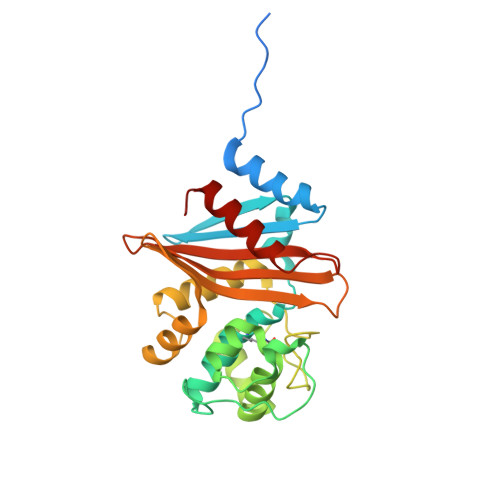
9NSW | pdb_00009nsw

apo-OXA-23, pH 7.5


Experimental Data Snapshot

  • Method: X-RAY DIFFRACTION
  • Resolution: 1.40 Å
  • R-Value Free: 
    0.201 (Depositor), 0.203 (DCC) 
  • R-Value Work: 
    0.166 (Depositor), 0.167 (DCC) 
  • R-Value Observed: 
    0.168 (Depositor) 

Starting Model: experimental
View more details

wwPDB Validation 3D Report Full Report

Validation slider image for 9NSW

This is version 1.2 of the entry. See complete history

Literature

Dual mechanism of the OXA-23 carbapenemase inhibition by the carbapenem NA-1-157.

Toth, M.Stewart, N.K.Quan, P.Khan, M.M.K.Cox, J.Buynak, J.D.Smith, C.A.Vakulenko, S.B.

(2025) Antimicrob Agents Chemother 69: e0091825-e0091825

  • DOI: https://doi.org/10.1128/aac.00918-25
  • Primary Citation Related Structures: 
    9NSW, 9NSX, 9NSY, 9NSZ, 9NT0

  • PubMed Abstract: 

    Carbapenem-resistant Acinetobacter baumannii continues to be a leading cause of life-threatening infections that result in high mortality rates. The major cause of carbapenem resistance in this pathogen is the production of class D carbapenemases, enzymes that inactivate the last resort carbapenem antibiotics, thus significantly diminishing the available therapeutic options. In this study, we evaluated the interaction of OXA-23, the most widely disseminated class D carbapenemase in A. baumannii clinical isolates, with the atypically modified carbapenem, NA-1-157. The MICs of this compound against strains producing OXA-23 were reduced from highly resistant levels observed for the commercial carbapenems meropenem and imipenem (16-128 µg/mL) to sensitive or intermediate levels (2-4 µg/mL). Kinetic studies showed that NA-1-157 inhibits the enzyme due to a significant decrease (>2,000-fold) in the deacylation rate relative to its closest structural analog, meropenem. Structural studies and molecular dynamics simulations demonstrated that inhibition is caused by both the inability of a water molecule to get close enough to the scissile bond to perform deacylation and by partial decarboxylation of the catalytic lysine residue upon formation of the acyl-enzyme intermediate.


  • Organizational Affiliation
    • Department of Chemistry and Biochemistry, University of Notre Dame, Notre Dame, Indiana, USA.

Macromolecule Content 

  • Total Structure Weight: 31.37 kDa 
  • Atom Count: 2,240 
  • Modeled Residue Count: 247 
  • Deposited Residue Count: 273 
  • Unique protein chains: 1

Macromolecules

Find similar proteins by:|  3D Structure
Entity ID: 1
MoleculeChains  Sequence LengthOrganismDetailsImage
Beta-lactamase OXA-23273Acinetobacter baumanniiMutation(s): 0 
Gene Names: OXA-23ari-1bla-OXA-23bla_2bla_3blaOXAblaOXA-23ABUW_0563
EC: 3.5.2.6
UniProt
Find proteins for Q9L4P2 (Acinetobacter baumannii)
Explore Q9L4P2 
Go to UniProtKB:  Q9L4P2
Entity Groups
Sequence Clusters30% Identity50% Identity70% Identity90% Identity95% Identity100% Identity
UniProt GroupQ9L4P2
Sequence Annotations
Expand
Reference Sequence

Small Molecules

Experimental Data & Validation

Experimental Data

  • Method: X-RAY DIFFRACTION
  • Resolution: 1.40 Å
  • R-Value Free:  0.201 (Depositor), 0.203 (DCC) 
  • R-Value Work:  0.166 (Depositor), 0.167 (DCC) 
  • R-Value Observed: 0.168 (Depositor) 
Space Group: P 42 21 2
Unit Cell:
Length ( Å )Angle ( ˚ )
a = 82.771α = 90
b = 82.771β = 90
c = 84.892γ = 90
Software Package:
Software NamePurpose
PHENIXrefinement
XDSdata reduction
Aimlessdata scaling
MOLREPphasing

Structure Validation

View Full Validation Report


Entry History 

& Funding Information

Deposition Data


Funding OrganizationLocationGrant Number
National Institutes of Health/National Institute Of Allergy and Infectious Diseases (NIH/NIAID)United States1R01 AI155723

Revision History  (Full details and data files)

  • Version 1.0: 2025-08-06
    Type: Initial release
  • Version 1.1: 2025-09-03
    Changes: Database references
  • Version 1.2: 2025-10-15
    Changes: Database references