Download Mendeley
Structural basis for loading of transcription repair-coupling factor Mfd onto stalled elongation complexes.
Brewer, J., Llewellyn, E., Chen, J., Campbell, E.A., Darst, S.A.(2026) Nucleic Acids Res 54
- PubMed: 42444603 Search on PubMedSearch on PubMed Central
- DOI: https://doi.org/10.1093/nar/gkag698
- Primary Citation Related Structures:
9N07 - PubMed Abstract:
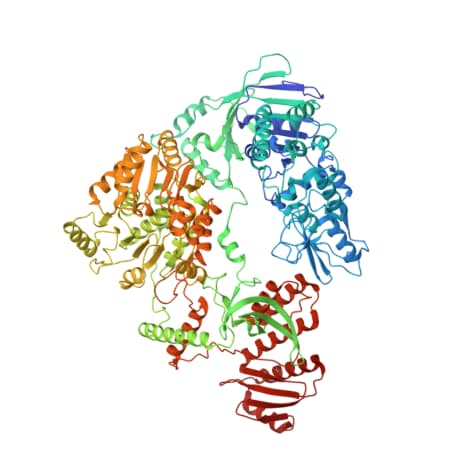
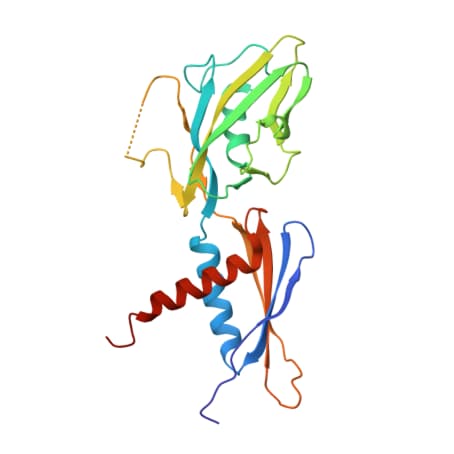
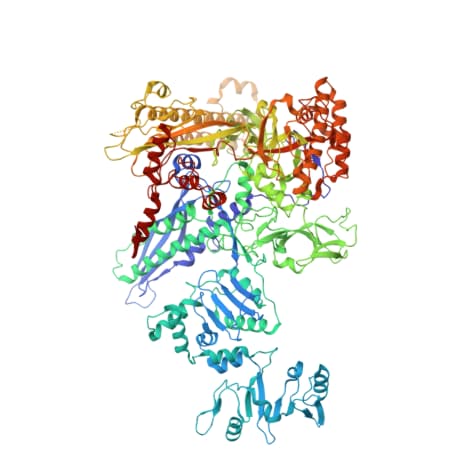
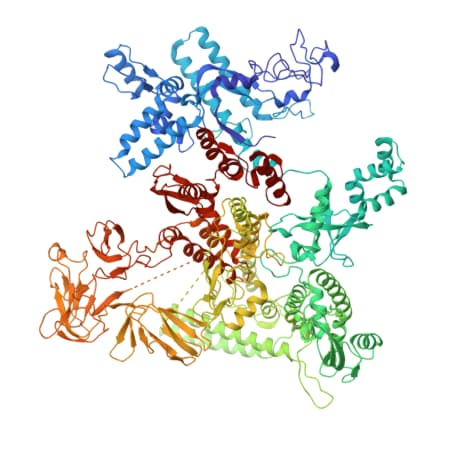
Transcription-coupled repair (TCR) is a nucleotide excision repair sub-pathway that preferentially removes lesions from the DNA template-strand that stall RNA polymerase elongation complexes (ECs). In bacteria, the superfamily 2 Mfd translocase mediates TCR by displacing stalled ECs and recruiting Uvr(A)B. Using cryo-electron microscopy, we previously visualized seven Mfd-EC complexes spanning the ATP-dependent Mfd loading and EC displacement pathway [L1 → L2(ADP) → C1(ATP) → C2(ATP) → C3(ADP) → C4(ADP) → C5(ATP)]. The first intermediate (L1) was poorly resolved (4.1 Å nominal resolution) due to low particle occupancy. The pathway is characterized by very large Mfd structural transitions, notably the L1 → L2 transition. Here, we pre-loaded Mfd with ATP in the presence of the γ-phosphate mimic, BeF3-, limiting rounds of ATP hydrolysis. The resulting accumulation of early intermediates allowed us to resolve the L1 intermediate to 3.5 Å nominal resolution, revealing bound ADP-BeF3-. We also identified a new intermediate between L1 and L2, L1.5, providing further insight into Mfd conformational changes during loading.
- Laboratory of Molecular Biophysics, The Rockefeller University, New York, NY 10065, United States.
Organizational Affiliation: