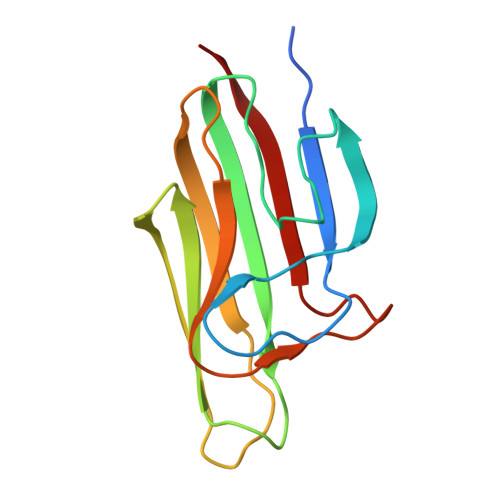
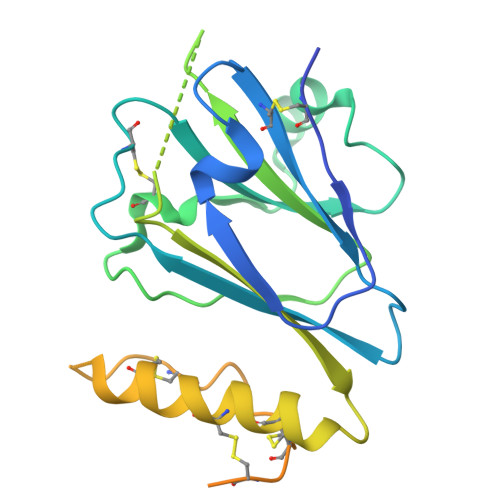
9LKL | pdb_00009lkl

Cryo-EM map of C1ql1-gC1q hexamer and BAI3-eCUB complex


Experimental Data Snapshot

  • Method: ELECTRON MICROSCOPY
  • Resolution: 3.48 Å
  • Aggregation State: PARTICLE 
  • Reconstruction Method: SINGLE PARTICLE 

Starting Models: experimental, in silico
View more details

wwPDB Validation   3D Report Full Report


This is version 1.0 of the entry. See complete history


Literature

Structural basis of calcium-dependent C1ql1/BAI3 assemblies in synaptic connectivity.

Liao, L.Han, Y.Niu, F.Wang, Y.Lu, Y.Xu, S.Zhu, H.Lin, L.Xiao, J.Tou, H.I.Gao, J.Zhang, B.Wei, Z.

(2025) Nat Commun 

  • DOI: https://doi.org/10.1038/s41467-025-66254-1
  • Primary Citation of Related Structures:  
    9LKK, 9LKL, 9LKM

  • PubMed Abstract: 

    Cell adhesion molecules (CAMs) are pivotal in establishing and maintaining synaptic connectivity. Emerging evidence indicates that some secreted factors within the synaptic cleft, including C1q-like proteins (C1qls), play a crucial role in bridging pre- and post-synapses by connecting the bilateral CAMs. However, the mechanisms of those secreted factors in synapse assembly remain incomplete. Here, we explore C1ql-mediated synaptic connectivity, focusing on the assembly of C1ql1 and its postsynaptic receptor brain-specific angiogenesis inhibitor 3 (BAI3, also called ADGRB3). Our biochemical, structural, and computational analyses reveal that the trimeric globular C1q (gC1q) domain of C1ql1 undergoes a calcium-modulated domain-swapping event to form a hexamer. Cryo-EM study manifests the stabilizing role of calcium ions on the C1ql1_gC1q hexamer in complex with the extended CUB domain of BAI3. Using the gC1q hexamer, full-length C1ql1 further assembles into linear clusters, possibly providing a scaffold to accumulate BAI3 receptors on the plasma membrane. Our cellular and in vivo studies support a role for the gC1q-mediated dynamic assembly of C1ql1 in receptor accumulation and synapse maintenance. Collectively, our findings provide a plausible mechanism of secreted factor-mediated synaptic connectivity, driven by the calcium-modulated assembly of C1qls and their interactions with CAMs.


  • Organizational Affiliation
    • Shenzhen Key Laboratory of Biomolecular Assembling and Regulation, Shenzhen, Guangdong, China.

Macromolecules
Find similar proteins by:  (by identity cutoff)  |  3D Structure
Entity ID: 1
MoleculeChains Sequence LengthOrganismDetailsImage
C1q-related factor
A, B, C, F, G
A, B, C, F, G, H
140Mus musculusMutation(s): 0 
Gene Names: C1ql1C1qrfCrfCtrp14
UniProt
Find proteins for O88992 (Mus musculus)
Explore O88992 
Go to UniProtKB:  O88992
Entity Groups  
Sequence Clusters30% Identity50% Identity70% Identity90% Identity95% Identity100% Identity
UniProt GroupO88992
Sequence Annotations
Expand
  • Reference Sequence
Find similar proteins by:  (by identity cutoff)  |  3D Structure
Entity ID: 2
MoleculeChains Sequence LengthOrganismDetailsImage
Adhesion G protein-coupled receptor B3
D, E, I, J
238Homo sapiensMutation(s): 0 
Gene Names: ADGRB3BAI3KIAA0550
UniProt & NIH Common Fund Data Resources
Find proteins for O60242 (Homo sapiens)
Explore O60242 
Go to UniProtKB:  O60242
PHAROS:  O60242
GTEx:  ENSG00000135298 
Entity Groups  
Sequence Clusters30% Identity50% Identity70% Identity90% Identity95% Identity100% Identity
UniProt GroupO60242
Sequence Annotations
Expand
  • Reference Sequence
Experimental Data & Validation

Experimental Data

  • Method: ELECTRON MICROSCOPY
  • Resolution: 3.48 Å
  • Aggregation State: PARTICLE 
  • Reconstruction Method: SINGLE PARTICLE 
EM Software:
TaskSoftware PackageVersion
RECONSTRUCTIONcryoSPARCv4.1
MODEL REFINEMENTPHENIX1.19.2_4158

Structure Validation

View Full Validation Report


Entry History & Funding Information

Deposition Data


Funding OrganizationLocationGrant Number
National Natural Science Foundation of China (NSFC)China32471250
National Natural Science Foundation of China (NSFC)China32471262

Revision History  (Full details and data files)

  • Version 1.0: 2025-12-17
    Type: Initial release