Download Mendeley
A meiotic driver hijacks an epigenetic reader to disrupt mitosis in noncarrier offspring.
Hua, Y., Zhang, J., Yang, M.Y., Zhang, F.Y., Ren, J.Y., Lyu, X.H., Ding, Y., Suo, F., Shao, G.C., Li, J., Dong, M.Q., Ye, K., Du, L.L.(2024) Proc Natl Acad Sci U S A 121: e2408347121-e2408347121
- PubMed: 39485795 Search on PubMedSearch on PubMed Central
- DOI: https://doi.org/10.1073/pnas.2408347121
- Primary Citation Related Structures:
9JA5 - PubMed Abstract:
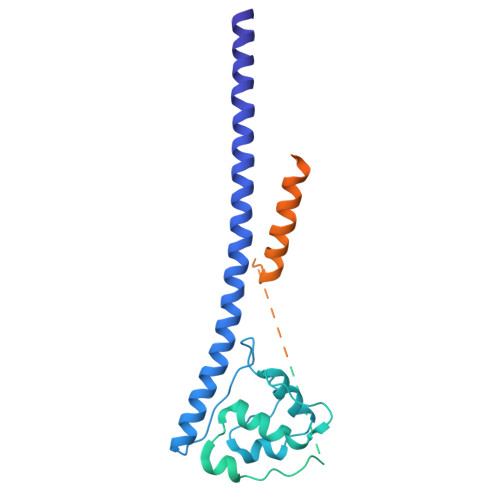
Killer meiotic drivers (KMDs) are selfish genetic elements that distort Mendelian inheritance by selectively killing meiotic products lacking the KMD element, thereby promoting their own propagation. Although KMDs have been found in diverse eukaryotes, only a limited number of them have been characterized at the molecular level, and their killing mechanisms remain largely unknown. In this study, we identify that a gene previously deemed essential for cell survival in the fission yeast Schizosaccharomyces pombe is a single-gene KMD. This gene, tdk1 , kills nearly all tdk1Δ progeny in a tdk1+ × tdk1Δ cross. By analyzing polymorphisms of tdk1 among natural strains, we identify a resistant haplotype, HT3. This haplotype lacks killing ability yet confers resistance to killing by the wild-type tdk1 . Proximity labeling experiments reveal an interaction between Tdk1, the protein product of tdk1 , and the epigenetic reader Bdf1. Interestingly, the nonkilling Tdk1-HT3 variant does not interact with Bdf1. Cryoelectron microscopy further elucidated the binding interface between Tdk1 and Bdf1, pinpointing mutations within Tdk1-HT3 that disrupt this interface. During sexual reproduction, Tdk1 forms stable Bdf1-binding nuclear foci in all spores after meiosis. These foci persist in germinated tdk1Δ progeny and impede chromosome segregation during mitosis by generating aberrant chromosomal adhesions. This study identifies a KMD that masquerades as an essential gene and reveals the molecular mechanism by which this KMD hijacks cellular machinery to execute killing. Additionally, we unveil that losing the hijacking ability is an evolutionary path for this single-gene KMD to evolve into a nonkilling resistant haplotype.
- National Institute of Biological Sciences, Beijing 102206, China.
Organizational Affiliation: