9J7L | pdb_00009j7l

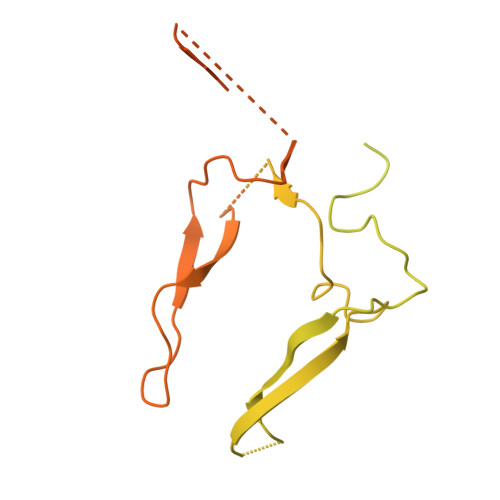
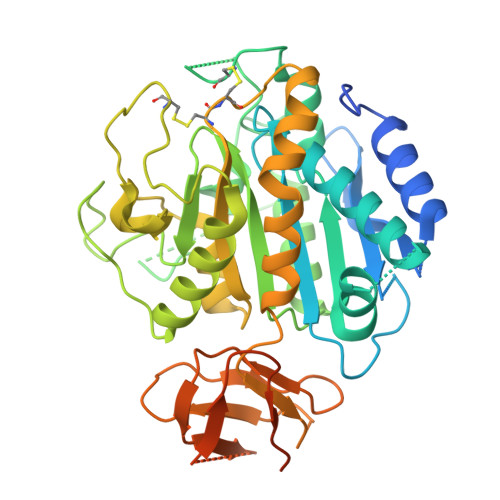
Structure of AAV8 capsid in complex with receptor


Experimental Data Snapshot

  • Method: ELECTRON MICROSCOPY
  • Resolution: 2.89 Å
  • Aggregation State: PARTICLE 
  • Reconstruction Method: SINGLE PARTICLE 

wwPDB Validation   3D Report Full Report


This is version 1.2 of the entry. See complete history


Literature

An alternate receptor for adeno-associated viruses.

Dhungel, B.P.Xu, H.Nagarajah, R.Vitale, J.Wong, A.C.H.Gokal, D.Feng, Y.Tabar, M.S.Metierre, C.Parsania, C.Song, X.Wang, G.Su, X.D.Bailey, C.G.Rasko, J.E.J.

(2025) Cell 188: 4924

  • DOI: https://doi.org/10.1016/j.cell.2025.06.026
  • Primary Citation of Related Structures:  
    9J6Z, 9J7K, 9J7L

  • PubMed Abstract: 

    Systemic gene therapy using adeno-associated virus (AAV) vectors is approved for the treatment of several genetic disorders, but challenges and toxicities associated with high vector doses remain. We report an alternate receptor for AAV (AAVR2, carboxypeptidase D [CPD]), which is distinct from the multi-serotype AAV receptor (AAVR). AAVR2 enables the transduction of clade E AAVs, including AAV8, and determines an exclusive AAVR-independent transduction pathway for AAV11 and AAV12. We characterized direct binding between the AAV8 capsid and AAVR2 by cryo-electron microscopy (cryo-EM) and identified contact residues. We observed that AAV8 directly binds to the carboxypeptidase-like domain 1 of AAVR2 via its variable region VIII and demonstrated that AAV capsids that lack AAVR2 binding can be bioengineered to engage with AAVR2. Finally, we overexpressed a minimal functional AAVR2 to enhance AAV transduction in vivo. Our study provides insights into AAV biology and clinically deployable solutions to reduce dose-related toxicities associated with AAV vectors.


  • Organizational Affiliation
    • School of Medical Sciences, Faculty of Medicine & Health, The University of Sydney, Camperdown, NSW 2006, Australia; Cancer & Gene Regulation Laboratory Centenary Institute, The University of Sydney, Camperdown, NSW 2050, Australia; Centre for Rare Diseases & Gene Therapy Centenary Institute, The University of Sydney, Camperdown, NSW 2050, Australia.

Macromolecules
Find similar proteins by:  (by identity cutoff)  |  3D Structure
Entity ID: 1
MoleculeChains Sequence LengthOrganismDetailsImage
Capsid protein738adeno-associated virus 8Mutation(s): 0 
UniProt
Find proteins for Q8JQF8 (adeno-associated virus 8)
Explore Q8JQF8 
Go to UniProtKB:  Q8JQF8
Entity Groups  
Sequence Clusters30% Identity50% Identity70% Identity90% Identity95% Identity100% Identity
UniProt GroupQ8JQF8
Sequence Annotations
Expand
  • Reference Sequence
Find similar proteins by:  (by identity cutoff)  |  3D Structure
Entity ID: 2
MoleculeChains Sequence LengthOrganismDetailsImage
Carboxypeptidase DD [auth A]470Homo sapiensMutation(s): 0 
Gene Names: CPD
EC: 3.4.17.22
UniProt & NIH Common Fund Data Resources
Find proteins for O75976 (Homo sapiens)
Explore O75976 
Go to UniProtKB:  O75976
PHAROS:  O75976
GTEx:  ENSG00000108582 
Entity Groups  
Sequence Clusters30% Identity50% Identity70% Identity90% Identity95% Identity100% Identity
UniProt GroupO75976
Sequence Annotations
Expand
  • Reference Sequence
Experimental Data & Validation

Experimental Data

  • Method: ELECTRON MICROSCOPY
  • Resolution: 2.89 Å
  • Aggregation State: PARTICLE 
  • Reconstruction Method: SINGLE PARTICLE 

Structure Validation

View Full Validation Report


Entry History & Funding Information

Deposition Data


Funding OrganizationLocationGrant Number
Ministry of Science and Technology (MoST, China)China--

Revision History  (Full details and data files)

  • Version 1.0: 2025-07-23
    Type: Initial release
  • Version 1.1: 2025-07-30
    Changes: Data collection, Database references
  • Version 1.2: 2025-09-24
    Changes: Data collection, Database references