9J7G | pdb_00009j7g

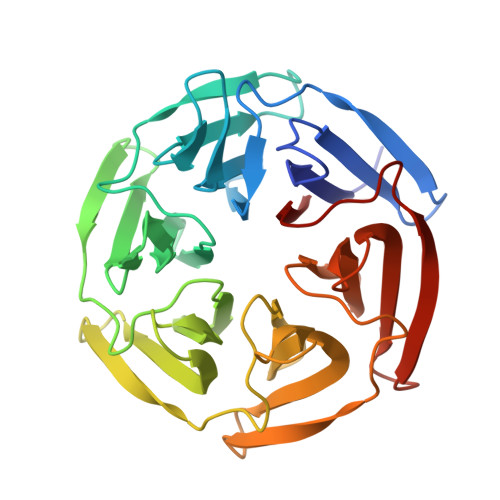
Crystal strcuture of Keap1_compound_8

  • Classification: LIGASE
  • Organism(s): Homo sapiens
  • Expression System: Escherichia coli
  • Mutation(s): No 

  • Deposited: 2024-08-18 Released: 2025-06-25 
  • Deposition Author(s): Xu, K.
  • Funding Organization(s): National Natural Science Foundation of China (NSFC)

Experimental Data Snapshot

  • Method: X-RAY DIFFRACTION
  • Resolution: 2.99 Å
  • R-Value Free: 
    0.250 (Depositor), 0.250 (DCC) 
  • R-Value Work: 
    0.199 (Depositor), 0.205 (DCC) 
  • R-Value Observed: 
    0.202 (Depositor) 

Starting Model: experimental
View more details

wwPDB Validation   3D Report Full Report


Ligand Structure Quality Assessment 


This is version 1.1 of the entry. See complete history


Literature

Chemical knockdown of Keap1 and homoPROTAC-ing allergic rhinitis.

Yan, J.Wang, T.Yu, R.Xu, L.Shao, H.Li, T.Wang, Z.Cha, X.Miao, Z.Xing, C.Xu, K.Liu, H.Zhuang, C.

(2025) Acta Pharm Sin B 15: 4137-4155

  • DOI: https://doi.org/10.1016/j.apsb.2025.05.025
  • Primary Citation of Related Structures:  
    9J70, 9J71, 9J7F, 9J7G

  • PubMed Abstract: 

    Allergic rhinitis (AR), a globally prevalent immune-mediated inflammatory condition, is still an incurable disease. In the present study, we have validated the impact of the Kelch-like ECH associated protein 1 (Keap1)-related oxidative stress and inflammatory response in clinical AR patient peripheral blood and nasal swab samples, emphasizing the biological relevance of Keap1 and AR. Targeting Keap1 -nuclear factor erythroid 2-related factor 2 (Nrf2) related anti-oxidative stress may be effective for AR intervention. Drawing inspiration from the Keap1 homodimerization and the E3 ligase characteristics, we herein present a design of novel bivalent molecules for chemical knockdown of Keap1. For the first time, we characterized ternary complexes of Keap1 dimer and one molecule of bivalent compounds. The best bivalent molecule 8 encompasses robust capacity to degrade Keap1 as a homoPROTAC KEAP1 . It efficaciously suppresses inflammatory cytokines in extensively different cells, including human nasal epithelial cells. Moreover, in an AR mouse model, we confirmed that the chemical degradation induced by homoPROTAC KEAP1 led to therapeutic benefits in managing AR symptoms, oxidative stress and inflammation. In summary, our findings underscore the efficacy of targeting the Keap1 system through the homoPROTAC-ing technology as an innovative and promising treatment strategy for the incurable allergic disorders.


  • Organizational Affiliation
    • The Center for Basic Research and Innovation of Medicine and Pharmacy (MOE), School of Pharmacy, Naval Medical University/Second Military Medical University, Shanghai 200433, China.

Macromolecules
Find similar proteins by:  (by identity cutoff)  |  3D Structure
Entity ID: 1
MoleculeChains Sequence LengthOrganismDetailsImage
Kelch-like ECH-associated protein 1A,
B,
C,
D [auth X]
288Homo sapiensMutation(s): 0 
Gene Names: KEAP1INRF2KIAA0132KLHL19
UniProt & NIH Common Fund Data Resources
Find proteins for Q14145 (Homo sapiens)
Explore Q14145 
Go to UniProtKB:  Q14145
PHAROS:  Q14145
GTEx:  ENSG00000079999 
Entity Groups  
Sequence Clusters30% Identity50% Identity70% Identity90% Identity95% Identity100% Identity
UniProt GroupQ14145
Sequence Annotations
Expand
  • Reference Sequence
Small Molecules
Ligands 2 Unique
IDChains Name / Formula / InChI Key2D Diagram3D Interactions
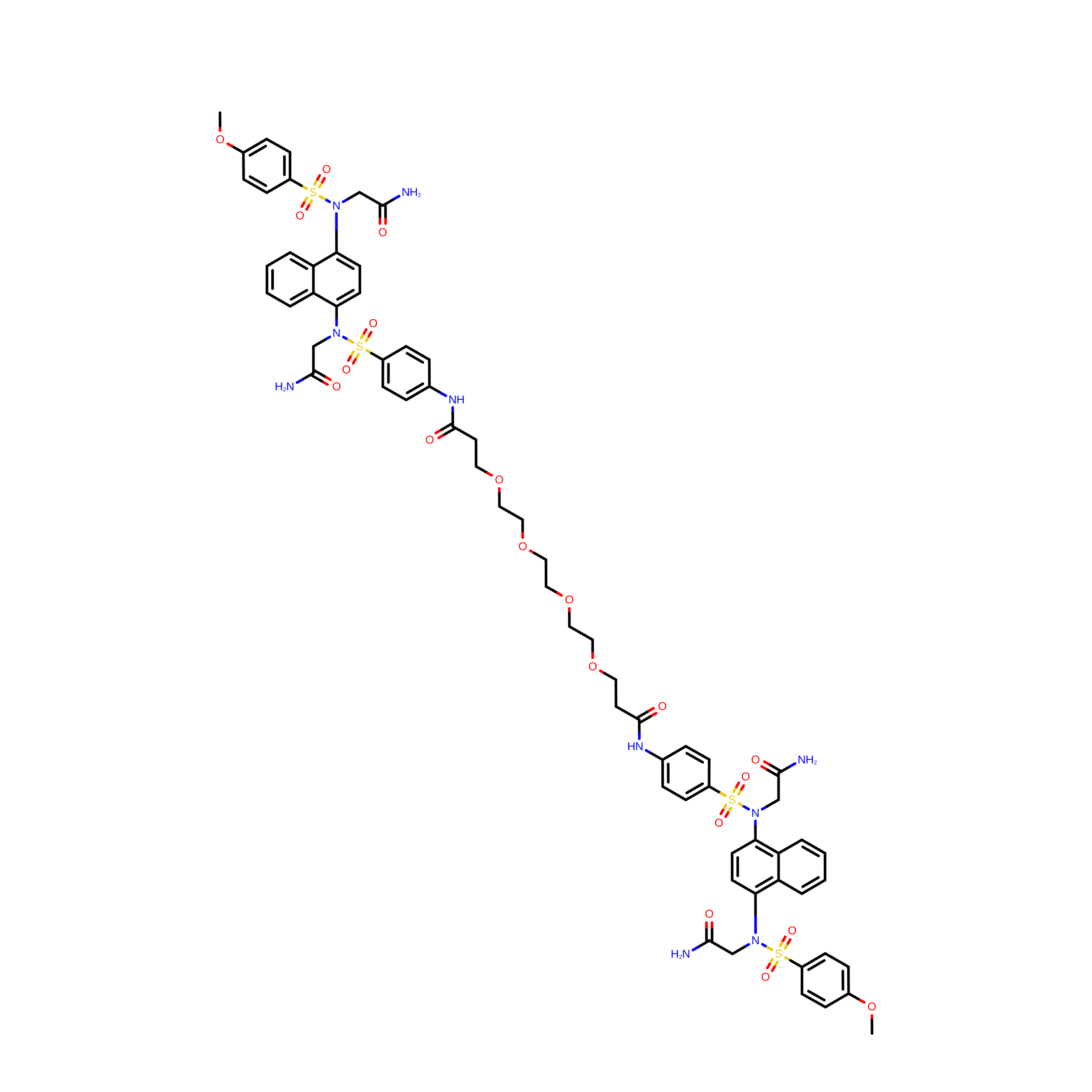
A1EMM (Subject of Investigation/LOI)
Query on A1EMM

Download Ideal Coordinates CCD File 
G [auth X]~{N}-[4-[(2-azanyl-2-oxidanylidene-ethyl)-[4-[(2-azanyl-2-oxidanylidene-ethyl)-(4-methoxyphenyl)sulfonyl-amino]naphthalen-1-yl]sulfamoyl]phenyl]-3-[2-[2-[2-[3-[[4-[(2-azanyl-2-oxidanylidene-ethyl)-[4-[(2-azanyl-2-oxidanylidene-ethyl)-(4-methoxyphenyl)sulfonyl-amino]naphthalen-1-yl]sulfamoyl]phenyl]amino]-3-oxidanylidene-propoxy]ethoxy]ethoxy]ethoxy]propanamide
C66 H72 N10 O20 S4
HHZFKMAZVHFXER-UHFFFAOYSA-N
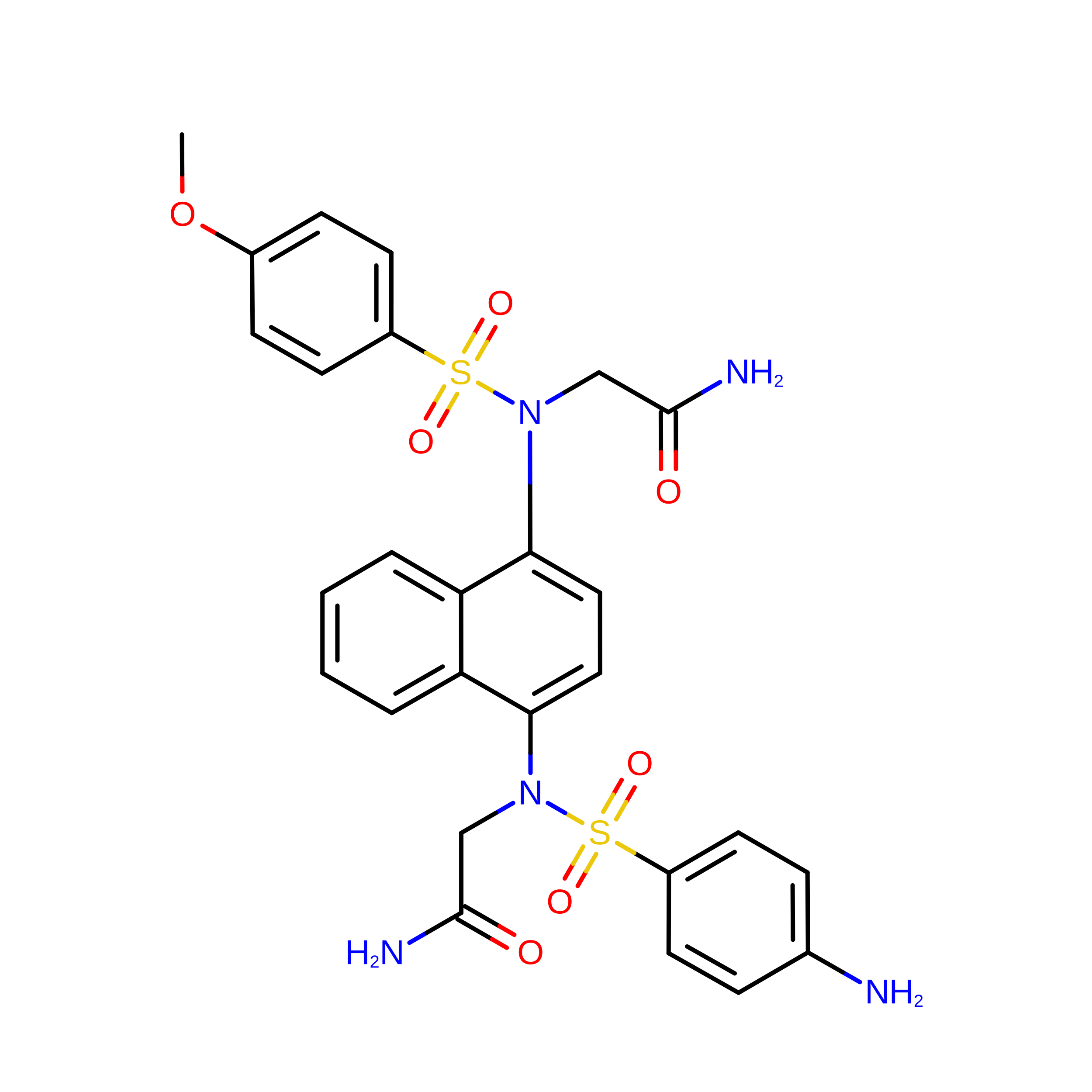
GFD
Query on GFD

Download Ideal Coordinates CCD File 
E [auth A],
F [auth C]
2-[(4-aminophenyl)sulfonyl-[4-[(2-azanyl-2-oxidanylidene-ethyl)-(4-methoxyphenyl)sulfonyl-amino]naphthalen-1-yl]amino]ethanamide
C27 H27 N5 O7 S2
DFIZGWXPFCOCFG-UHFFFAOYSA-N
Experimental Data & Validation

Experimental Data

  • Method: X-RAY DIFFRACTION
  • Resolution: 2.99 Å
  • R-Value Free:  0.250 (Depositor), 0.250 (DCC) 
  • R-Value Work:  0.199 (Depositor), 0.205 (DCC) 
  • R-Value Observed: 0.202 (Depositor) 
Space Group: P 1 21 1
Unit Cell:
Length ( Å )Angle ( ˚ )
a = 109.472α = 90
b = 74.149β = 100.861
c = 123.113γ = 90
Software Package:
Software NamePurpose
PHENIXrefinement
PHENIXphasing
Cootmodel building
XDSdata scaling
XDSdata reduction

Structure Validation

View Full Validation Report


Ligand Structure Quality Assessment 


Entry History & Funding Information

Deposition Data

  • Released Date: 2025-06-25 
  • Deposition Author(s): Xu, K.

Funding OrganizationLocationGrant Number
National Natural Science Foundation of China (NSFC)China--

Revision History  (Full details and data files)

  • Version 1.0: 2025-06-25
    Type: Initial release
  • Version 1.1: 2025-09-17
    Changes: Database references