Download Mendeley
Myeloperoxidase transforms chromatin into neutrophil extracellular traps.
Burn, G.L., Raisch, T., Tacke, S., Winkler, M., Prumbaum, D., Thee, S., Gimber, N., Raunser, S., Zychlinsky, A.(2025) Nature 647: 747-756
- PubMed: 40963017 Search on PubMedSearch on PubMed Central
- DOI: https://doi.org/10.1038/s41586-025-09523-9
- Primary Citation Related Structures:
9GEN, 9GEO, 9GEP, 9GEQ, 9GER, 9IHD, 9IHE, 9IHF - PubMed Abstract:
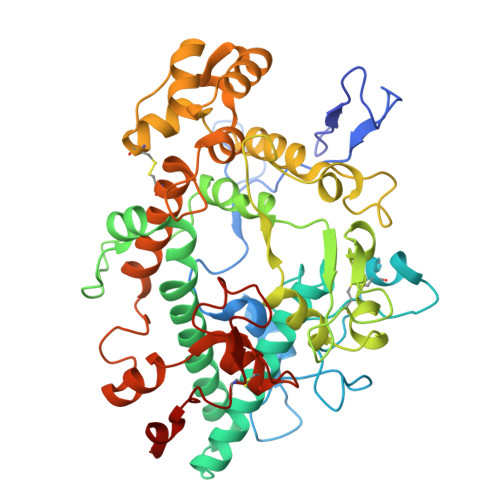
Neutrophils, the most abundant and biotoxic immune cells, extrude nuclear DNA into the extracellular space to maintain homeostasis. Termed neutrophil extracellular traps (NETs), these protein-modified and decondensed extracellular DNA scaffolds control infection and are involved in coagulation, autoimmunity and cancer 1,2 . Here we show how myeloperoxidase (MPO), a highly expressed neutrophil protein, disassembles nucleosomes, thereby facilitating NET formation, yet also binds stably to NETs extracellularly. We describe how the oligomeric status of MPO governs both outcomes. MPO dimers interact with nucleosomal DNA using one protomer and concurrently dock into the nucleosome acidic patch with the other protomer. As a consequence, dimeric MPO displaces DNA from the core complex, culminating in nucleosome disassembly. On the other hand, MPO monomers stably interact with the nucleosome acidic patch without making concomitant DNA contacts, explaining how monomeric MPO binds to and licences NETs to confer hypohalous acid production in the extracellular space 3 . Our data demonstrate that the binding of MPO to chromatin is governed by specific molecular interactions that transform chromatin into a non-replicative, non-encoding state that offers new biological functions in a cell-free manner. We propose that MPO is, to our knowledge, the first member of a class of proteins that convert chromatin into an immune effector.
- Department of Cellular Microbiology, Max Planck Institute for Infection Biology, Berlin, Germany.
Organizational Affiliation: