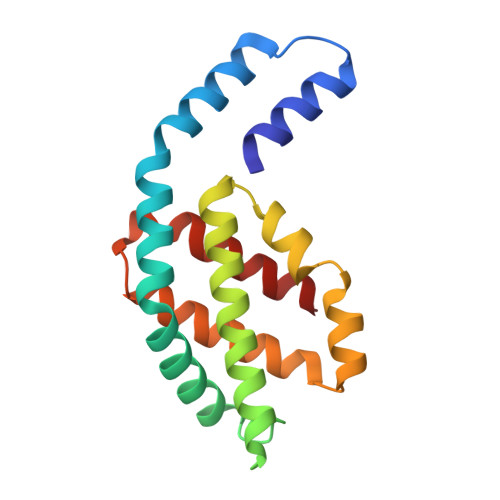
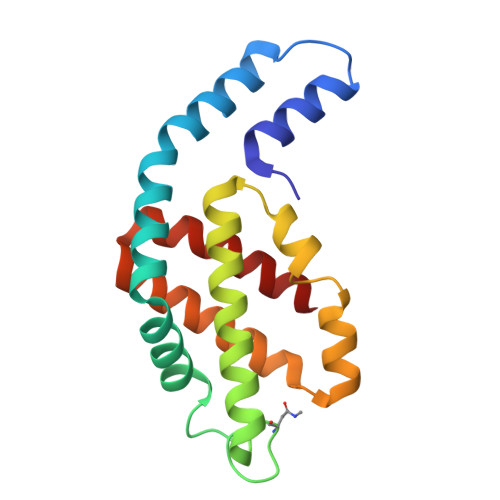
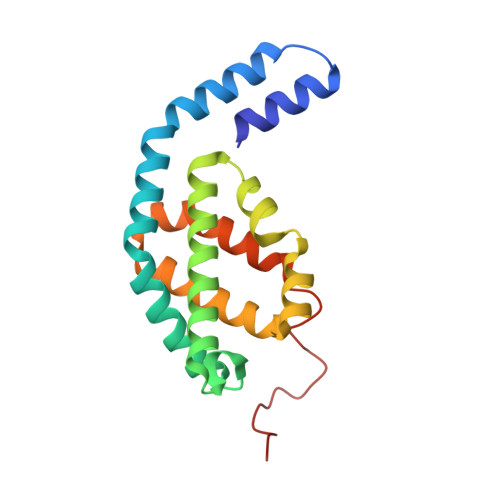
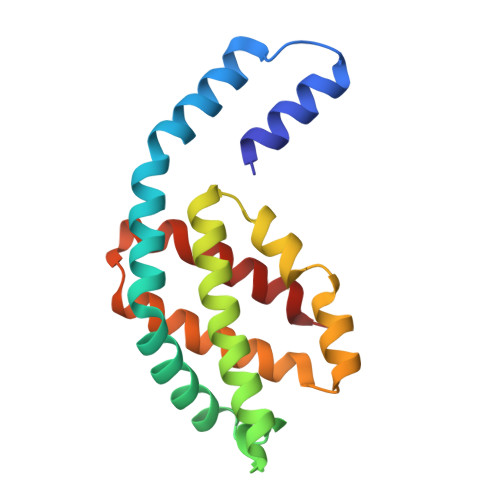
9I1R | pdb_00009i1r

Structure of the bicylindrical allophycocyanin core expressed during far-red light photoacclimation (FaRLiP)


Experimental Data Snapshot

  • Method: ELECTRON MICROSCOPY
  • Resolution: 2.51 Å
  • Aggregation State: PARTICLE 
  • Reconstruction Method: SINGLE PARTICLE 

Starting Model: experimental
View more details

wwPDB Validation   3D Report Full Report


This is version 1.0 of the entry. See complete history


Literature

Structure of a stripped-down and tuned-up far-red phycobilisome.

Consoli, G.Leong, H.F.Davis, G.A.Richardson, T.McInnes, A.Murray, J.W.Fantuzzi, A.Rutherford, A.W.

(2025) Commun Biol 8: 907-907

  • DOI: https://doi.org/10.1038/s42003-025-08326-y
  • Primary Citation of Related Structures:  
    9I1R

  • PubMed Abstract: 

    A diverse subset of cyanobacteria can transiently modify their photosynthetic machinery during far-red light photoacclimation to drive photosynthesis with less energetic photons (700 nm-800 nm). To achieve this, all the main light-driven components of the photosynthetic apparatus, including their allophycocyanin antenna, are replaced with red-shifted paralogues. Recent studies based on the structure of an incomplete complex provided some insights into the tuning of the far-red phycobiliproteins. Here, we solved the structure of the intact bicylindrical allophycocyanin complex from the cyanobacterium Chroococcidiopsis thermalis PCC 7203 at a resolution of 2.51 Å determined by Cryo-electron microscopy single particle analysis. A comparison between conserved structural features in far-red and white light allophycocyanin cores provides insight on the evolutionary adaptations needed to optimize excitation energy transfer in the far-red light adapted photosynthetic apparatus. The reduction in antenna size in far-red photosynthesis suggests a need to optimize membrane packing to increase the number of photosystems and tune the ratio between chlorophyll f molecules and bilin pigments, while the wider spread in the absorption range of the bilins suggests faster and more efficient excitation energy transfer to far-red Photosystem II by limiting backflow of excitation from the reaction centres to the far-red bilin pigments.


  • Organizational Affiliation
    • Department of Life Sciences, Imperial College, London, UK.

Macromolecules
Find similar proteins by:  (by identity cutoff)  |  3D Structure
Entity ID: 1
MoleculeChains Sequence LengthOrganismDetailsImage
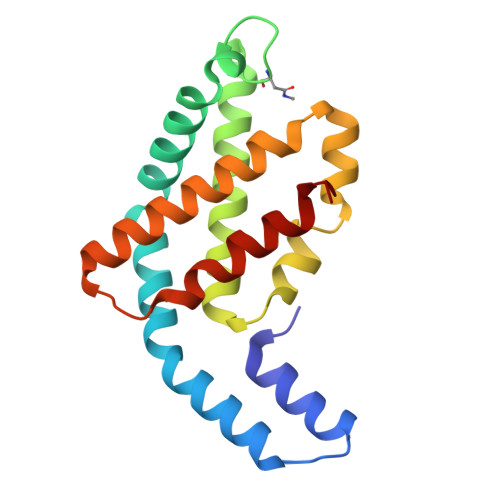
Phycocyanin158Chroococcidiopsis thermalis PCC 7203Mutation(s): 0 
Gene Names: Chro_1032
UniProt
Find proteins for K9TX42 (Chroococcidiopsis thermalis (strain PCC 7203))
Explore K9TX42 
Go to UniProtKB:  K9TX42
Entity Groups  
Sequence Clusters30% Identity50% Identity70% Identity90% Identity95% Identity100% Identity
UniProt GroupK9TX42
Sequence Annotations
Expand
  • Reference Sequence
Find similar proteins by:  (by identity cutoff)  |  3D Structure
Entity ID: 2
MoleculeChains Sequence LengthOrganismDetailsImage
Allophycocyanin beta subunit apoprotein161Chroococcidiopsis thermalis PCC 7203Mutation(s): 0 
Gene Names: Chro_1033
UniProt
Find proteins for K9TVG8 (Chroococcidiopsis thermalis (strain PCC 7203))
Explore K9TVG8 
Go to UniProtKB:  K9TVG8
Entity Groups  
Sequence Clusters30% Identity50% Identity70% Identity90% Identity95% Identity100% Identity
UniProt GroupK9TVG8
Sequence Annotations
Expand
  • Reference Sequence
Find similar proteins by:  (by identity cutoff)  |  3D Structure
Entity ID: 3
MoleculeChains Sequence LengthOrganismDetailsImage
PhycocyaninBA [auth c],
C
175Chroococcidiopsis thermalis PCC 7203Mutation(s): 0 
Gene Names: Chro_1036
UniProt
Find proteins for K9TVZ1 (Chroococcidiopsis thermalis (strain PCC 7203))
Explore K9TVZ1 
Go to UniProtKB:  K9TVZ1
Entity Groups  
Sequence Clusters30% Identity50% Identity70% Identity90% Identity95% Identity100% Identity
UniProt GroupK9TVZ1
Sequence Annotations
Expand
  • Reference Sequence
Find similar proteins by:  (by identity cutoff)  |  3D Structure
Entity ID: 4
MoleculeChains Sequence LengthOrganismDetailsImage
PhycocyaninHA [auth i],
I
159Chroococcidiopsis thermalis PCC 7203Mutation(s): 0 
Gene Names: Chro_1034
UniProt
Find proteins for K9TWK3 (Chroococcidiopsis thermalis (strain PCC 7203))
Explore K9TWK3 
Go to UniProtKB:  K9TWK3
Entity Groups  
Sequence Clusters30% Identity50% Identity70% Identity90% Identity95% Identity100% Identity
UniProt GroupK9TWK3
Sequence Annotations
Expand
  • Reference Sequence
Find similar proteins by:  (by identity cutoff)  |  3D Structure
Entity ID: 5
MoleculeChains Sequence LengthOrganismDetailsImage
Allophycocyanin beta-18 subunit apoproteinIA [auth j],
J
169Chroococcidiopsis thermalis PCC 7203Mutation(s): 0 
Gene Names: Chro_1766
UniProt
Find proteins for K9TY40 (Chroococcidiopsis thermalis (strain PCC 7203))
Explore K9TY40 
Go to UniProtKB:  K9TY40
Entity Groups  
Sequence Clusters30% Identity50% Identity70% Identity90% Identity95% Identity100% Identity
UniProt GroupK9TY40
Sequence Annotations
Expand
  • Reference Sequence
Find similar proteins by:  (by identity cutoff)  |  3D Structure
Entity ID: 6
MoleculeChains Sequence LengthOrganismDetailsImage
Phycobiliprotein ApcEJA [auth k],
K
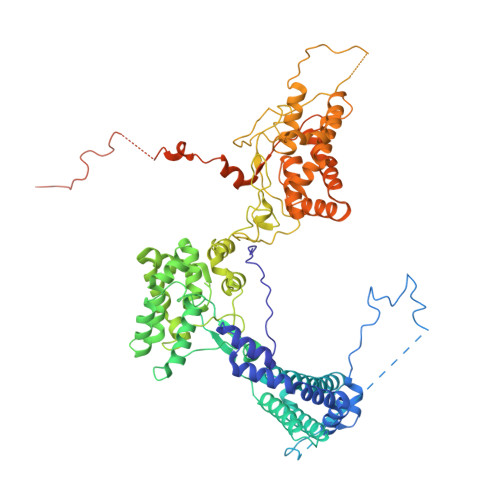
780Chroococcidiopsis thermalis PCC 7203Mutation(s): 0 
Gene Names: Chro_1035
UniProt
Find proteins for K9TUP3 (Chroococcidiopsis thermalis (strain PCC 7203))
Explore K9TUP3 
Go to UniProtKB:  K9TUP3
Entity Groups  
Sequence Clusters30% Identity50% Identity70% Identity90% Identity95% Identity100% Identity
UniProt GroupK9TUP3
Sequence Annotations
Expand
  • Reference Sequence
Find similar proteins by:  (by identity cutoff)  |  3D Structure
Entity ID: 7
MoleculeChains Sequence LengthOrganismDetailsImage
Phycobilisome 7.8 kDa linker polypeptide, allophycocyanin-associated, coreRA [auth s],
S
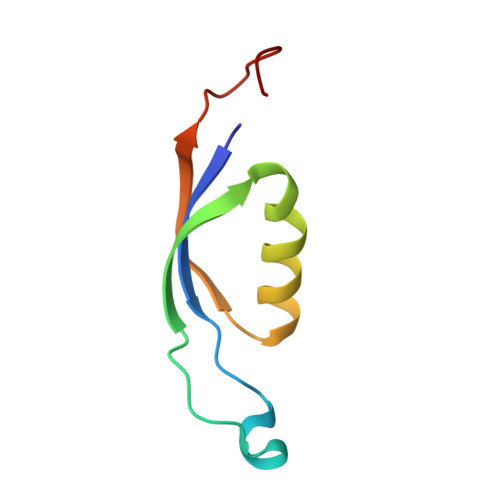
67Chroococcidiopsis thermalis PCC 7203Mutation(s): 0 
Gene Names: Chro_4322
UniProt
Find proteins for K9U510 (Chroococcidiopsis thermalis (strain PCC 7203))
Explore K9U510 
Go to UniProtKB:  K9U510
Entity Groups  
Sequence Clusters30% Identity50% Identity70% Identity90% Identity95% Identity100% Identity
UniProt GroupK9U510
Sequence Annotations
Expand
  • Reference Sequence
Small Molecules
Ligands 1 Unique
IDChains Name / Formula / InChI Key2D Diagram3D Interactions
CYC (Subject of Investigation/LOI)
Query on CYC

Download Ideal Coordinates CCD File 
AB [auth C]
AC [auth e]
BB [auth D]
BC [auth f]
CB [auth E]
AB [auth C],
AC [auth e],
BB [auth D],
BC [auth f],
CB [auth E],
CC [auth g],
DB [auth F],
DC [auth h],
EB [auth G],
EC [auth i],
FB [auth H],
FC [auth j],
GB [auth I],
GC [auth k],
HB [auth J],
HC [auth l],
IB [auth K],
IC [auth m],
JB [auth L],
JC [auth n],
KB [auth M],
KC [auth o],
LB [auth N],
LC [auth p],
MB [auth O],
MC [auth q],
NB [auth P],
NC [auth r],
OB [auth Q],
OC [auth t],
PB [auth R],
PC [auth u],
QB [auth T],
QC [auth v],
RB [auth U],
RC [auth w],
SB [auth V],
SC [auth x],
TB [auth W],
TC [auth y],
UB [auth X],
VB [auth Y],
WB [auth a],
XB [auth b],
YA [auth A],
YB [auth c],
ZA [auth B],
ZB [auth d]
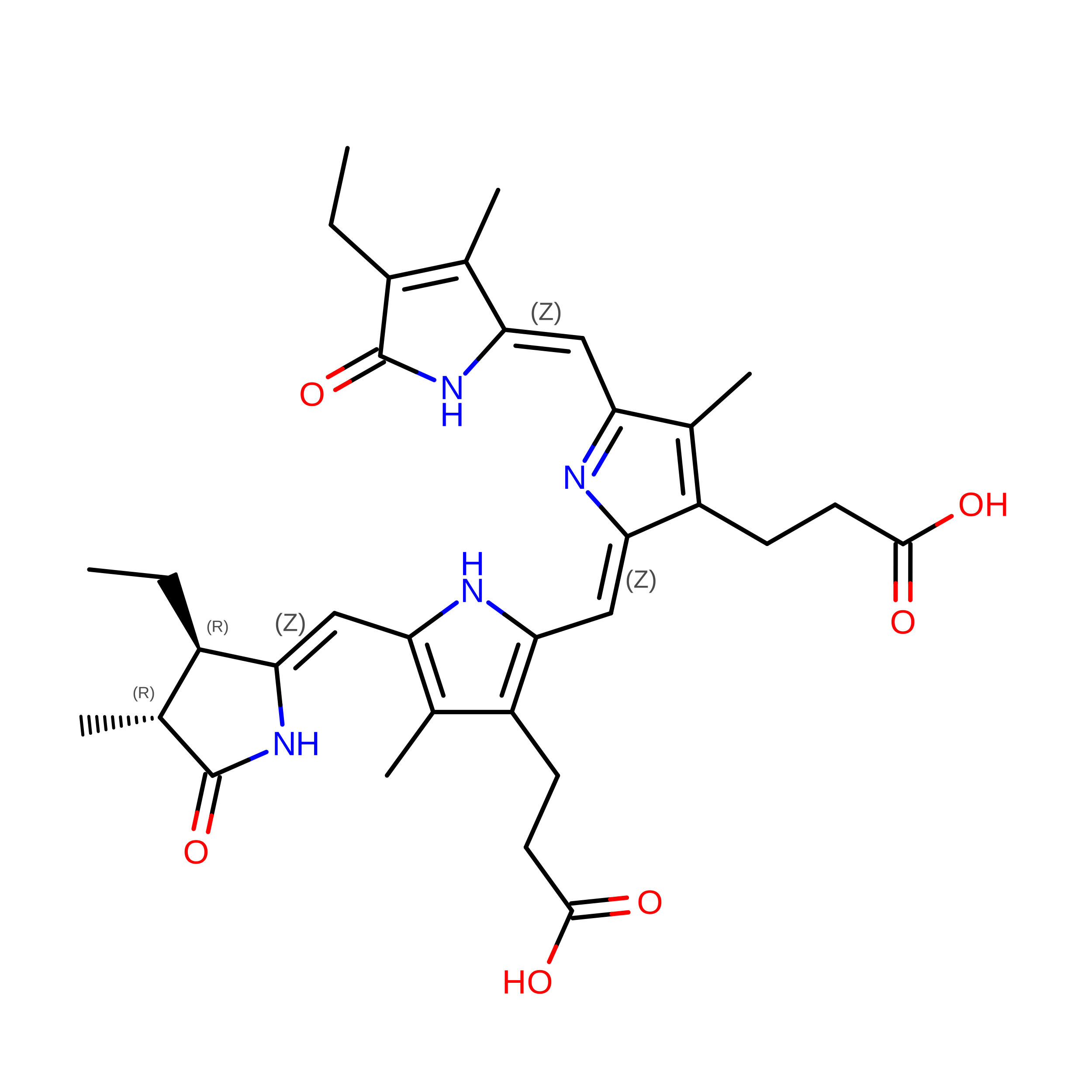
PHYCOCYANOBILIN
C33 H40 N4 O6
VXTXPYZGDQPMHK-GMXXPEQVSA-N
Modified Residues  1 Unique
IDChains TypeFormula2D DiagramParent
MEN
Query on MEN
AA [auth b]
B
CA [auth d]
D
EA [auth f]
AA [auth b],
B,
CA [auth d],
D,
EA [auth f],
F,
GA [auth h],
H,
KA [auth l],
L,
MA [auth n],
N,
OA [auth p],
P,
QA [auth r],
R,
TA [auth u],
U,
VA [auth w],
W,
XA [auth y],
Y
L-PEPTIDE LINKINGC5 H10 N2 O3ASN
Experimental Data & Validation

Experimental Data

  • Method: ELECTRON MICROSCOPY
  • Resolution: 2.51 Å
  • Aggregation State: PARTICLE 
  • Reconstruction Method: SINGLE PARTICLE 
EM Software:
TaskSoftware PackageVersion
MODEL REFINEMENTPHENIX1.21.2_5419

Structure Validation

View Full Validation Report


Entry History & Funding Information

Deposition Data


Funding OrganizationLocationGrant Number
H2020 Marie Curie Actions of the European CommissionEuropean Union955520
Biotechnology and Biological Sciences Research Council (BBSRC)United KingdomBB/R001383/1
Biotechnology and Biological Sciences Research Council (BBSRC)United KingdomBB/V002015/1
Biotechnology and Biological Sciences Research Council (BBSRC)United KingdomBB/R00921X
Leverhulme TrustUnited KingdomRPG-2022-203
Royal SocietyUnited KingdomRoyal Society Research Professorship 2024

Revision History  (Full details and data files)

  • Version 1.0: 2025-07-02
    Type: Initial release