9GKS | pdb_00009gks

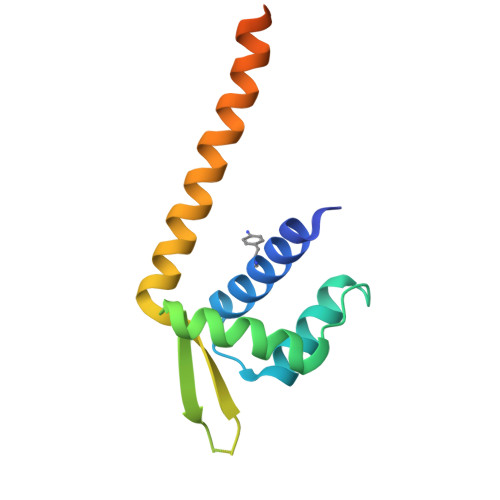
Crystal structure of artificial enzyme LmrR_pAF variant RMH in crystal form 2


Experimental Data Snapshot

  • Method: X-RAY DIFFRACTION
  • Resolution: 2.24 Å
  • R-Value Free: 
    0.294 (Depositor), 0.294 (DCC) 
  • R-Value Work: 
    0.227 (Depositor), 0.232 (DCC) 
  • R-Value Observed: 
    0.230 (Depositor) 

Starting Model: experimental
View more details

wwPDB Validation   3D Report Full Report


This is version 1.0 of the entry. See complete history


Literature

Evolutionary Specialization of a Promiscuous Designer Enzyme.

Leveson-Gower, R.B.Tiessler-Sala, L.Rozeboom, H.J.Thunnissen, A.W.H.Marechal, J.D.Roelfes, G.

(2025) ACS Catal 15: 1544-1552

  • DOI: https://doi.org/10.1021/acscatal.4c06409
  • Primary Citation of Related Structures:  
    9GKR, 9GKS, 9GKT

  • PubMed Abstract: 

    The evolution of a promiscuous enzyme for its various activities often results in catalytically specialized variants. This is an important natural mechanism to ensure the proper functioning of natural metabolic networks. It also acts as both a curse and blessing for enzyme engineers, where enzymes that have undergone directed evolution may exhibit exquisite selectivity at the expense of a diminished overall catalytic repertoire. We previously performed two independent directed evolution campaigns on a promiscuous designer enzyme that leverages the unique properties of a noncanonical amino acid (ncAA) para -aminophenylalanine (pAF) as catalytic residue, resulting in two evolved variants which are both catalytically specialized. Here, we combine mutagenesis, crystallography, and computation to reveal the molecular basis of the specialization phenomenon. In one evolved variant, an unexpected change in quaternary structure biases substrate dynamics to promote enantioselective catalysis, while the other demonstrates synergistic cooperation between natural side chains and the pAF residue to form semisynthetic catalytic machinery.


  • Organizational Affiliation
    • Stratingh Institute for Chemistry, University of Groningen, 9747AG Groningen, The Netherlands.

Macromolecules
Find similar proteins by:  (by identity cutoff)  |  3D Structure
Entity ID: 1
MoleculeChains Sequence LengthOrganismDetailsImage
Transcriptional regulator, PadR-like family
A, B
131Lactococcus cremoris subsp. cremoris MG1363Mutation(s): 4 
Gene Names: llmg_0323
UniProt
Find proteins for A2RI36 (Lactococcus lactis subsp. cremoris (strain MG1363))
Explore A2RI36 
Go to UniProtKB:  A2RI36
Entity Groups  
Sequence Clusters30% Identity50% Identity70% Identity90% Identity95% Identity100% Identity
UniProt GroupA2RI36
Sequence Annotations
Expand
  • Reference Sequence
Small Molecules
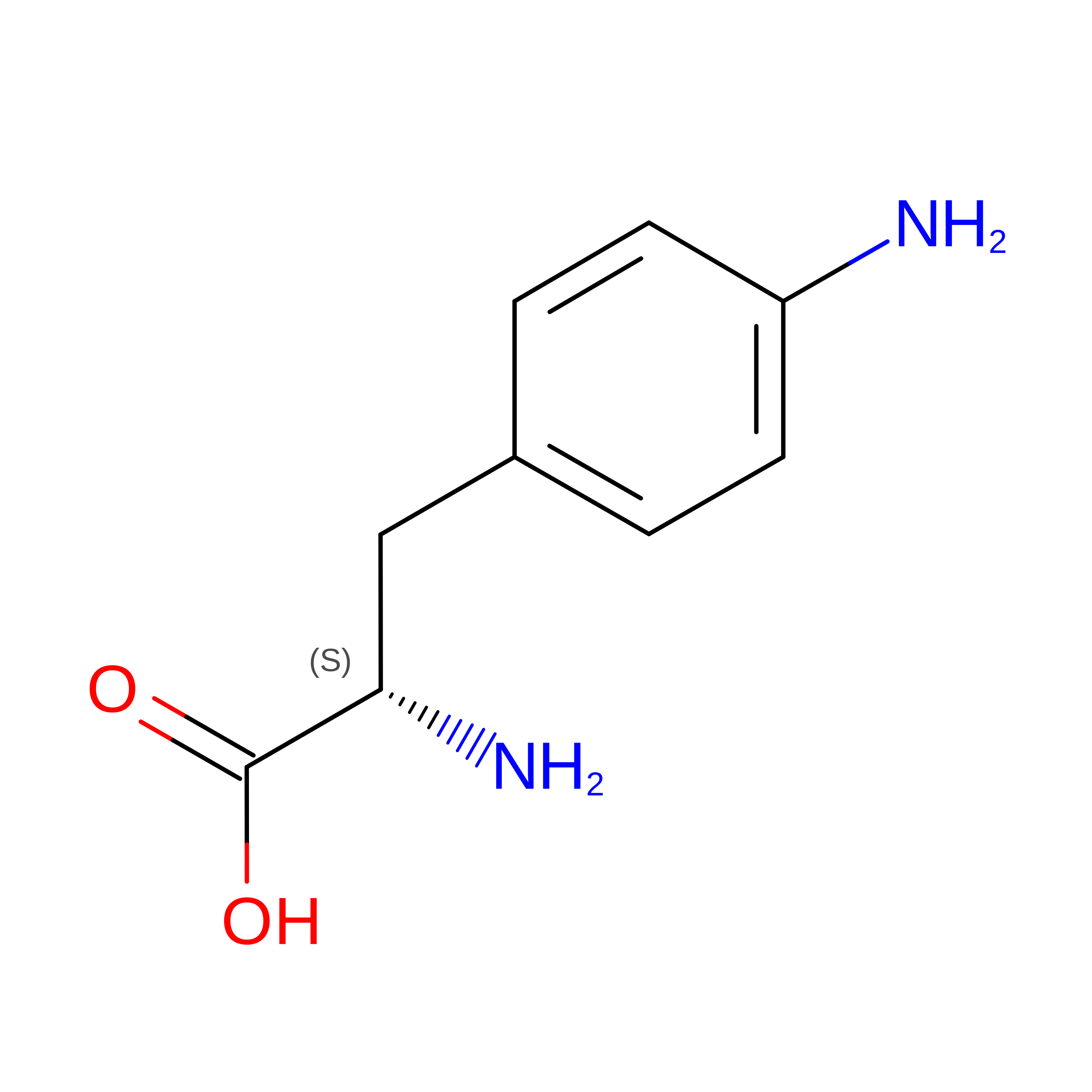
Modified Residues  1 Unique
IDChains TypeFormula2D DiagramParent
HOX
Query on HOX
A, B
L-PEPTIDE LINKINGC9 H12 N2 O2PHE
Experimental Data & Validation

Experimental Data

  • Method: X-RAY DIFFRACTION
  • Resolution: 2.24 Å
  • R-Value Free:  0.294 (Depositor), 0.294 (DCC) 
  • R-Value Work:  0.227 (Depositor), 0.232 (DCC) 
  • R-Value Observed: 0.230 (Depositor) 
Space Group: C 1 2 1
Unit Cell:
Length ( Å )Angle ( ˚ )
a = 104.927α = 90
b = 35.303β = 97.27
c = 68.18γ = 90
Software Package:
Software NamePurpose
DIALSdata reduction
Aimlessdata scaling
PHASERphasing
PHENIXrefinement

Structure Validation

View Full Validation Report


Entry History & Funding Information

Deposition Data


Funding OrganizationLocationGrant Number
European Research Council (ERC)European Union885396

Revision History  (Full details and data files)

  • Version 1.0: 2025-02-26
    Type: Initial release