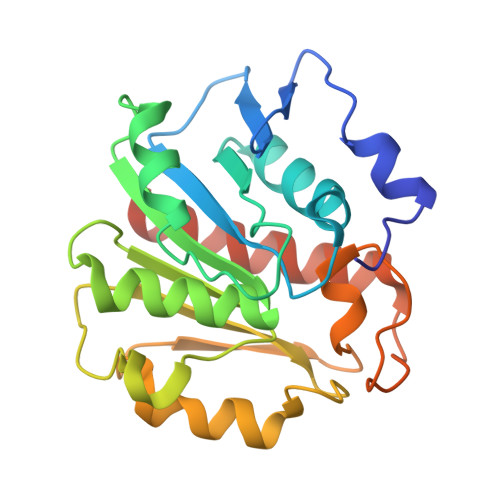
9EH6 | pdb_00009eh6

Crystal Structure of AroC


Experimental Data Snapshot

  • Method: X-RAY DIFFRACTION
  • Resolution: 2.25 Å
  • R-Value Free: 
    0.240 (Depositor), 0.236 (DCC) 
  • R-Value Work: 
    0.186 (Depositor), 0.184 (DCC) 

Starting Model: in silico
View more details

wwPDB Validation   3D Report Full Report


This is version 1.4 of the entry. See complete history


Literature

Mining Thermophile Genomes for New PETases with Exceptional Thermostabilities Using Sequence Similarity Networks.

Hu, Z.Klupt, K.Zechel, D.L.Jia, Z.Howe, G.

(2025) Chembiochem 26: e202500065-e202500065

  • DOI: https://doi.org/10.1002/cbic.202500065
  • Primary Citation of Related Structures:  
    9EH6

  • PubMed Abstract: 

    Enzymatic hydrolysis of polyethylene terephthalate (PET) is a promising technology for advancing a circular PET economy. Several PET-degrading α/β hydrolases have been identified, but the full potential of this enzyme family to catalyze PET hydrolysis remains largely unexplored. To address this, sequence similarity networks were employed to investigate the α/β hydrolase fold-5 subfamily (IPR029059) for new PETases. Priority was given to sequences from thermophiles, as thermostable enzymes are likely more suitable for industrial applications. Ten enzymes with ~20% sequence identity to the well-known LCC-PETase were identified, and seven were successfully overexpressed and purified for in vitro characterization. Each enzyme catalyzed the hydrolysis of p-nitrophenyl butyrate, a mimic of trimeric PET, and emulsified PET nanoparticles. Notably, three enzymes were also capable of hydrolyzing PET films. Novel PETases exhibited melting temperatures (Tm) exceeding 55 °C and only modest losses of activity after incubation at 70 °C for 24 hours. The crystal structure of AroC (Tm = 85 °C) was resolved to 2.2 Å, revealing several salt bridges that likely confer thermostability, and a unique loop that is conserved amongst the PETases described here. These novel enzymes will enable engineering campaigns to generate thermostable and catalytically efficient PETases for use as industrial biocatalysts.


  • Organizational Affiliation
    • Queens University, Chemistry, CANADA.

Macromolecules
Find similar proteins by:  (by identity cutoff)  |  3D Structure
Entity ID: 1
MoleculeChains Sequence LengthOrganismDetailsImage
Alpha/beta hydrolase fold-5 domain-containing protein
A, B
230Caldilinea aerophilaMutation(s): 0 
Gene Names: CLDAP_20430
UniProt
Find proteins for I0I495 (Caldilinea aerophila (strain DSM 14535 / JCM 11387 / NBRC 104270 / STL-6-O1))
Explore I0I495 
Go to UniProtKB:  I0I495
Entity Groups  
Sequence Clusters30% Identity50% Identity70% Identity90% Identity95% Identity100% Identity
UniProt GroupI0I495
Sequence Annotations
Expand
  • Reference Sequence
Experimental Data & Validation

Experimental Data

  • Method: X-RAY DIFFRACTION
  • Resolution: 2.25 Å
  • R-Value Free:  0.240 (Depositor), 0.236 (DCC) 
  • R-Value Work:  0.186 (Depositor), 0.184 (DCC) 
Space Group: P 1 21 1
Unit Cell:
Length ( Å )Angle ( ˚ )
a = 56.189α = 90
b = 46.817β = 101.969
c = 76.468γ = 90
Software Package:
Software NamePurpose
REFMACrefinement
XDSdata reduction
Aimlessdata scaling
MOLREPphasing

Structure Validation

View Full Validation Report


Entry History & Funding Information

Deposition Data


Funding OrganizationLocationGrant Number
Natural Sciences and Engineering Research Council (NSERC, Canada)CanadaRGPIN-2020-04455
Natural Sciences and Engineering Research Council (NSERC, Canada)CanadaRGPIN-2024-05181

Revision History  (Full details and data files)

  • Version 1.0: 2025-02-26
    Type: Initial release
  • Version 1.1: 2025-03-26
    Changes: Database references
  • Version 1.2: 2025-04-16
    Changes: Database references
  • Version 1.3: 2025-07-02
    Changes: Database references
  • Version 1.4: 2025-07-23
    Changes: Database references