9ECZ | pdb_00009ecz

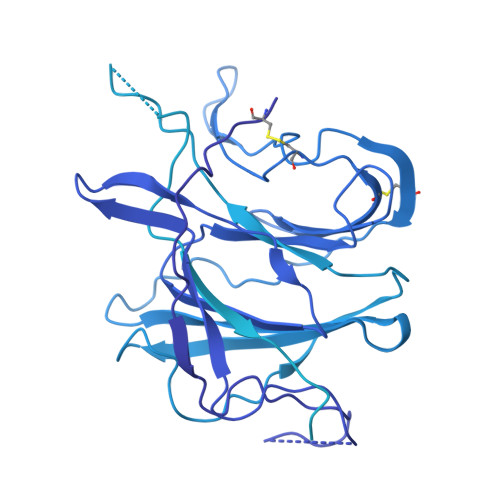
Cryo-EM structure of SARS-CoV-2 spike protein in complex with human neutralizing antibody WRAIR-2008 (focused refinement of NTD and WRAIR-2008)


Experimental Data Snapshot

  • Method: ELECTRON MICROSCOPY
  • Resolution: 3.89 Å
  • Aggregation State: PARTICLE 
  • Reconstruction Method: SINGLE PARTICLE 

Starting Model: experimental
View more details

wwPDB Validation   3D Report Full Report


This is version 1.2 of the entry. See complete history


Literature

First-generation N-terminal domain supersite public antibodies retain activity against Omicron-derived lineages and protect mice against Omicron BA.5 challenge.

Dussupt, V.Jensen, J.L.Thomas, P.V.Mendez-Rivera, L.Lal, K.G.Zemil McCrea, M.Swafford, I.Hernandez, J.Sankhala, R.S.Rao, M.Arora, J.Hajduczki, A.Jian, N.Rees, P.A.Showell-De Leon, I.Smith, G.Smith, L.Wasson, D.Schmid, A.Teng, I.T.Zhou, T.Kwong, P.D.Currier, J.R.Reiley, W.W.Paquin-Proulx, D.Polonis, V.R.Collins, N.D.Michael, N.L.Joyce, M.G.Krebs, S.J.

(2025) mBio 16: e0103625-e0103625

  • DOI: https://doi.org/10.1128/mbio.01036-25
  • Primary Citation of Related Structures:  
    9ECX, 9ECY, 9ECZ, 9MI3

  • PubMed Abstract: 

    Monoclonal antibodies to SARS-CoV-2 can offer prophylactic and therapeutic protection against severe disease, with particular utility for immunosuppressed and vulnerable populations. With the constant emergence of new variants, understanding the neutralizing potency of monoclonal antibodies to dynamic spike protein epitopes is crucial. We show that a set of VH1-24-derived N-terminal domain (NTD)-directed antibodies, isolated from a convalescent donor early in the pandemic, displayed remarkable neutralization resilience against many Omicron SARS-CoV-2 variants, including BA.2, BA.5, and BQ.1.1. Neutralization potency to these Omicron variants is associated with slower off-rates to the spike protein. Structural characterization of the most potent NTD antibody, WRAIR-2008, revealed a conserved mode of interaction shared with other antibodies of the same multi-donor class. WRAIR-2008 protected mice from weight loss following BA.5 challenge and reduced infectious viral titers in the lungs. Our study highlights the retention of neutralization activity and protection of first-generation VH1-24-derived NTD-directed antibodies to specific Omicron variants and provides valuable insights into the shifting landscape of SARS-CoV-2 variants that are vulnerable to select monoclonal antibodies. As SARS-CoV-2 circulating variants evolve, it is important to understand the vulnerabilities of these viruses to neutralizing antibodies. Within this manuscript, we describe first-generation antibodies isolated following infection with WA-1 that retain viral neutralization to subsequent Omicron variants by targeting a site of viral vulnerability called the NTD. This work highlights the shifting landscape of SARS-CoV-2 variants and provides mechanistic insights into how antibodies from prior infections may play a role in preventing subsequent SARS-CoV-2 variant infections.


  • Organizational Affiliation
    • Viral Diseases Program, Walter Reed Army Institute of Research, Silver Spring, Maryland, USA.

Macromolecules
Find similar proteins by:  (by identity cutoff)  |  3D Structure
Entity ID: 1
MoleculeChains Sequence LengthOrganismDetailsImage
Spike glycoprotein1,288Severe acute respiratory syndrome coronavirus 2Mutation(s): 9 
Gene Names: S2
UniProt
Find proteins for P0DTC2 (Severe acute respiratory syndrome coronavirus 2)
Explore P0DTC2 
Go to UniProtKB:  P0DTC2
Entity Groups  
Sequence Clusters30% Identity50% Identity70% Identity90% Identity95% Identity100% Identity
UniProt GroupP0DTC2
Glycosylation
Glycosylation Sites: 6Go to GlyGen: P0DTC2-1
Sequence Annotations
Expand
  • Reference Sequence
Find similar proteins by:  (by identity cutoff)  |  3D Structure
Entity ID: 2
MoleculeChains Sequence LengthOrganismDetailsImage
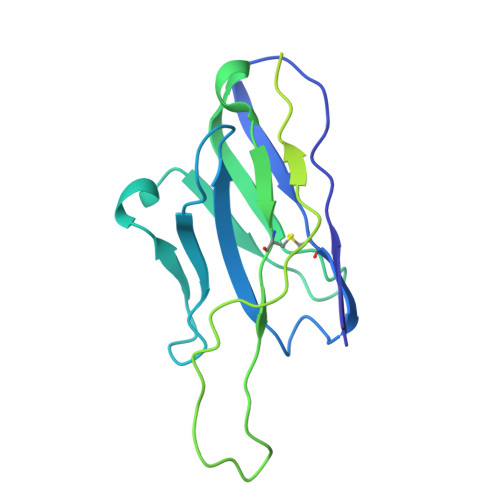
WRAIR-2008 antibody Fab heavy chainB [auth H]233Homo sapiensMutation(s): 0 
Entity Groups  
Sequence Clusters30% Identity50% Identity70% Identity90% Identity95% Identity100% Identity
Sequence Annotations
Expand
  • Reference Sequence
Find similar proteins by:  (by identity cutoff)  |  3D Structure
Entity ID: 3
MoleculeChains Sequence LengthOrganismDetailsImage
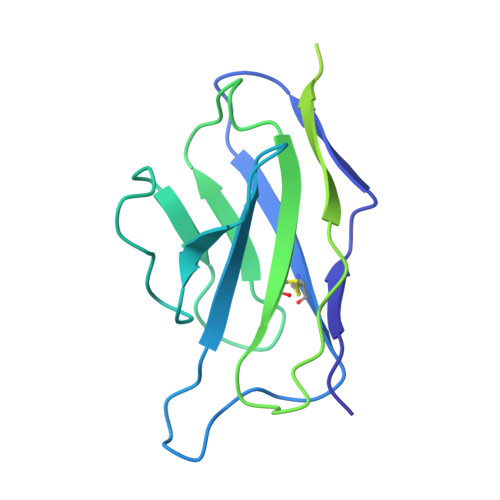
WRAIR-2008 antibody Fab light chainC [auth L]219Homo sapiensMutation(s): 0 
Entity Groups  
Sequence Clusters30% Identity50% Identity70% Identity90% Identity95% Identity100% Identity
Sequence Annotations
Expand
  • Reference Sequence
Oligosaccharides

Help

Entity ID: 4
MoleculeChains Length2D Diagram Glycosylation3D Interactions
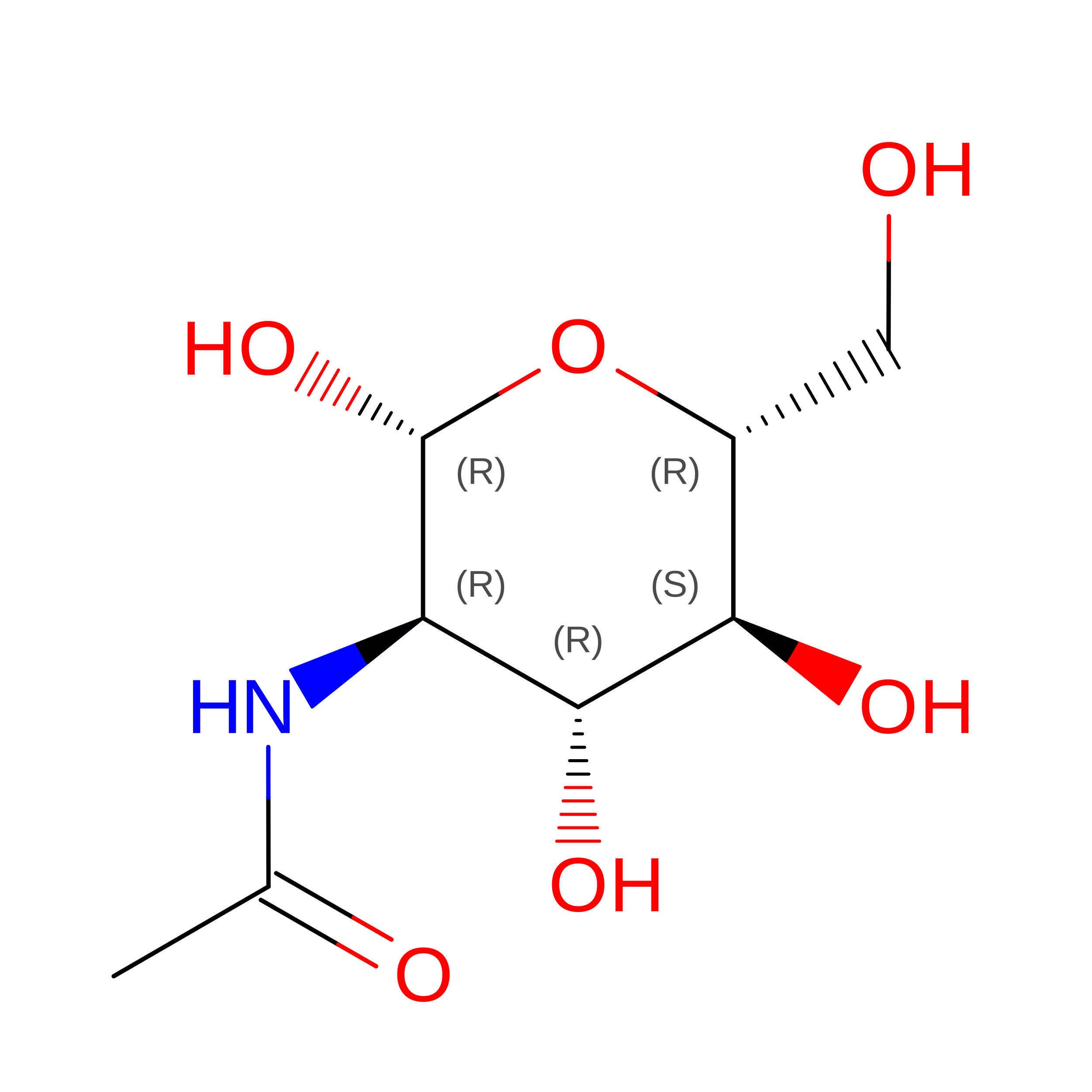
beta-D-mannopyranose-(1-4)-2-acetamido-2-deoxy-beta-D-glucopyranose-(1-4)-2-acetamido-2-deoxy-beta-D-glucopyranoseD [auth B],
E [auth C],
G [auth D]
3N-Glycosylation
Glycosylation Resources
GlyTouCan:  G15407YE
GlyCosmos:  G15407YE
GlyGen:  G15407YE
Entity ID: 5
MoleculeChains Length2D Diagram Glycosylation3D Interactions
2-acetamido-2-deoxy-beta-D-glucopyranose-(1-4)-2-acetamido-2-deoxy-beta-D-glucopyranoseF [auth E]2N-Glycosylation
Glycosylation Resources
GlyTouCan:  G42666HT
GlyCosmos:  G42666HT
GlyGen:  G42666HT
Experimental Data & Validation

Experimental Data

  • Method: ELECTRON MICROSCOPY
  • Resolution: 3.89 Å
  • Aggregation State: PARTICLE 
  • Reconstruction Method: SINGLE PARTICLE 
EM Software:
TaskSoftware PackageVersion
RECONSTRUCTIONcryoSPARC4.4.0
MODEL REFINEMENTISOLDE
MODEL REFINEMENTCoot

Structure Validation

View Full Validation Report


Entry History & Funding Information

Deposition Data


Funding OrganizationLocationGrant Number
Department of Defense (DOD, United States)United StatesW81XWH-18-2-0040

Revision History  (Full details and data files)

  • Version 1.0: 2025-08-20
    Type: Initial release
  • Version 1.1: 2025-09-10
    Changes: Data collection, Database references
  • Version 1.2: 2025-10-22
    Changes: Data collection, Database references