9DME | pdb_00009dme

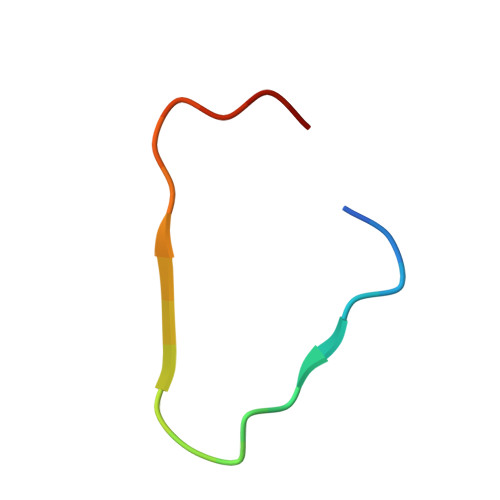
Type 3 KD-mxyl filament of miniature tau macrocycle derived from 4R tauopathic fold


Experimental Data Snapshot

  • Method: ELECTRON MICROSCOPY
  • Resolution: 3.20 Å
  • Aggregation State: FILAMENT 
  • Reconstruction Method: HELICAL 

wwPDB Validation   3D Report Full Report


This is version 1.2 of the entry. See complete history


Literature

Macrocyclic beta-arch peptides that mimic the structure and function of disease-associated tau folds.

Angera, I.J.Xu, X.Rajewski, B.H.Hallinan, G.I.Zhang, X.Ghetti, B.Vidal, R.Jiang, W.Del Valle, J.R.

(2025) Nat Chem 17: 865-874

  • DOI: https://doi.org/10.1038/s41557-025-01805-z
  • Primary Citation of Related Structures:  
    9B3A, 9DME

  • PubMed Abstract: 

    Tauopathies are a class of neurodegenerative disorders that feature tau protein aggregates in the brain. Misfolded tau has the capacity to seed the fibrillization of soluble tau, leading to the prion-like spread of aggregates. Within these filaments, tau protomers always exhibit a cross-β amyloid structure. However, distinct cross-β amyloid folds correlate with specific diseases. An understanding of how these conformations impact seeding activity remains elusive. Identifying the minimal epitopes required for transcellular propagation of tau aggregates represents a key step towards more relevant models of disease progression. Here we implement a diversity-oriented peptide macrocyclization approach towards miniature tau, or 'mini-tau', proteomimetics that can seed the aggregation of tau in engineered cells and primary neurons. Structural elucidation of one such seed-competent macrocycle reveals remarkable conformational congruence with core folds from patient-derived extracts of tau. The ability to impart β-arch form and function through peptide stapling has broad-ranging implications for the minimization and mimicry of pathological tau and other amyloid proteins that drive neurodegeneration.


  • Organizational Affiliation
    • Department of Chemistry & Biochemistry, University of Notre Dame, Notre Dame, IN, USA.

Macromolecules

Find similar proteins by:  Sequence   |   3D Structure  

Entity ID: 1
MoleculeChains Sequence LengthOrganismDetailsImage
Microtubule-associated protein tau23Homo sapiensMutation(s): 0 
UniProt & NIH Common Fund Data Resources
Find proteins for P10636 (Homo sapiens)
Explore P10636 
Go to UniProtKB:  P10636
PHAROS:  P10636
GTEx:  ENSG00000186868 
Entity Groups  
Sequence Clusters30% Identity50% Identity70% Identity90% Identity95% Identity100% Identity
UniProt GroupP10636
Sequence Annotations
Expand
  • Reference Sequence
Small Molecules
Ligands 1 Unique
IDChains Name / Formula / InChI Key2D Diagram3D Interactions
8VH (Subject of Investigation/LOI)
Query on 8VH

Download Ideal Coordinates CCD File 
AA [auth N]
BA [auth E]
CA [auth B]
DA [auth H]
P [auth J]
AA [auth N],
BA [auth E],
CA [auth B],
DA [auth H],
P [auth J],
Q [auth L],
R [auth A],
S [auth C],
T [auth D],
U [auth F],
V [auth G],
W [auth I],
X [auth M],
Y [auth O],
Z [auth K]
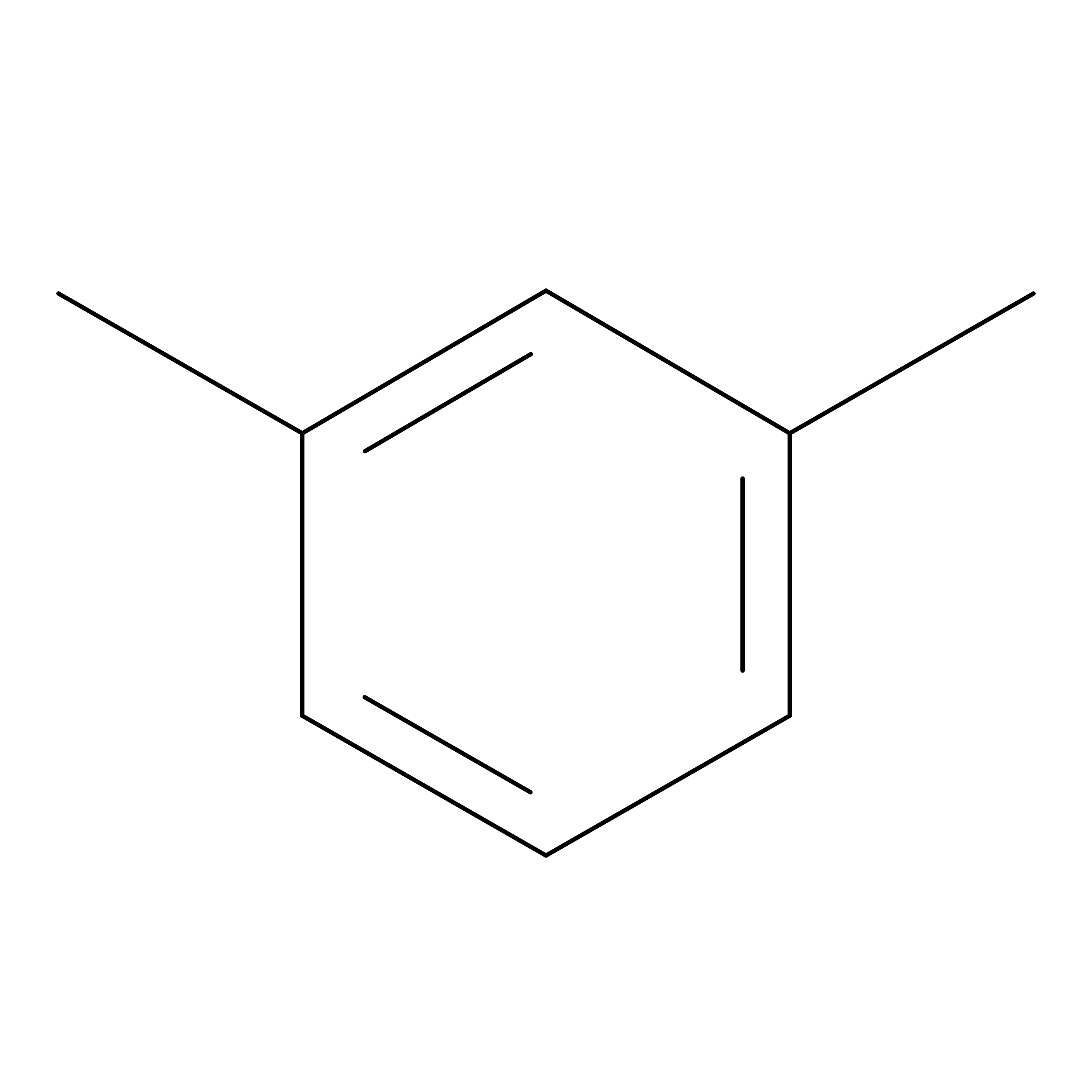
1,3-dimethylbenzene
C8 H10
IVSZLXZYQVIEFR-UHFFFAOYSA-N
Experimental Data & Validation

Experimental Data

  • Method: ELECTRON MICROSCOPY
  • Resolution: 3.20 Å
  • Aggregation State: FILAMENT 
  • Reconstruction Method: HELICAL 
EM Software:
TaskSoftware PackageVersion
MODEL REFINEMENTPHENIX

Structure Validation

View Full Validation Report


Entry History & Funding Information

Deposition Data


Funding OrganizationLocationGrant Number
National Institutes of Health/National Institute on Aging (NIH/NIA)United StatesR01 AG074570
National Science Foundation (NSF, United States)United StatesCHE2109008

Revision History  (Full details and data files)

  • Version 1.0: 2025-04-23
    Type: Initial release
  • Version 1.1: 2025-05-21
    Changes: Data collection
  • Version 1.2: 2025-11-05
    Changes: Data collection, Database references