Download Mendeley
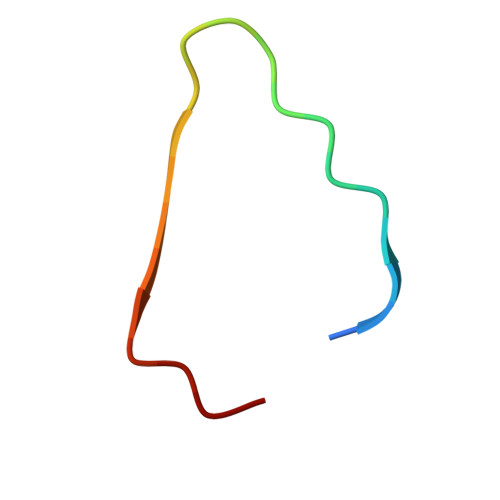
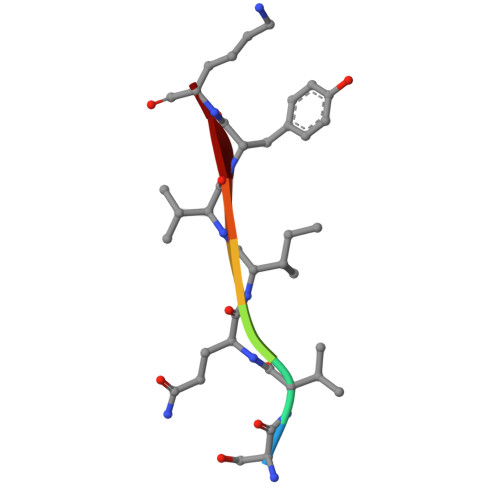
Macrocyclic beta-arch peptides that mimic the structure and function of disease-associated tau folds.
Angera, I.J., Xu, X., Rajewski, B.H., Hallinan, G.I., Zhang, X., Ghetti, B., Vidal, R., Jiang, W., Del Valle, J.R.(2025) Nat Chem 17: 865-874
- PubMed: 40307419 Search on PubMedSearch on PubMed Central
- DOI: https://doi.org/10.1038/s41557-025-01805-z
- Primary Citation Related Structures:
9B3A, 9DME - PubMed Abstract:
Tauopathies are a class of neurodegenerative disorders that feature tau protein aggregates in the brain. Misfolded tau has the capacity to seed the fibrillization of soluble tau, leading to the prion-like spread of aggregates. Within these filaments, tau protomers always exhibit a cross-β amyloid structure. However, distinct cross-β amyloid folds correlate with specific diseases. An understanding of how these conformations impact seeding activity remains elusive. Identifying the minimal epitopes required for transcellular propagation of tau aggregates represents a key step towards more relevant models of disease progression. Here we implement a diversity-oriented peptide macrocyclization approach towards miniature tau, or 'mini-tau', proteomimetics that can seed the aggregation of tau in engineered cells and primary neurons. Structural elucidation of one such seed-competent macrocycle reveals remarkable conformational congruence with core folds from patient-derived extracts of tau. The ability to impart β-arch form and function through peptide stapling has broad-ranging implications for the minimization and mimicry of pathological tau and other amyloid proteins that drive neurodegeneration.
- Department of Chemistry & Biochemistry, University of Notre Dame, Notre Dame, IN, USA.
Organizational Affiliation: