Download Mendeley
Studies of Isonitrile Synthases Help Elucidate the Mechanism of Isonitrile Installation.
Chen, T.Y., Kim, W., Guo, M., Yao, A., Zhang, Y.J., Chang, W.C.(2025) ACS Catal 15: 12005-12013
- PubMed: 40893210 Search on PubMedSearch on PubMed Central
- DOI: https://doi.org/10.1021/acscatal.5c03282
- Primary Citation Related Structures:
9DH4, 9DHM, 9DHN - PubMed Abstract:
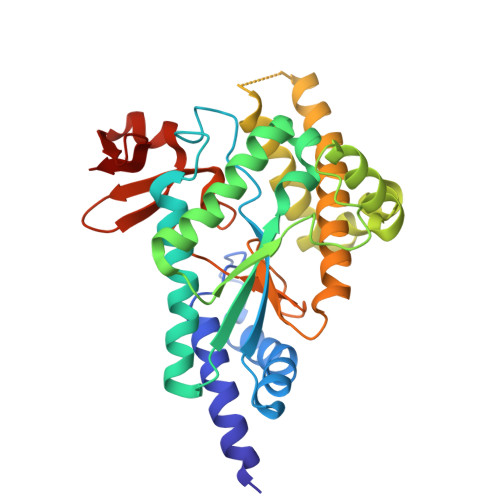
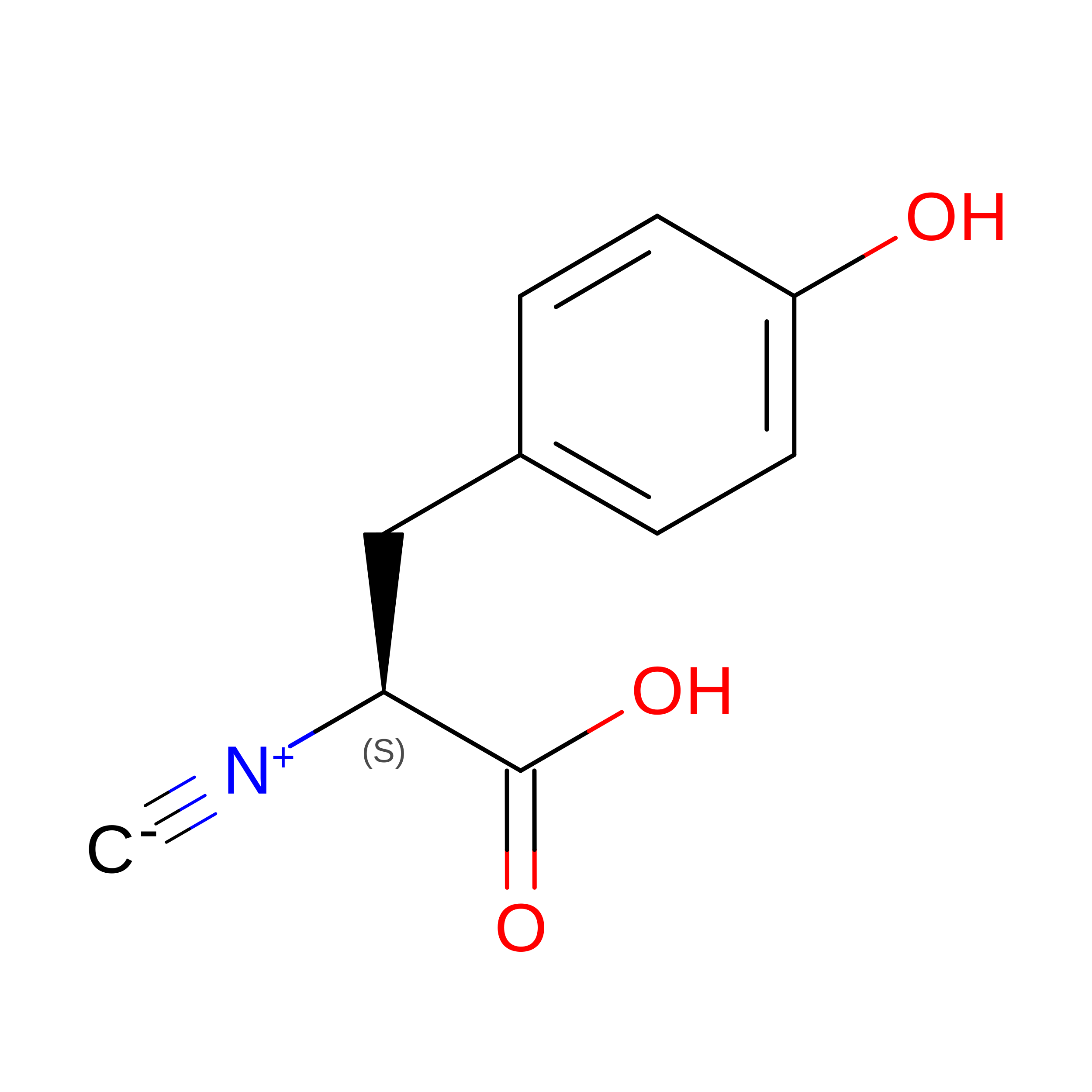
Isonitrile functional group is abundant in natural products and associated with various biological properties. To date, two pathways are known for isonitrile group installation. One is catalyzed by mononuclear nonheme iron dependent isonitrilases in which the reaction mechanism involves consecutive desaturation and decarboxylation processes. The other pathway includes isonitrile synthases, however, how isonitrile synthases enable the condensation of a sugar phosphate and an aromatic amino acid to install isonitrile group remains understudied. In this study, we examine substrate analogs and quantify reaction products using isotopologues to establish the substrate requirements of two isonitrile synthases, WelI1 and PIsnA, providing insights into their spatial and substrate requirements. Under experimental conditions, isonitrile synthases can only enable single turnover, with product binding likely associated with this observation. To reveal the reaction mechanism, we solved substrate- and product-bound protein structures. Furthermore, using a sequential soaking approach, we successfully trapped a plausible intermediate in crystallo. Observation of the plausible C2-imine intermediate in the active site suggests the reaction starts from the imine installation between the carbonyl group of the sugar phosphate and the amine group of the amino acid. Altogether, these studies provide insights into substrate recognition, i.e., pentose phosphate and L-aromatic amino acid, and the reaction mechanism of isonitrile synthases.
- Department of Chemistry, North Carolina State University, Raleigh, NC 27695, USA.
Organizational Affiliation: