Download Mendeley
alpha-Methylation Enables the X-ray Crystallographic Observation of Oligomeric Assemblies Formed by a beta-Hairpin Peptide Derived from A beta.
Samdin, T.D., Kreutzer, A.G., Sahrai, V., Wierzbicki, M., Nowick, J.S.(2025) J Org Chem 90: 394-400
- PubMed: 39689228 Search on PubMedSearch on PubMed Central
- DOI: https://doi.org/10.1021/acs.joc.4c02344
- Primary Citation Related Structures:
9BI3 - PubMed Abstract:
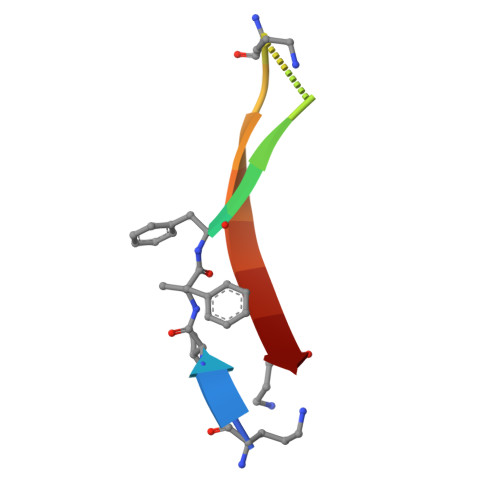
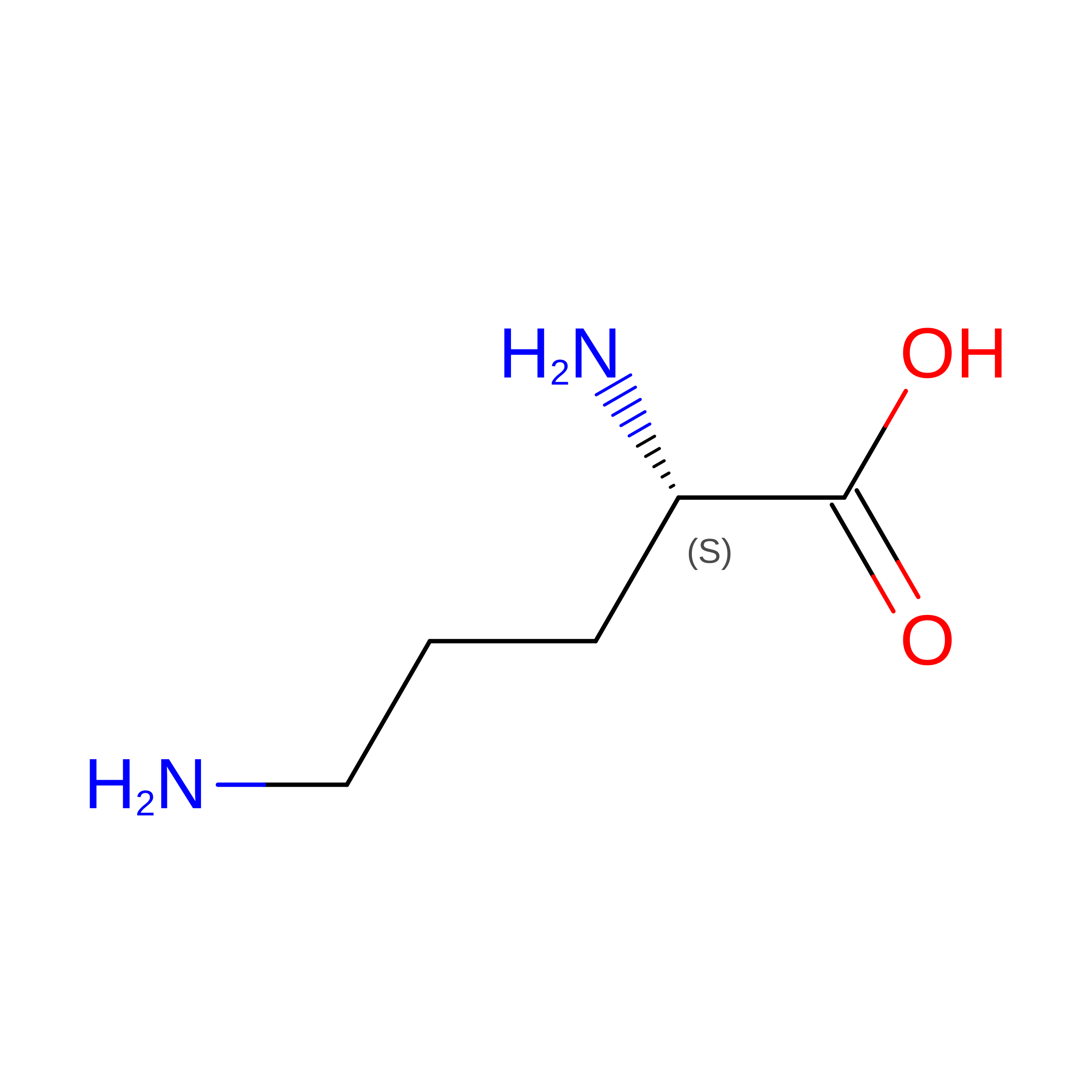
The assembly of the β-amyloid peptide Aβ into toxic oligomers plays a significant role in the neurodegeneration associated with the pathogenesis of Alzheimer's disease. Our laboratory has developed N -methylation as a tool to enable X-ray crystallographic studies of oligomers formed by macrocyclic β-hairpin peptides derived from Aβ. In this investigation, we set out to determine whether α-methylation could be used as an alternative to N -methylation in studying the oligomerization of a β-hairpin peptide derived from Aβ. α-Methylation permits the crystallographic assembly of a triangular trimer and ball-shaped dodecamer, resembling assemblies formed by the N -methylated homolog. Subtle differences are observed in the conformation of the α-methylated peptide when compared to the N -methylated homolog. Notably, α-methylation appears to promote a flatter and more extended β-sheet conformation than that of N -methylated β-sheets or a typical unmodified β-sheet. α-Methylation provides an alternative to N -methylation in X-ray crystallographic studies of oligomers formed by peptides derived from Aβ, with the attractive feature of preserving NH hydrogen-bond donors along the peptide backbone.
- Department of Chemistry, University of California, Irvine, California 92697, United States.
Organizational Affiliation: