8XI6 | pdb_00008xi6

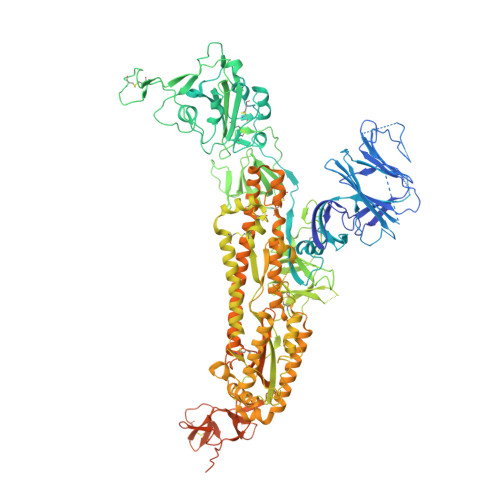
SARS-CoV-2 Omicron BQ.1.1 Variant Spike Protein Complexed with MO11 Fab


Experimental Data Snapshot

  • Method: ELECTRON MICROSCOPY
  • Resolution: 2.30 Å
  • Aggregation State: PARTICLE 
  • Reconstruction Method: SINGLE PARTICLE 

Starting Models: experimental, in silico
View more details

wwPDB Validation 3D Report Full Report

Validation slider image for 8XI6

This is version 1.2 of the entry. See complete history

Literature

Epitopes of an antibody that neutralizes a wide range of SARS-CoV-2 variants in a conserved subdomain 1 of the spike protein.

Ishimaru, H.Nishimura, M.Shigematsu, H.Marini, M.I.Hasegawa, N.Takamiya, R.Iwata, S.Mori, Y.

(2024) J Virol 98: e0041624-e0041624

  • DOI: https://doi.org/10.1128/jvi.00416-24
  • Primary Citation Related Structures: 
    8XI6

  • PubMed Abstract: 

    The evolution of severe acute respiratory syndrome coronavirus 2 (SARS-CoV-2) has continued, enabling the virus to escape from host immunity by changing its spike antigen, while biased toward the receptor-binding domain and N-terminal domain. Here, we isolated a novel pan-SARS-CoV-2 neutralizing antibody (which we named MO11) for even the recent dominators XBB.1.16 and EG.5.1, from a convalescent patient who had received three doses of an original mRNA COVID-19 vaccination. A cryo-electron microscopy analysis of the spike-MO11 complex at 2.3 Å atomic resolution revealed that it recognizes a conserved epitope hidden behind a glycan shield at N331 on subdomain 1 (SD1), holding both the N- and C-terminal segments comprising SD1. Our identification of MO11 unveiled the functional importance of SD1 for the spike's function, and we discuss the potential availability of a novel common epitope among the SARS-CoV-2 variants.IMPORTANCENovel severe acute respiratory syndrome coronavirus 2 variants with immune evasion ability are still repeatedly emerging, nonetheless, a part of immunity developed in responding to the antigen of earlier variants retains efficacy against recent variants irrespective of the numerous mutations. In exploration for the broadly effective antibodies, we identified a cross-neutralizing antibody, named MO11, from the B cells of the convalescent patient. MO11 targets a novel epitope in subdomain 1 (SD1) and was effective against all emerging variants including XBB.1.16 and EG.5.1. The neutralizing activity covering from D614G to EG.5.1 variants was explained by the conservation of the epitope, and it revealed the importance of the subdomain on regulating the function of the antigen for viral infection. Demonstrated identification of the neutralizing antibody that recognizes a conserved epitope implies basal contribution of such group of antibodies for prophylaxis against COVID-19.


  • Organizational Affiliation
    • Division of Clinical Virology, Center for Infectious Diseases, Kobe University Graduate School of Medicine, Kobe, Hyogo, Japan.

Macromolecule Content 

  • Total Structure Weight: 570.71 kDa 
  • Atom Count: 29,262 
  • Modeled Residue Count: 3,696 
  • Deposited Residue Count: 5,079 
  • Unique protein chains: 3

Macromolecules

Find similar proteins by:|  3D Structure
Entity ID: 1
MoleculeChains  Sequence LengthOrganismDetailsImage
Spike glycoprotein
A, B, C
1,247Severe acute respiratory syndrome coronavirus 2Mutation(s): 38 
Gene Names: S2
UniProt
Find proteins for P0DTC2 (Severe acute respiratory syndrome coronavirus 2)
Explore P0DTC2 
Go to UniProtKB:  P0DTC2
Entity Groups
Sequence Clusters30% Identity50% Identity70% Identity90% Identity95% Identity100% Identity
UniProt GroupP0DTC2
Glycosylation
Glycosylation Sites: 12Go to GlyGen: P0DTC2-1
Sequence Annotations
Expand
Reference Sequence
Find similar proteins by:|  3D Structure
Entity ID: 2
MoleculeChains  Sequence LengthOrganismDetailsImage
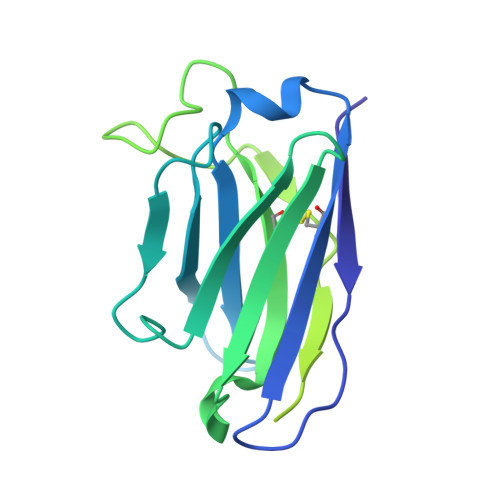
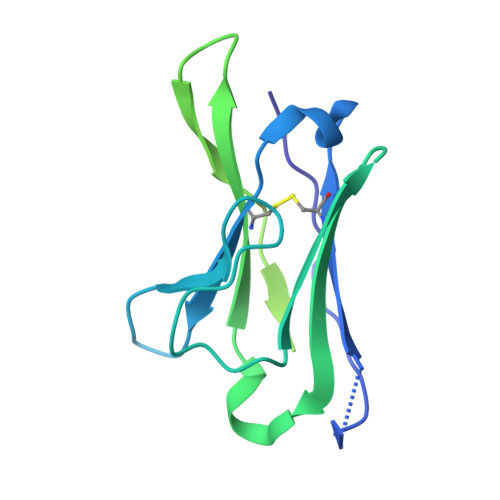
MO11 heavy chain
D, F, H
232Homo sapiensMutation(s): 0 
Find similar proteins by:|  3D Structure
Entity ID: 3
MoleculeChains  Sequence LengthOrganismDetailsImage
MO11 light chain
E, G, I
214Homo sapiensMutation(s): 0 

Oligosaccharides

Help  
Entity ID: 4
MoleculeChains Length2D Diagram GlycosylationD Interactions
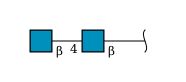
2-acetamido-2-deoxy-beta-D-glucopyranose-(1-4)-2-acetamido-2-deoxy-beta-D-glucopyranose
J, K, L, O, P
J, K, L, O, P, Q, T, U, V
2N-Glycosylation
Glycosylation Resources
GlyTouCan: G42666HT
GlyCosmos: G42666HT
GlyGen: G42666HT
Entity ID: 5
MoleculeChains Length2D Diagram GlycosylationD Interactions
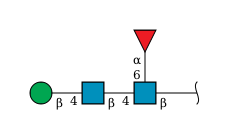
beta-D-mannopyranose-(1-4)-2-acetamido-2-deoxy-beta-D-glucopyranose-(1-4)-[alpha-L-fucopyranose-(1-6)]2-acetamido-2-deoxy-beta-D-glucopyranose
M, R, W
4N-Glycosylation
Glycosylation Resources
GlyTouCan: G32152BH
GlyCosmos: G32152BH
GlyGen: G32152BH
Entity ID: 6
MoleculeChains Length2D Diagram GlycosylationD Interactions
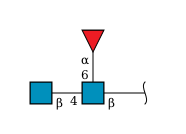
2-acetamido-2-deoxy-beta-D-glucopyranose-(1-4)-[alpha-L-fucopyranose-(1-6)]2-acetamido-2-deoxy-beta-D-glucopyranose
N, S, X
3N-Glycosylation
Glycosylation Resources
GlyTouCan: G21290RB
GlyCosmos: G21290RB
GlyGen: G21290RB

Small Molecules

Ligands 1 Unique
IDChains Name / Formula / InChI Key2D Diagram3D Interactions
NAG

Query on NAG


Download:Ideal Coordinates CCD File
AA [auth A]
BA [auth A]
CA [auth A]
DA [auth A]
EA [auth A]
AA [auth A],
BA [auth A],
CA [auth A],
DA [auth A],
EA [auth A],
FA [auth B],
GA [auth B],
HA [auth B],
IA [auth B],
JA [auth B],
KA [auth B],
LA [auth B],
MA [auth C],
NA [auth C],
OA [auth C],
PA [auth C],
QA [auth C],
RA [auth C],
SA [auth C],
Y [auth A],
Z [auth A]
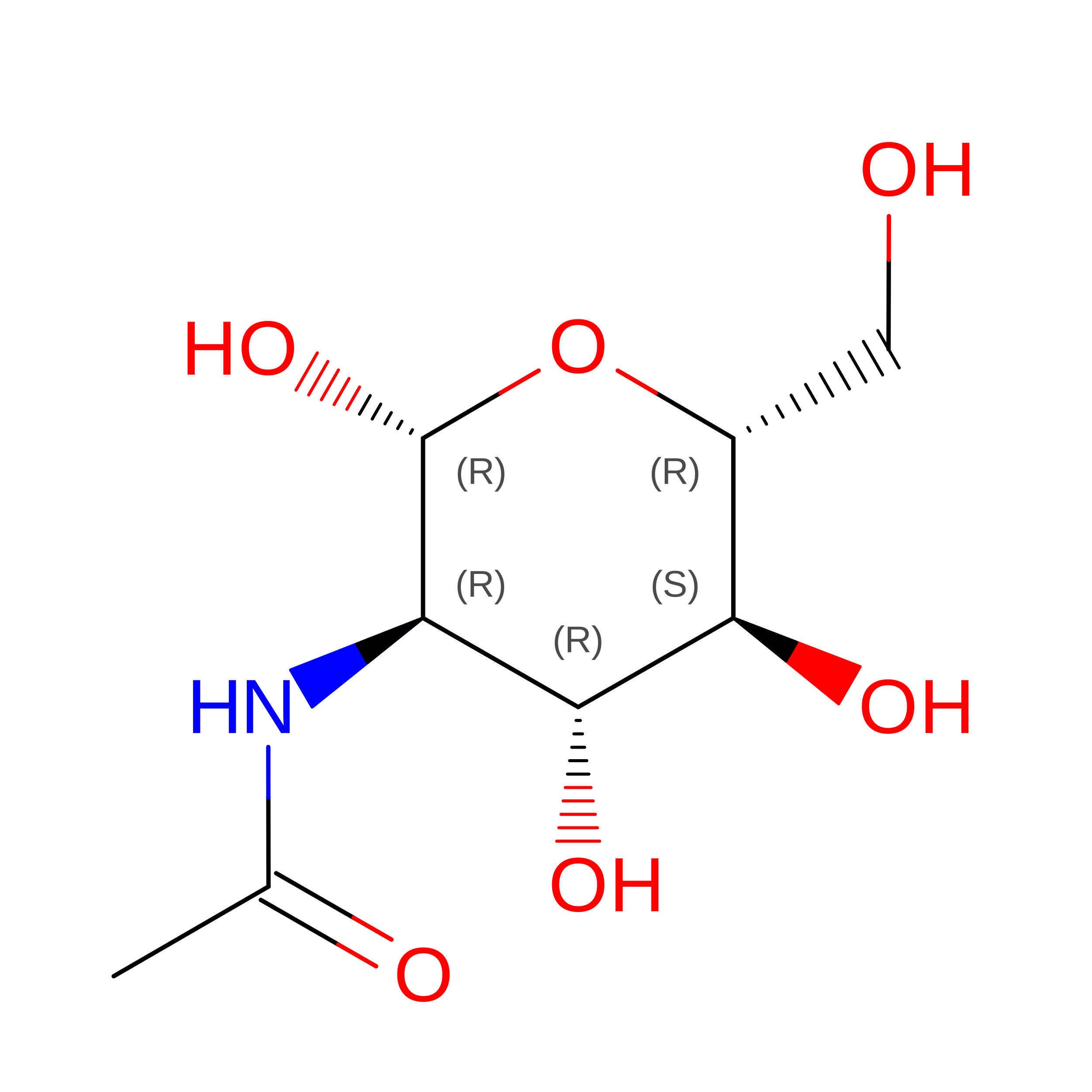
2-acetamido-2-deoxy-beta-D-glucopyranose
C8 H15 N O6
OVRNDRQMDRJTHS-FMDGEEDCSA-N

Experimental Data & Validation

Experimental Data

  • Method: ELECTRON MICROSCOPY
  • Resolution: 2.30 Å
  • Aggregation State: PARTICLE 
  • Reconstruction Method: SINGLE PARTICLE 
EM Software:
TaskSoftware PackageVersion
MODEL REFINEMENTPHENIX1.21rc1_5109
MODEL REFINEMENTCoot0.9.8.1
RECONSTRUCTIONRELION4.0.0

Structure Validation

View Full Validation Report


Entry History 

& Funding Information

Deposition Data


Funding OrganizationLocationGrant Number
Not funded--

Revision History  (Full details and data files)

  • Version 1.0: 2024-04-24
    Type: Initial release
  • Version 1.1: 2024-05-29
    Changes: Database references
  • Version 1.2: 2024-10-16
    Changes: Data collection, Structure summary